Evolution and Mechanics of Global Martial Arts
Biomechanical Striking Mechanics
The Body as a Whip
A powerful strike isn't just about arm or leg strength. It's about turning your entire body into a system for generating and transferring energy. This is the core principle of the kinetic chain—a sequence of movements that starts from the ground and culminates at the point of impact. Think of it like cracking a whip. The handle moves first, and that energy flows smoothly to the very tip, creating incredible speed.
The Muay Thai roundhouse kick is a perfect example. The motion begins with the fighter pushing off the ball of their standing foot. This initial force travels up through the leg, into the hips, which then rotate violently. The energy continues up the torso, into the shoulder, and finally down the kicking leg, which acts as the tip of the whip. Every link in the chain adds momentum, creating a devastating impact far greater than what the leg muscles alone could produce.
Effective striking isn't about isolated muscle action. It's a full-body event, where the ground is the ultimate source of power.
Stance Dictates Strategy
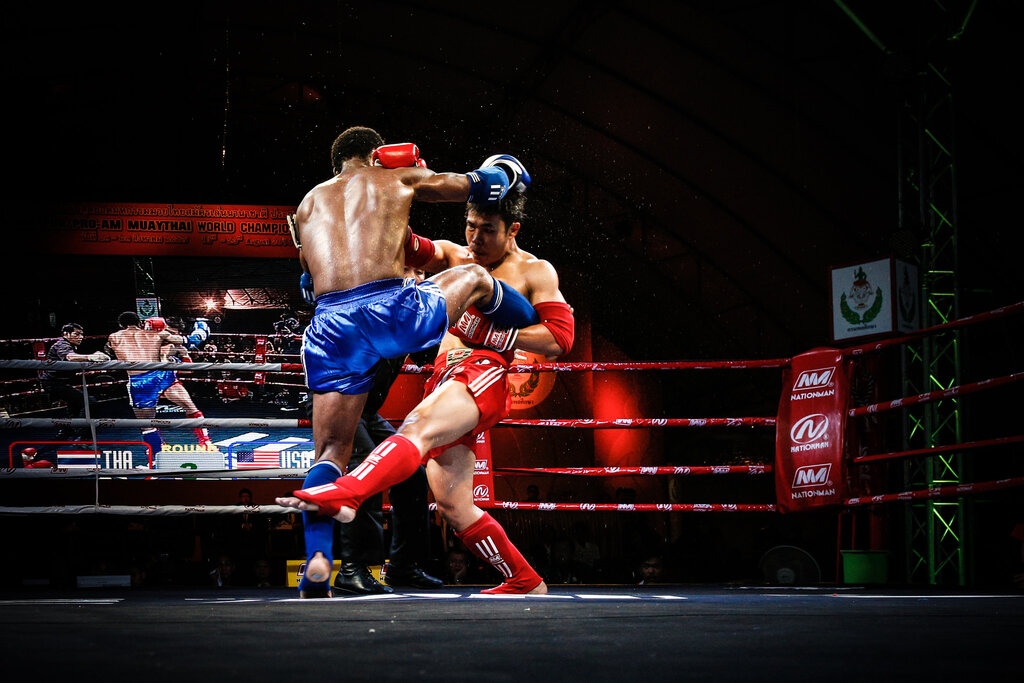
A fighter's stance is the foundation for every offensive and defensive move. It's a constant trade-off between stability, power, and mobility. The traditional Muay Thai stance is relatively square, with weight slightly forward. This posture isn't optimized for quick, linear footwork. Instead, its purpose is biomechanically defensive and tailored for close-range weapons.
A squared stance makes it easy to lift a leg to "check" an incoming low kick without losing balance. It also keeps the hips in a neutral position, ready to rotate powerfully for kicks, knees, and elbows. In contrast, a more bladed stance, common in Karate or American kickboxing, positions the body sideways. This reduces the target area for an opponent and primes the body for explosive, linear attacks like a jab or a blitz. However, it makes checking kicks more difficult and requires a larger hip turn to generate power in a roundhouse.
This difference in stance also influences how power is generated. Muay Thai's rotational force is ideal for single, heavy strikes. This contrasts with the high-volume combinations favored in styles like Dutch Kickboxing, which blends the powerful low kicks of Muay Thai with the relentless hand combinations and footwork of Western boxing. A Dutch-style fighter might use a more mobile, boxing-oriented stance to set up punches, then shift their weight and rotate their hips to end the combination with a heavy leg kick. It’s a hybrid approach that adapts biomechanics for a different tactical goal.
Tools for a Purpose
The tools a fighter trains with are designed to refine specific biomechanical principles. The heavy bag is the classic tool for developing power. Its weight and resistance provide feedback on the entire kinetic chain. A sloppy punch, using only arm muscles, will barely move the bag. A properly executed strike that transfers energy from the ground up will create a satisfying thud and move the bag significantly. It teaches a fighter how to manage their center of mass and commit their body weight to a strike.
The speed bag serves a completely different purpose. It's not for power. Its light weight and rapid rebound are for developing timing, hand-eye coordination, and rhythm. Striking it correctly requires a fighter to maintain a consistent cadence, which builds shoulder endurance and trains the muscle memory needed for rapid combinations. Each bag hones a different aspect of striking mechanics: one for force transfer, the other for efficiency and timing.
Technique Emphasis: Dutch Kickboxing places a strong emphasis on punching combinations, low kicks, and head movement, while Muay Thai incorporates a wider variety of strikes, including punches, kicks, elbows, and knees, along with clinch techniques and sweeps.
Time to see how well these concepts have landed.
What is the primary function of the kinetic chain in executing a powerful strike?
The traditional Muay Thai stance is biomechanically designed for what primary purpose?
Understanding these mechanical principles is the difference between simply throwing a punch and truly knowing how to strike. It elevates martial arts from a series of movements to a science of motion.