Everyday Probability for Better Decisions
Probability Basics
The Language of Chance
Life is full of uncertainty. Will it rain tomorrow? Will my favorite team win the championship? Will I roll a six in this board game? Probability is simply a way to measure and talk about this uncertainty.
It gives us a number between 0 and 1 to describe how likely something is to happen. A probability of 0 means the event is impossible. A probability of 1 means it's absolutely certain. Most things in life fall somewhere in between.
Probability
noun
A measure of the likelihood that an event will occur, expressed as a number between 0 (impossibility) and 1 (certainty).
Think about flipping a standard coin. There are two possible results: heads or tails. Assuming the coin is fair, each outcome is equally likely. So, there's a 1 in 2 chance of getting heads. As a probability, we'd write this as 0.5.
Sample Spaces and Events
To calculate probabilities, we first need to understand all the possible results of an action. In probability, we call an action like flipping a coin or rolling a die an experiment.
Each possible result of an experiment is an outcome. For a coin flip, the outcomes are "heads" and "tails."
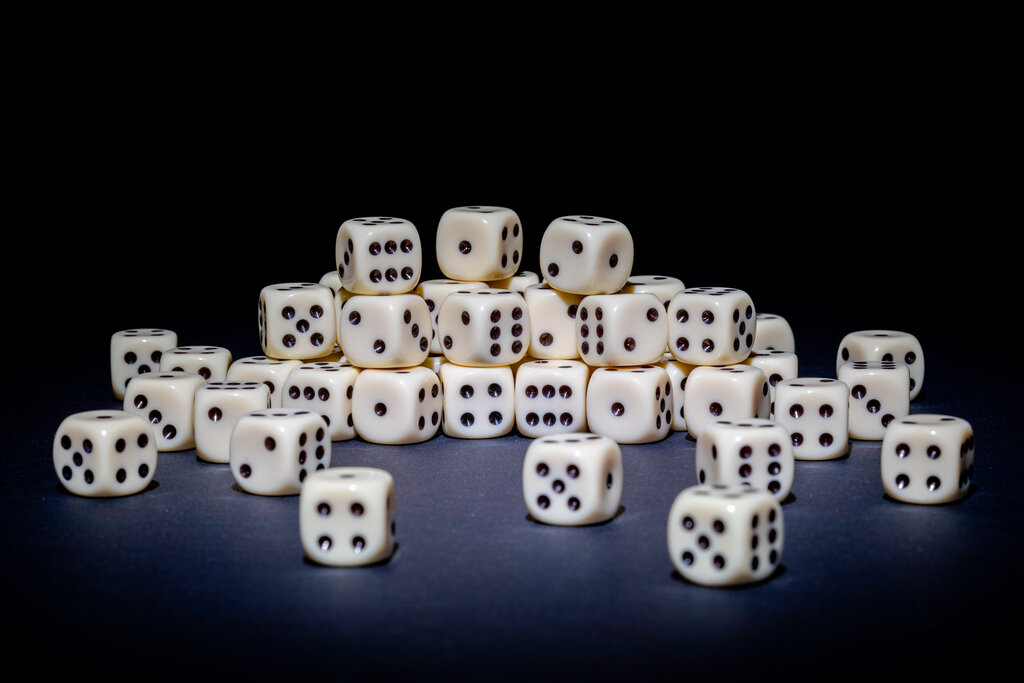
The set of all possible outcomes is called the sample space. For a single coin flip, the sample space is {Heads, Tails}. For rolling a standard six-sided die, the sample space is {1, 2, 3, 4, 5, 6}.
An event is a specific outcome or a group of outcomes that we are interested in. It's a subset of the sample space.
For example, if we roll a die, an event (let's call it Event A) could be "rolling an even number." The outcomes that satisfy this event are {2, 4, 6}. Another event (Event B) could be "rolling a number greater than 4." The outcomes for Event B would be {5, 6}.
Calculating Simple Probability
When all outcomes in a sample space are equally likely, we can calculate the probability of an event using a straightforward formula.
Let's use our dice-rolling example. What is the probability of Event A, rolling an even number?
- The number of favorable outcomes (the outcomes in Event A) is 3: {2, 4, 6}.
- The total number of possible outcomes (the size of our sample space) is 6: {1, 2, 3, 4, 5, 6}.
Plugging this into our formula:
So, the probability of rolling an even number on a standard die is 0.5, or 50%.
Here are three fundamental rules, or axioms, that all probabilities must follow:
- The probability of any event is always between 0 and 1. You can't have a negative probability or a probability greater than 100%.
- The probability of the entire sample space is 1. It's a certainty that one of the possible outcomes will occur.
- If two events are mutually exclusive (meaning they can't happen at the same time), the probability of either one happening is the sum of their individual probabilities. For example, the event "rolling a 1" and the event "rolling a 2" are mutually exclusive. The probability of rolling a 1 or a 2 is .
Let's try one more. What's the probability of drawing a King from a standard 52-card deck?
- The number of favorable outcomes (Kings) is 4 (King of Spades, Hearts, Diamonds, Clubs).
- The total number of possible outcomes is 52 (the total number of cards).
The probability is low, but not impossible. Understanding these basic calculations is the first step toward using probability to make more informed decisions.
A probability of 1 indicates that an event is __________.
When rolling a standard six-sided die, what does the set {1, 2, 3, 4, 5, 6} represent?
These building blocks, from sample spaces to simple calculations, are the foundation for understanding the role that chance plays all around us.