Everyday Pressure Applications
Introduction to Pressure
Force Over an Area
Pressure is all about how a force is spread out. Imagine trying to push a thumbtack into a wall. You push on the flat, wide head, but the sharp, tiny point is what goes into the wall. You apply the same force to both ends, but the effect is dramatically different. The small point concentrates that force into a tiny area, creating very high pressure. This is the core idea of pressure: a force applied over a specific area.
Think of it this way: walking on deep snow in boots, you sink. But with snowshoes, you stay on top. The snowshoes spread your weight (a force) over a much larger area, reducing the pressure on the snow.
Mathematically, this relationship is straightforward. Pressure () is defined as the force () acting perpendicular to a surface, divided by the area () over which the force is distributed.
How We Measure Pressure
The standard unit for pressure in the International System of Units (SI) is the Pascal, named after the French physicist Blaise Pascal. One Pascal (Pa) is equal to one Newton of force applied over an area of one square meter. A single Pascal is a very small amount of pressure, so we often use kilopascals (kPa) or megapascals (MPa).
Pascal
noun
The SI unit of pressure, equal to one newton per square meter.
While the Pascal is the scientific standard, you'll encounter other units in different contexts. Atmospheric pressure is often measured in atmospheres (atm). Tire pressure is commonly measured in pounds per square inch (psi). Meteorologists often use bars or millibars.
| Unit | Abbreviation | Equivalent in Pascals (Pa) |
|---|---|---|
| Pascal | Pa | 1 Pa |
| Atmosphere | atm | 101,325 Pa |
| Bar | bar | 100,000 Pa |
| Pound per square inch | psi | ~6,895 Pa |
Pressure in Different States
Pressure behaves differently depending on the state of matter.
In a solid, pressure is straightforward. If you place a brick on a table, the pressure it exerts is directed downwards, in the same direction as the force of gravity pulling on it.
In liquids and gases, things get more interesting. A fluid (a liquid or a gas) exerts pressure in all directions. If you dive underwater, you feel the pressure on your ears, your chest, and your back. This pressure comes from the weight of the water above you. The deeper you go, the more water is above you, and the greater the pressure. This is known as hydrostatic pressure.
The pressure at a certain depth () in a fluid is calculated by multiplying the fluid's density (), the acceleration due to gravity (), and the depth.
Gases also exert pressure. The air around us is a gas, and the pressure it exerts is called atmospheric pressure. It's caused by the constant collisions of countless air molecules with every surface they touch. Just like with liquids, atmospheric pressure decreases as you go higher in altitude because there is less air above you.
Tools of the Trade
To measure these different pressures, scientists and engineers use specialized instruments.
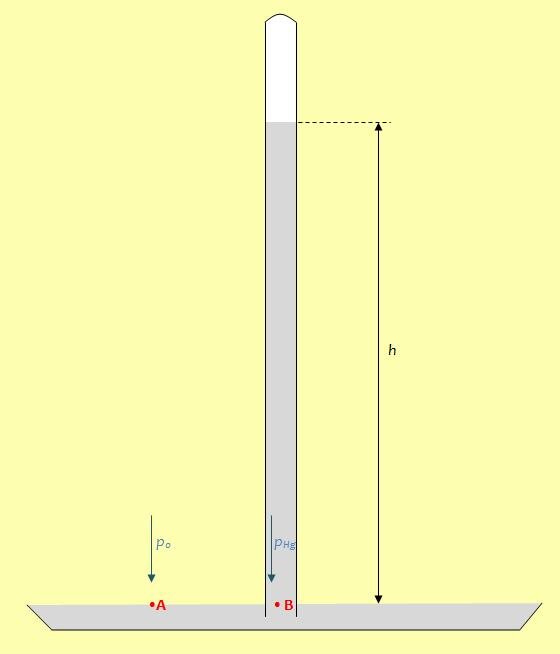
A barometer is used to measure atmospheric pressure. A simple mercury barometer works by balancing the weight of a column of mercury against the weight of the atmosphere. Changes in atmospheric pressure cause the mercury level to rise or fall, which can help forecast weather changes.
A manometer measures the pressure of a confined gas, such as the gas in a tank. It typically consists of a U-shaped tube containing a liquid. One end is connected to the gas container, and the other is open to the atmosphere. The difference in the liquid levels between the two arms of the tube indicates the gas pressure relative to atmospheric pressure.
These simple principles and tools are the foundation for understanding everything from weather patterns to the hydraulic systems that lift heavy machinery.
Ready to check your understanding?
Pressure is defined as:
Imagine two people of the same weight walking on soft snow. One is wearing snowshoes, and the other is wearing high-heeled boots. Who is more likely to sink into the snow and why?
Understanding pressure is the first step in exploring the fascinating world of fluid dynamics and thermodynamics.