Everyday AI Essentials
Introduction to Artificial Intelligence
What Is Artificial Intelligence?
At its core, artificial intelligence is the science of making machines that can think and learn like humans. It’s a broad field in computer science focused on building systems that can perform tasks that typically require human intelligence. This includes things like recognizing speech, making decisions, and translating languages.
Artificial intelligence (AI) is a branch of computer science and engineering that focuses on building machines that are capable of learning, solving problems, making decisions, and all other functions that are performed traditionally by the human intellect.
Think of it this way: AI isn't just about following a pre-written set of instructions. It's about creating systems that can adapt and improve on their own. Instead of being programmed for a single, specific task, AI is designed to handle novelty and ambiguity, much like we do.
A Quick Trip Through Time
The idea of intelligent machines has been around for centuries, but the formal field of AI research began in the 1950s. Early researchers were optimistic, believing that a machine as intelligent as a human being could be built in just a few decades.
Progress wasn't always a straight line. The field went through periods of high enthusiasm followed by “AI winters,” when funding and interest dried up because the technology couldn't meet the grand expectations. But recent breakthroughs in computing power and the availability of massive amounts of data have led to the AI boom we see today.
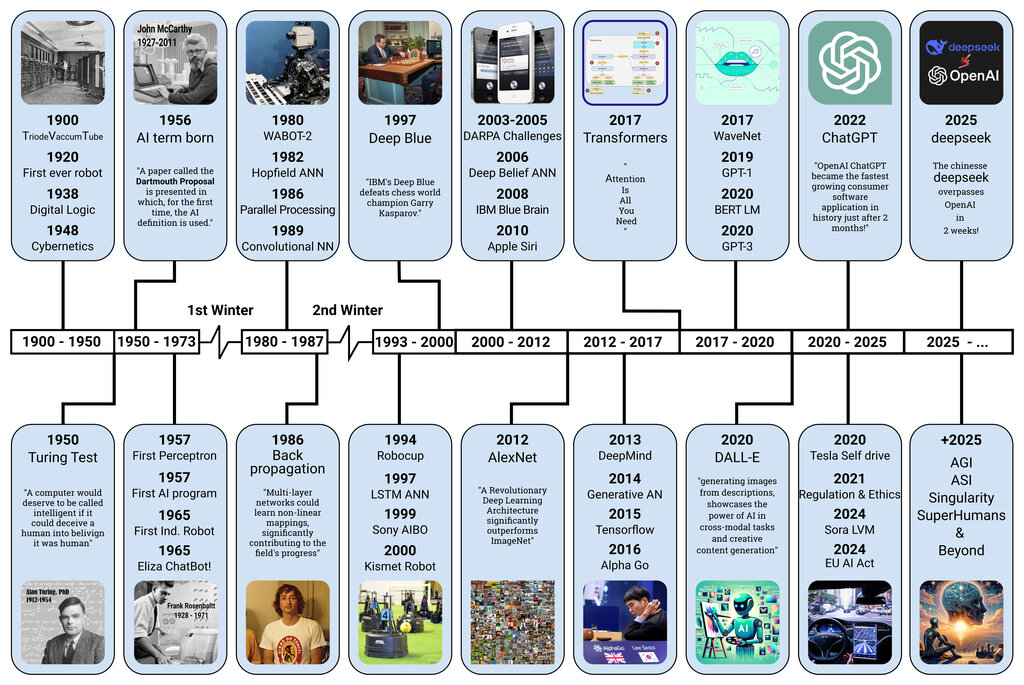
From early theoretical work to game-playing computers like Deep Blue, which defeated a world chess champion in 1997, each step has built upon the last, leading to the powerful AI tools we use every day.
AI vs. Traditional Programs
So what's the real difference between an AI and a standard computer program, like a word processor or a calculator? It comes down to how they handle problems.
A traditional program follows explicit, hard-coded rules. An AI system learns from data to create its own rules.
Imagine you want to write a program to identify pictures of cats. Using a traditional approach, you'd have to write millions of lines of code to define what a cat looks like. You might write rules like, “If it has pointy ears, and whiskers, and fur, it might be a cat.” This is incredibly difficult and brittle; what if the cat's ears are folded?
An AI approach is different. You would show the AI system thousands of pictures labeled “cat” and thousands labeled “not a cat.” The AI would then analyze these examples and learn the patterns on its own. It creates its own internal logic for what constitutes a cat, a logic that is often far more nuanced and effective than anything a human could program by hand.
| Feature | Traditional Program | Artificial Intelligence |
|---|---|---|
| Logic | Explicitly programmed rules | Learns rules from data |
| Adaptability | Fixed and unchanging | Adapts as it gets more data |
| Task Scope | Handles specific, defined tasks | Can handle ambiguity and novelty |
| Example | A calculator | A spam filter that improves over time |
The Building Blocks of AI
While AI is a vast field, most systems share a few key components that work together to create intelligent behavior.
- Data: AI needs information to learn from. This can be anything from images and text to numbers in a spreadsheet. The more relevant data an AI has, the better it becomes at its task.
- Algorithms: These are the learning processes that find patterns in the data. An algorithm guides the AI on how to interpret the information it’s given.
- Computation: Processing huge amounts of data requires a lot of computing power. Advances in computer hardware have been a major driver of recent AI progress.
- Action: The final component is the AI's output. This could be a prediction (like a weather forecast), a classification (identifying an email as spam), or the creation of something new (like text or an image).
These components form a cycle. The actions an AI takes can generate new data, which is then used to further refine its algorithms and improve its performance over time. This ability to learn and adapt is what makes AI such a powerful technology.
Now that you have a basic grasp of what AI is, let's test your knowledge.
What is the core idea that distinguishes artificial intelligence from a standard computer program like a calculator?
Which of the following is NOT considered a key component required for most modern AI systems?
Understanding these core ideas is the first step. By seeing AI as a system that learns from data rather than just following instructions, you can better appreciate its role in the world today.