Europe's Energy Crossroads Russian Imports
Energy Dependence
The Russian Connection
For decades, the Czech Republic's energy landscape was defined by a single, dominant supplier: Russia. This relationship, a legacy of the Soviet era, meant that the vast majority of the country's crude oil and natural gas flowed from the east. This wasn't just a matter of trade; it was a deep-seated dependency that shaped the nation's economy and infrastructure.
Historically, Russia supplied nearly 100% of the Czech Republic's natural gas and over 50% of its crude oil.
This reliance created significant economic vulnerabilities. Since the prices for these crucial commodities were set by a single, powerful state-controlled entity, the Czech economy was directly exposed to fluctuations in Russian supply and pricing decisions. Any disruption, whether for political or technical reasons, could send shockwaves through Czech industries and households. The cost of everything from manufacturing goods to heating homes was tethered to this single, external source.
Pipelines from the East
This energy relationship was physically cemented in steel. A massive network of pipelines, built during the Cold War, was designed to transport oil and gas from Siberian fields directly to Central and Eastern Europe. These weren't just pipes; they were strategic arteries that locked the region into Russia's energy grid.
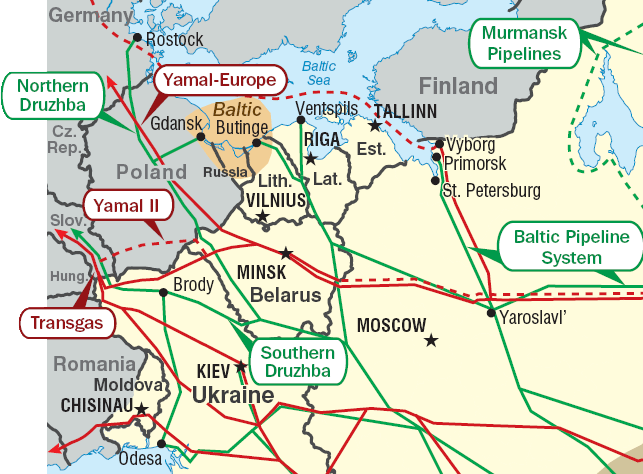
For the Czech Republic, two pipelines were paramount:
-
The Druzhba (Friendship) Pipeline: This is one of the world's longest oil pipelines. Its southern branch crosses Ukraine and Slovakia to deliver Russian crude oil directly to Czech refineries. For years, it was the primary, and often only, source of oil for the country.
-
The Brotherhood (Transgas) Pipeline: This natural gas pipeline follows a similar path, running through Ukraine and Slovakia. It was the main conduit for the gas needed to power Czech industry and warm its homes.
The very design of this infrastructure limited options. The pipelines flowed in one direction only: east to west. This made it difficult, and in many cases impossible, to source oil or gas from other countries without building entirely new, expensive infrastructure.
The Economic Impact
Living with this level of dependence had profound economic consequences. The primary concern was price volatility and supply security. Since Russia was the sole supplier, there was little room for negotiation. The Czech Republic had to accept the prices offered, making its national budget and industrial competitiveness susceptible to decisions made in Moscow.
| Economic Consequence | Description |
|---|---|
| Price Volatility | Energy prices could change suddenly due to political tensions or changes in Russian export strategy, creating uncertainty for businesses and consumers. |
| Supply Insecurity | Disputes between Russia and transit countries like Ukraine sometimes led to supply disruptions, highlighting the fragility of the system. |
| Limited Competition | The lack of alternative suppliers meant there was no market competition to help drive down prices. |
| Geopolitical Leverage | The dependency gave Russia significant political influence, as the threat of reducing energy supplies could be used as a tool in negotiations. |
This situation created a persistent economic risk. A sudden price hike or a supply cut could trigger inflation, slow down industrial production, and increase the cost of living for everyone. The reliance on Russian energy wasn't just an abstract geopolitical fact; it was a reality that directly affected the nation's economic health and stability.
For decades, who was the Czech Republic's single dominant supplier of crude oil and natural gas?
What were the names of the two primary pipelines that cemented the Czech Republic's energy relationship with Russia?
This deep-rooted connection to Russian energy has been a defining feature of the Czech economy for generations, shaping its infrastructure and its vulnerabilities on the world stage.