European Civilizations Chronological Tour
Prehistoric Europe
The First Farmers
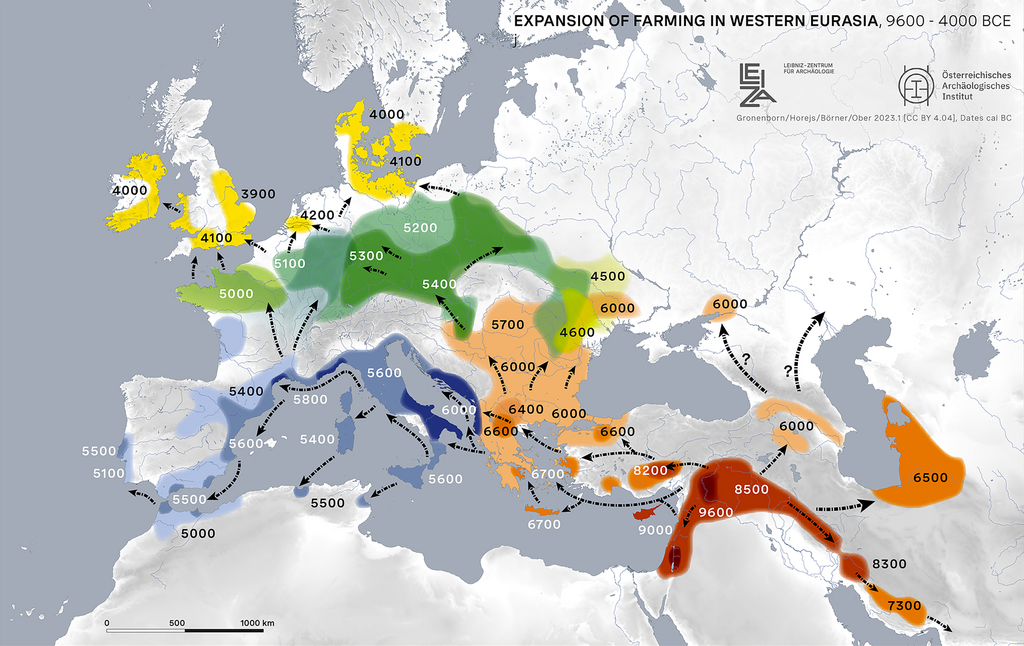
For thousands of years, the inhabitants of Europe were hunter-gatherers, moving with the seasons and the herds. But starting around 7000 BCE, a revolutionary change began to sweep across the continent from the southeast. This was the Neolithic Revolution, a gradual shift from a nomadic lifestyle to one based on farming and permanent settlements.
This transition wasn't an overnight event. It took thousands of years for agriculture to spread from its origins in the Near East across all of Europe.
People began to cultivate crops like wheat and barley and domesticate animals such as cattle, sheep, and pigs. This new, reliable food source allowed for larger populations and the establishment of villages. Life became more settled. Instead of temporary shelters, people built sturdy homes from wood, mud, and stone. This fundamental change in how people lived laid the groundwork for entirely new societies to emerge.
The adoption of agriculture also spurred technological innovation. The Neolithic period, or "New Stone Age," is named for the development of polished stone tools, which were more effective for clearing forests and working wood than the chipped tools of earlier eras. Pottery also became widespread, essential for storing grain and cooking food.
Early European Cultures
As farming took root, distinct cultures began to develop across Europe, each with its own unique traditions, art, and social structures. Two of the most remarkable early cultures emerged in Southeastern Europe.
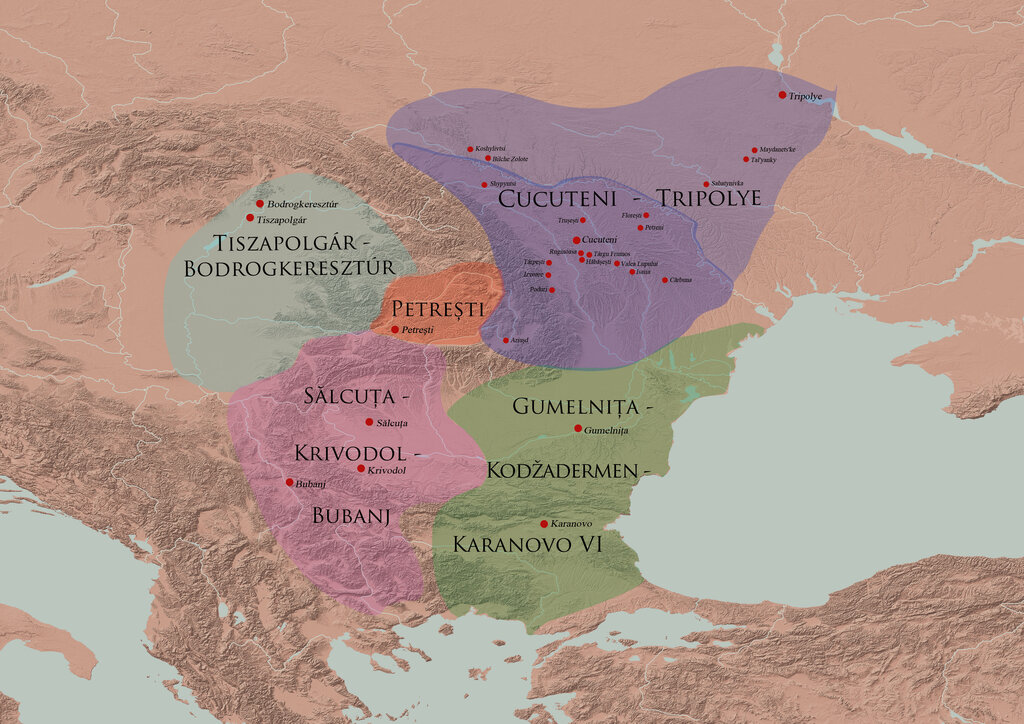
The Vinča culture, which flourished from roughly 5700 to 4500 BCE in the Balkans, is known for its advanced metallurgy for the time and distinctive pottery. Archaeologists have also uncovered thousands of clay figurines, thought to represent deities or ancestors. Perhaps most intriguingly, many Vinča artifacts are inscribed with a set of symbols. While some have argued this is Europe's earliest form of writing, most scholars believe they are more likely property marks or religious symbols, not a true writing system.
To the northeast, the Cucuteni-Trypillia culture (circa 5500 to 2750 BCE) built the largest settlements in Neolithic Europe, some housing up to 15,000 people. These proto-cities were meticulously planned, with houses arranged in concentric circles. They produced beautifully intricate pottery decorated with swirling patterns. A unique and mysterious aspect of this culture was their practice of deliberately burning their settlements every 60 to 80 years before rebuilding on top of the old site.
Monuments in Stone
While some Neolithic peoples built large settlements, others channeled their efforts into constructing massive stone monuments. These are known as megaliths, from the Greek words for "large" and "stone." Found primarily along the Atlantic coast, from Spain to Scandinavia, these structures stand as a powerful testament to the engineering skill and social organization of Neolithic communities.
Megalith
noun
A large stone that has been used to construct a prehistoric structure or monument, either alone or together with other stones.
Megalithic structures come in several forms. Some are simple standing stones, called menhirs. Others are tombs, known as dolmens, built with several large upright stones supporting a flat capstone. The most famous are the great stone circles, like Stonehenge in England. Built in several stages between 3000 and 1500 BCE, Stonehenge is an icon of prehistory. Its giant sarsen stones and smaller bluestones, transported from many miles away, are aligned with the movements of the sun and moon.
The exact purpose of these monuments is still debated. They were likely centers for ceremony, ritual, and burial. The astronomical alignments seen at Stonehenge and other sites suggest they may have served as calendars, helping these early agricultural societies track the seasons. Whatever their specific function, building them required immense cooperation and a shared vision, reflecting the complex social bonds that had developed in Neolithic Europe.
Ready to test your knowledge of Prehistoric Europe? Let's see what you've learned.
What was the most significant change that defined the Neolithic Revolution in Europe?
The symbols found on artifacts from the Vinča culture are considered by most scholars to be Europe's first true writing system.
These early farmers and builders transformed the European landscape and its societies, setting the stage for the civilizations that would follow in the Bronze Age and beyond.