Eukaryotic DNA Replication Mechanisms
Initiation and Licensing
Preparing for Replication
A eukaryotic cell faces a monumental task during S phase: copying its entire genome, which can consist of billions of base pairs. To do this efficiently, replication doesn't start at one end and run to the other. Instead, it kicks off at thousands of specific sites called origins of replication. The central challenge is ensuring that every single origin is used exactly once per cell cycle. Firing an origin twice could lead to extra copies of genes, while missing one would result in lost genetic information. Both errors can be catastrophic.
To solve this, the cell uses a two-step process. First, it "licenses" all origins by loading the necessary machinery onto them. Second, it activates this machinery to start replication, while simultaneously preventing any new licenses from being issued. This elegant system separates preparation from action, ensuring precise control.
Licensing the Origins
The licensing process happens during the G1 phase of the cell cycle, when the cell is growing and preparing for DNA synthesis. It all starts with a protein complex that acts as a landing pad.
The (ORC) is the first to the scene. It binds to the DNA at origins of replication, serving as a beacon for other factors. Once ORC is in place, it recruits two crucial loader proteins, Cdc6 and Cdt1. Together, this trio works to load the final, and most critical, component: the MCM2-7 helicase.
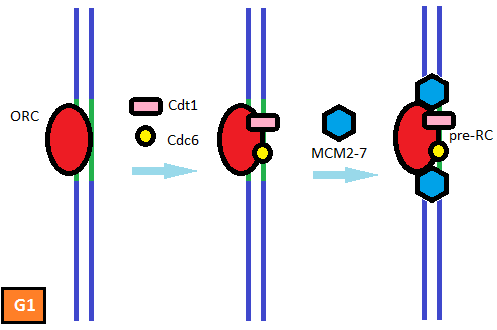
The is the engine that will eventually unwind the DNA double helix. It's a ring-shaped complex that must be threaded around the DNA. Cdc6 and Cdt1 use the energy from ATP hydrolysis to pry open the MCM ring and slip it onto the DNA strand at the origin where ORC is bound. Once the MCM2-7 helicase is loaded, Cdc6 and Cdt1 depart. The combination of ORC and the loaded MCM helicase on the DNA is called the pre-replicative complex, or for short. At this point, the origin is officially licensed and ready for action.
Firing the Origins
When the cell is ready to move from the G1 phase to the S phase, it needs a definitive signal to start replication. This signal comes from rising levels of specific enzymes called cyclin-dependent kinases (CDKs). CDKs are master regulators of the cell cycle, and their activity is low during G1 but spikes at the G1/S transition.
This surge in CDK activity does two things simultaneously to initiate replication and enforce the "once and only once" rule:
-
Activation: CDKs, along with another kinase called DDK, phosphorylate components of the pre-RC. This chemical modification acts like flipping a switch, activating the MCM2-7 helicase. The helicase begins to unwind the DNA, creating a replication bubble and recruiting DNA polymerase and other machinery to start synthesizing new DNA.
-
Inhibition: High CDK levels also phosphorylate and inactivate the licensing factors—ORC, Cdc6, and Cdt1. This removes them from the DNA or targets them for destruction, effectively shutting down the entire licensing system. No new MCM helicases can be loaded onto origins until the cell completes mitosis and CDK levels drop again in the next G1 phase.
Low CDK levels in G1 permit licensing. High CDK levels in S phase trigger firing and block re-licensing. This cycle ensures each origin fires only once.
This carefully orchestrated sequence of events ensures the stability of the genome. By linking the licensing of replication origins to one phase of the cell cycle (G1) and their activation to another (S phase), the cell creates a foolproof system. The rise and fall of CDK activity acts as a master clock, guaranteeing that the vast genetic library is copied completely and accurately, but never more than once.
What is the primary role of the MCM2-7 helicase in DNA replication?
The assembly of ORC, Cdc6, Cdt1, and the MCM2-7 helicase at an origin of replication is collectively known as the:
This separation of licensing and firing is a fundamental feature of eukaryotic cell division, providing the precision needed to manage large, complex genomes.