Essential Neural Networks for Beginners
Introduction to Neural Networks
The Brain as a Blueprint
Neural networks are computing systems inspired by the web of neurons in the human brain. But instead of biology, they are built with math. Their core purpose is to recognize patterns in data. This could be anything from the words in an email to the pixels in a photograph or the notes in a song.
Imagine a network as a team of simple calculators, all working together. Each one does a tiny piece of the job, passing its result to the next. By organizing these calculators into layers, the network can tackle incredibly complex problems, like translating languages or identifying objects in a video.
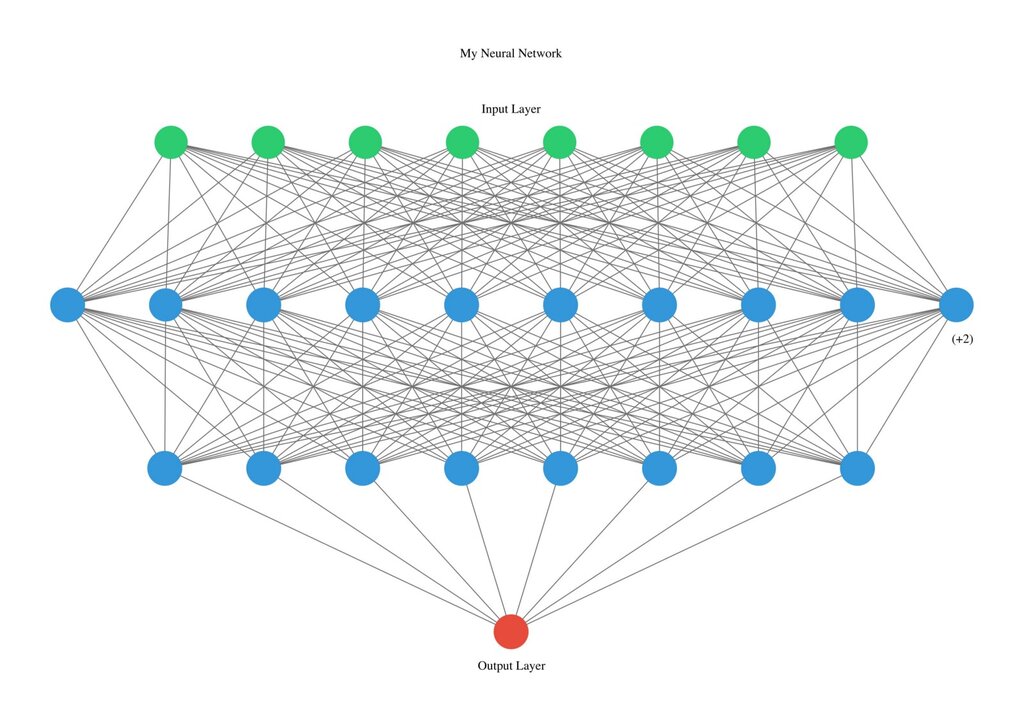
The basic structure consists of an input layer, one or more hidden layers, and an output layer. The input layer receives the raw data, like the individual pixels of an image. The hidden layers are where the real analysis happens. Each layer looks for increasingly complex patterns. The final output layer delivers the result, such as a label for the image.
neuron
noun
In a neural network, a neuron is a mathematical function that receives inputs, processes them, and produces an output.
For example, in a network designed to recognize faces, the first hidden layer might learn to identify simple edges and colors. The next layer could combine those edges to find patterns that look like eyes or noses. A deeper layer might then assemble those features into a complete face. This layered approach allows the network to build a sophisticated understanding from simple starting points.
Making a Decision
How does a neuron decide what information to pass on? It uses an activation function. Think of it like a gatekeeper. After a neuron processes its inputs, the activation function determines if the resulting signal is strong enough to be passed to the next layer. It decides whether the neuron is “activated” or not.
An activation function introduces non-linearity, allowing the network to learn complex relationships that a simple straight line can't capture.
This decision isn't always a simple yes or no. Some activation functions provide a graded output, like a dimmer switch, signaling the strength or confidence of the pattern it detected. One common example is the sigmoid function, which squishes any input value into a smooth curve between 0 and 1.
Learning From Mistakes
A neural network isn't useful until it's been trained. Training is the process of teaching the network to make accurate predictions. This is done by showing it thousands or even millions of examples. For each example, the network makes a guess.
If the network's guess is wrong, an algorithm called backpropagation kicks in. It works backward from the output layer, calculating how much each neuron contributed to the error. It's like a coach reviewing a game tape to see exactly where a play went wrong. The network then adjusts the connections between its neurons to correct for that error. This adjustment process often uses an optimization technique called gradient descent, which nudges the network's parameters in the direction that reduces the error most effectively.
This cycle of guessing, checking, and correcting is repeated over and over. With each iteration, the network gets a little bit better, until it can consistently make accurate predictions on new, unseen data.
Different Tools for Different Jobs
Not all neural networks are built the same way. Their architecture changes based on the task.
| Network Type | Best For | Example Use |
|---|---|---|
| Feedforward | Classification & regression | Predicting house prices |
| Convolutional (CNN) | Image & video analysis | Recognizing objects in photos |
| Recurrent (RNN) | Sequential data | Language translation, music generation |
Feedforward networks are the simplest type, where information flows in one direction. Convolutional Neural Networks (CNNs) are specialists at processing grid-like data, making them ideal for images. Recurrent Neural Networks (RNNs) have a kind of memory, allowing them to handle sequences of data, like sentences or stock market prices. Understanding these basic types is the first step toward seeing how AI can tackle such a wide variety of challenges.