Essential Math for Physics Undergrads
Calculus Fundamentals
The Mathematics of Change
Calculus is the mathematical study of continuous change. While algebra helps us solve for static unknowns, calculus gives us the tools to understand how things change from one moment to the next. It’s built on two powerful ideas: finding the instantaneous rate of change (differentiation) and summing up infinite tiny pieces to find a total (integration).
These concepts are the language of physics. To describe the velocity of a falling apple, the work done by a changing force, or the flow of electricity, we need calculus. Let's start with the fundamental idea that makes it all possible: the limit.
Getting Infinitely Close with Limits
A limit describes the value a function approaches as its input gets closer and closer to a certain number. It doesn't care what the value is at that number, only what it's trending toward.
Consider the function . If you try to plug in , you get , which is undefined. But what happens as gets very close to 2? Let's try values like 1.9, 1.99, and 1.999. The function gives us 3.9, 3.99, and 3.999. Now from the other side: 2.1, 2.01, and 2.001 give us 4.1, 4.01, and 4.001. The function is clearly squeezing in on the number 4.
We say the limit of the function as approaches 2 is 4. In mathematical notation, it looks like this:
This idea of approaching a value is the bedrock of calculus. It allows us to handle the concept of infinity and analyze points with precision. A function is considered continuous at a point if its limit exists, its value is defined, and the limit equals the value. Informally, you can draw a continuous function without lifting your pencil from the paper.
Derivatives and Rates of Change
A derivative measures the instantaneous rate of change of a function. Think about driving a car. Your average speed is the total distance divided by the total time. But your speedometer shows your instantaneous speed—how fast you're going at that exact moment. A derivative is the speedometer for any function.
Graphically, the derivative of a function at a point is the slope of the line tangent to the curve at that point. A steep slope means rapid change; a flat slope means no change.
We find the derivative using limits. The formal definition looks at the slope between two points on the curve and finds the limit as the distance between those points shrinks to zero.
Thankfully, we don't always need to use this definition. There are simpler rules. The most common is the power rule, which works for functions like or .
The Power Rule: To find the derivative of , you bring the exponent down as a multiplier and then subtract 1 from the original exponent. The derivative of is .
For example, the derivative of is . The derivative of is .
In physics, derivatives are essential. If an object's position over time is described by the function , then:
- Its velocity is the derivative of position: .
- Its acceleration is the derivative of velocity: .
Integrals and Summing It All Up
Integration is the other side of the calculus coin. It's about accumulation, or summing up infinitely many small parts to find a whole. The classic example is finding the area under a curve.
How can you find the exact area of an irregular shape? Integration solves this by slicing the area into an infinite number of infinitesimally thin rectangles and adding their areas together. The symbol for an integral is an elongated S, for "sum."
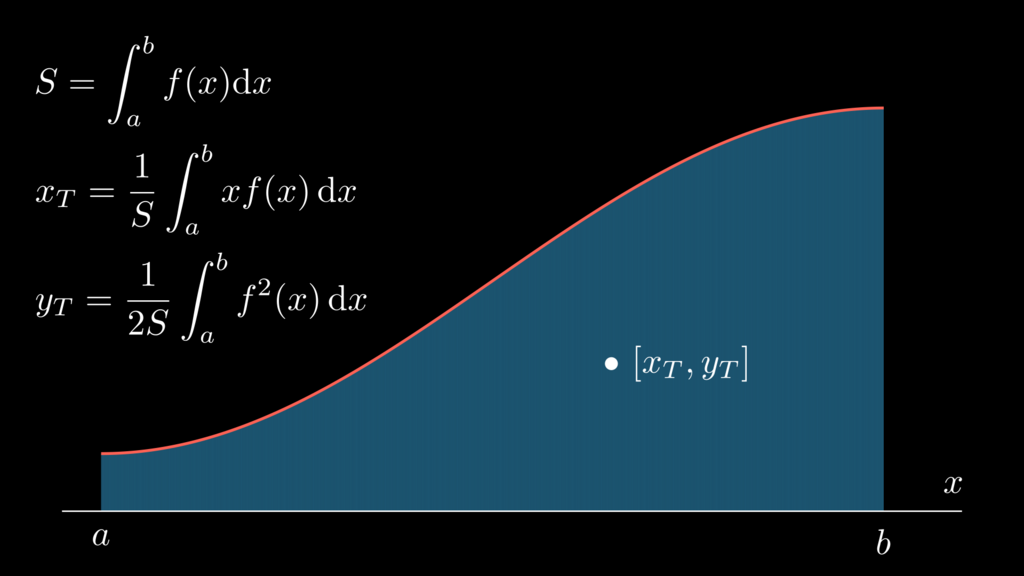
This process of finding the area is called a definite integral, which calculates a value between two bounds, and .
The amazing connection between derivatives and integrals is revealed by the Fundamental Theorem of Calculus. It states that differentiation and integration are inverse operations. If you take the integral of a function and then take the derivative of the result, you get your original function back.
This theorem is what allows us to calculate integrals easily. To find the integral of a function, we just need to think backwards: what function, when differentiated, gives us the function we started with? This reverse process is called finding the antiderivative.
For example, we know the derivative of is . Therefore, the antiderivative of is . (Technically it is , where C is any constant, because the derivative of a constant is zero).
Just like with derivatives, there are rules for integration. The power rule for integration reverses the derivative rule.
The Power Rule for Integration: To find the integral of , you add 1 to the exponent and then divide by the new exponent. The integral of is .
Integration is incredibly useful in physics. It allows us to calculate:
- Displacement from velocity: If you know an object's velocity , its total displacement between time and is .
- Work from a variable force: Work is force times distance. If the force changes with position, the total work done moving an object from position to is .
- Center of Mass: Finding the balancing point of an object with non-uniform density.
What does a derivative represent in the context of a function?
According to the power rule, what is the derivative of the function ?
Calculus provides the essential mathematical framework for describing the physical world in motion. Understanding these core concepts of limits, derivatives, and integrals is the first step toward tackling more advanced problems in physics.