Essential Math for Middle Schoolers
Numbers and Logic
More Than Just Counting
We use numbers every day, but have you ever stopped to think about how they actually work? It’s not just about counting one, two, three. The real power comes from a system called where the position of a digit changes its meaning.
Take the number 352. The '2' is just two. But the '5' isn't just five; it's five tens (50). And the '3' is three hundreds (300). Each spot is ten times bigger than the spot to its right. This is the base-ten system, and it lets us write down huge numbers using only ten simple symbols (0, 1, 2, 3, 4, 5, 6, 7, 8, 9).
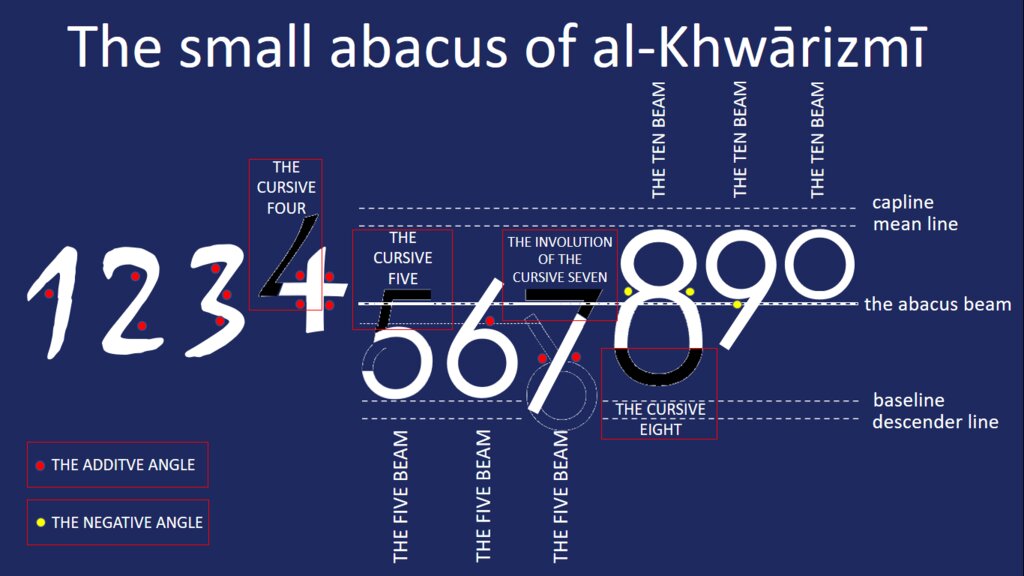
The most important symbol in this system might be the one that means 'nothing': zero. For a long time, people didn't have a way to write zero. If you wanted to write 302, you might have to leave an awkward empty space. The invention of zero as a placeholder was a massive breakthrough. It allows us to distinguish between 52, 502, and 520 without any confusion.
Beyond Zero
But zero is more than a placeholder. It’s the center of the number line, the point that separates positive numbers from negative numbers. All the whole numbers, both positive and negative, including zero, are called integers.
Think of a thermometer. Numbers above zero are positive temperatures. Numbers below zero are negative temperatures. If it’s 5 degrees and the temperature drops by 8 degrees, you move past zero into -3 degrees. Negative numbers let us talk about things like debt, sea level, or moving backward.
The number line helps us visualize this. Moving right is addition. Moving left is subtraction. Starting at 2 and subtracting 5 means taking 5 steps to the left, landing you on -3.
The concept of zero and negative numbers was formalized by ancient mathematicians. An Indian mathematician named was one of the first to set down rules for working with zero and negative numbers in the 7th century. He described how to add, subtract, multiply, and divide them, treating them as real concepts, like debts (negative) and fortunes (positive).
Integer
noun
A whole number that can be positive, negative, or zero. Examples include -10, -3, 0, 1, and 42. Fractions and decimals are not integers.
The Rules of the Game
Once we have our numbers, we need rules for working with them. You already know the four basic operations: addition, subtraction, multiplication, and division. But some useful properties make calculations easier.
The commutative property means you can swap the order of numbers in addition and multiplication. For example, is the same as . Likewise, is the same as . This doesn't work for subtraction or division!
The associative property lets you regroup numbers when adding or multiplying. gives the same result as . It's about which pair you handle first.
| Property | For Addition | For Multiplication |
|---|---|---|
| Commutative | a + b = b + a | a × b = b × a |
| Associative | (a + b) + c = a + (b + c) | (a × b) × c = a × (b × c) |
When you have a long calculation with many different operations, there's a specific sequence you must follow. This is called the order of operations, often remembered by the acronym (or BODMAS in some regions).
It stands for:
- Parentheses
- Exponents
- Multiplication and Division (from left to right)
- Addition and Subtraction (from left to right)
Following this order ensures everyone gets the same answer from the same problem. For example, in the expression , you must do the multiplication first () and then the subtraction (). If you went from left to right without the rule, you'd get a wrong answer: , and .
Let's check your understanding.
In the number 954, what is the value of the digit '5'?
The invention of zero as a placeholder was a major breakthrough. It allows us to distinguish between numbers like 23, 203, and 230.
These building blocks are the foundation of all mathematics. Understanding them well makes everything else that follows much easier.