Essential Japanese Foundations
Hiragana Mastery
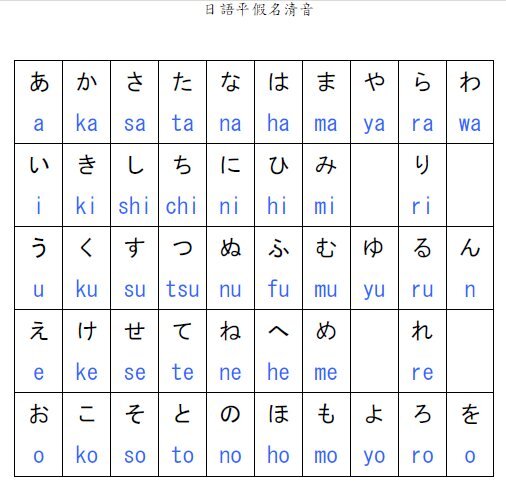
The Hiragana Grid
Hiragana is a phonetic script, meaning each character corresponds to a specific sound, much like letters in the English alphabet. The core of Hiragana is a grid of 46 base characters called the Gojūon, or "fifty sounds."
This grid is organized logically. The top row consists of the five vowels: あ (a), い (i), う (u), え (e), お (o). Each subsequent row combines a consonant with these five vowels. For example, the 'k' row is か (ka), き (ki), く (ku), け (ke), こ (ko). Learning this pattern makes memorization much easier than it might seem.
| a | i | u | e | o | |
|---|---|---|---|---|---|
| Vowels | あ | い | う | え | お |
| K | か | き | く | け | こ |
| S | さ | し | す | せ | そ |
| T | た | ち | つ | て | と |
| N | な | に | ぬ | ね | の |
| H | は | ひ | ふ | へ | ほ |
| M | ま | み | む | め | も |
| Y | や | ゆ | よ | ||
| R | ら | り | る | れ | ろ |
| W | わ | を | |||
| n | ん |
Notice the gaps for 'yi', 'ye', and 'wu'. These sounds don't exist in modern standard Japanese. The character を (wo) is pronounced 'o' and is almost exclusively used as a grammatical particle. The final character, ん (n), is the only one that doesn't end in a vowel sound.
Adding Voice and Plosives
The base characters can be modified to create new sounds. This is done with two small marks placed at the top-right of a character.
The first is the dakuten, which looks like a small quotation mark ( ゛). It "voices" a consonant. For example, the voiceless 'k' sound (か, ka) becomes a voiced 'g' sound (が, ga). The 's' sound becomes 'z', 't' becomes 'd', and 'h' becomes 'b'.
The second mark is the handakuten, a small circle ( ゜). It is only used with the 'h' row characters, changing the sound to a plosive 'p'.
| a | i | u | e | o | |
|---|---|---|---|---|---|
| G | が | ぎ | ぐ | げ | ご |
| Z | ざ | じ | ず | ぜ | ぞ |
| D | だ | ぢ | づ | で | ど |
| B | ば | び | ぶ | べ | ぼ |
| P | ぱ | ぴ | ぷ | ぺ | ぽ |
Note that し (shi) with a dakuten becomes じ (ji), and ち (chi) and つ (tsu) become ぢ (ji) and づ (zu) respectively. While じ and ぢ sound identical, as do ず and づ, the first form in each pair is far more common.
Combining and Extending Sounds
Japanese also has contracted sounds, called yōon. These are formed by combining a character from the 'i' column (like き, し, ち) with a small version of や, ゆ, or よ. This creates a single syllable.
For example, き (ki) + ゃ (small ya) becomes きゃ (kya), not ki-ya. The 'i' sound of the first character blends into the following 'y' sound.
| kya | kyu | kyo | |
|---|---|---|---|
| き | きゃ | きゅ | きょ |
| し | しゃ | しゅ | しょ |
| ち | ちゃ | ちゅ | ちょ |
| に | にゃ | にゅ | にょ |
| ... | ... | ... | ... |
Two other key concepts are the small つ and long vowels.
A small つ, called a sokuon, is not pronounced. Instead, it indicates a quick pause or a doubled consonant. For instance, きて (kite) is one beat per character, while きって (kitte) has a slight stop before the 'te', making the 't' sound sharp and doubled.
Long vowels are straightforward. To extend a vowel sound, you simply add the corresponding vowel character. For example, おばさん (obasan, aunt) has short vowels, but おばあさん (obaasan, grandmother) extends the 'a' sound with an extra あ. The same logic applies to い, う, and え. For the 'o' sound, う is usually added to extend it, as in おはよう (ohayou, good morning).
Writing It Right
Writing Hiragana correctly depends on stroke order. Following the proper sequence isn't just about tradition; it ensures your characters are balanced, legible, and written efficiently. The rules are generally intuitive:
- Top to bottom.
- Left to right.
- Horizontal strokes before vertical strokes that cross them.
Mastering the flow for each character takes practice, but it quickly becomes muscle memory.
Be aware that handwritten characters can look slightly different from their typed counterparts. For example, characters like き (ki) and さ (sa) are often written with connected, flowing strokes that aren't visible in most digital fonts. Don't let this throw you off; the underlying structure is the same.
Ready to test your knowledge? Let's see how well you've grasped these core concepts.
What is the fundamental structure of the Gojūon, the basic Hiragana chart?
How is the sound of the hiragana character か (ka) modified when a dakuten (゛) is added to it?
With these rules, you can now decode any word written in Hiragana. The next step is practice until recognition is instant.