ESP32 Embedded Software Development
ESP32 Architecture
The Brains of the Operation
At the heart of every ESP32 chip are two Xtensa LX6 processor cores. Think of them as two independent workers who can handle different jobs simultaneously. One core might be busy maintaining a Wi-Fi connection while the other is reading data from a sensor or updating a display. This dual-core design is a major advantage, allowing for more complex and responsive applications than a single-core microcontroller could manage.
Each core can be controlled separately. You can run different tasks on each one, or even turn one off completely to save power. This parallel processing capability is what makes the ESP32 so powerful for tasks like streaming audio, processing images, or managing multiple connections at once.
Memory Organization
A processor is nothing without memory. The ESP32 has a few different types, each with a specific job. Understanding them is key to writing efficient code.
-
ROM (Read-Only Memory): This is the permanent memory that's programmed at the factory. It contains the essential code needed to start up the chip, called the bootloader, as well as some core functions. You can't change what's in ROM.
-
SRAM (Static Random-Access Memory): This is the main workbench for your code. When your program runs, its variables and data are stored here for quick access. SRAM is fast but volatile, meaning it loses all its data when the power is turned off.
-
RTC Memory: This is a special, small amount of SRAM that is part of the Real-Time Clock (RTC) subsystem. Its superpower is that it can retain data even when the main processors are in a low-power "deep sleep" mode. This is incredibly useful for waking the device periodically and remembering what it was doing without a full reboot.
This diagram shows how the components fit together. The two cores communicate with memory and all the chip's other features through a central system bus, which acts like a highway for data.
Connecting to the World
The ESP32 isn't just a processor and memory; it's a complete system on a chip with built-in tools for interacting with the outside world. These are called peripherals.
General Purpose Input/Output (GPIO) pins are the most fundamental way the ESP32 interacts with other electronics. You can configure each pin as either an input, to read a signal (like from a button), or an output, to send a signal (like turning on an LED).
For signals that aren't just on or off, the ESP32 has converters:
- ADC (Analog-to-Digital Converter): Measures a continuous analog voltage, like the input from a temperature sensor or a microphone, and converts it into a number your code can use.
- DAC (Digital-to-Analog Converter): Does the reverse. It takes a number from your code and produces a corresponding analog voltage, which can be used to create audio tones or control certain types of motors.
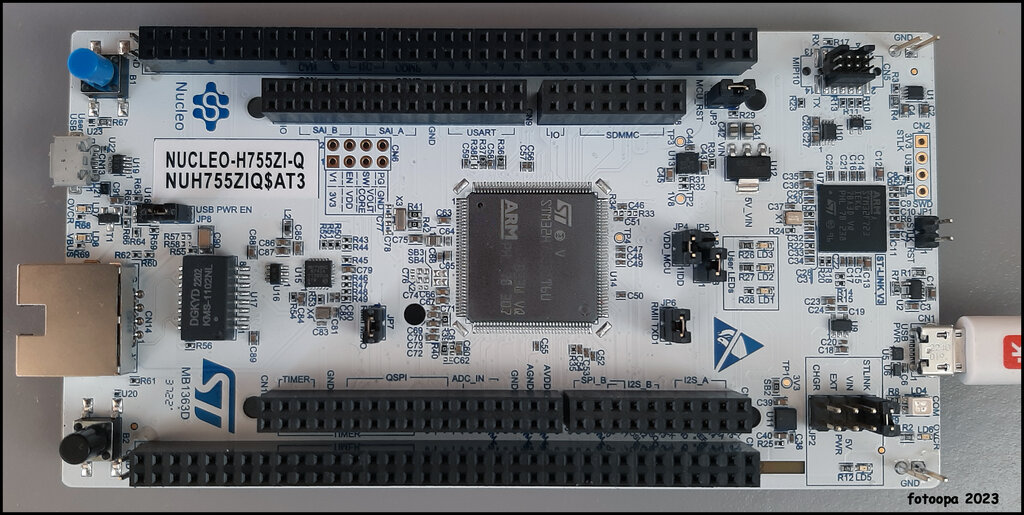
To talk to other chips and devices, the ESP32 includes hardware for several standard communication protocols.
| Protocol | Name | Wires Used | Use Case |
|---|---|---|---|
| UART | Universal Asynchronous Receiver-Transmitter | 2 | Simple text-based communication with computers or other microcontrollers. |
| SPI | Serial Peripheral Interface | 4 | Fast data transfer with devices like SD cards, displays, and some sensors. |
| I2C | Inter-Integrated Circuit | 2 | Communicating with many devices (like sensors) on a shared two-wire bus. |
These built-in communication interfaces save you from having to implement these protocols in software, making it much easier and more efficient to connect to a huge range of external components.
What is the primary advantage of the ESP32's dual-core architecture?
Which type of memory on the ESP32 is volatile and serves as the main 'workbench' for a running program's variables?
Now that you've got the lay of the land, you're ready to see how these architectural features are put to use.