ESL Toddler Activity Booklet Design
Understanding Toddler Development
A Toddler's Amazing Brain
Between the ages of one and three, a toddler's brain is growing at an incredible rate. It's forming connections faster than at any other time in life. This period of rapid development is what makes toddlers like sponges, soaking up information from the world around them, especially language.
Cognitively, toddlers are making huge leaps. They're starting to understand that objects still exist even when they can't see them (object permanence). They're figuring out cause and effect—if I push this block tower, it will fall! This newfound understanding of how the world works is the foundation for language. A word like "gone" only makes sense once a child understands that things can disappear and reappear.
Feelings, Friends, and First Words
Language isn't just about labeling objects. It's deeply tied to a toddler's social and emotional world. During this time, children start to recognize and name emotions in themselves and others. They begin to develop empathy and learn social cues. This is also when they start to crave independence, with "mine" and "me do it" becoming frequent declarations.
These social and emotional milestones are powerful motivators for communication. A toddler learns to say "sad" because they want to share their feelings. They learn to ask for the "ball" because they want to play with a friend. This type of interaction, known as parallel play, where toddlers play alongside each other rather than together, is a critical step. It allows them to observe, imitate, and practice their budding social and language skills in a low-pressure setting.
Children learn language best in context, so your everyday activities are perfect opportunities to model vocabulary, sentence structure, and conversation.
How Toddlers Learn Best
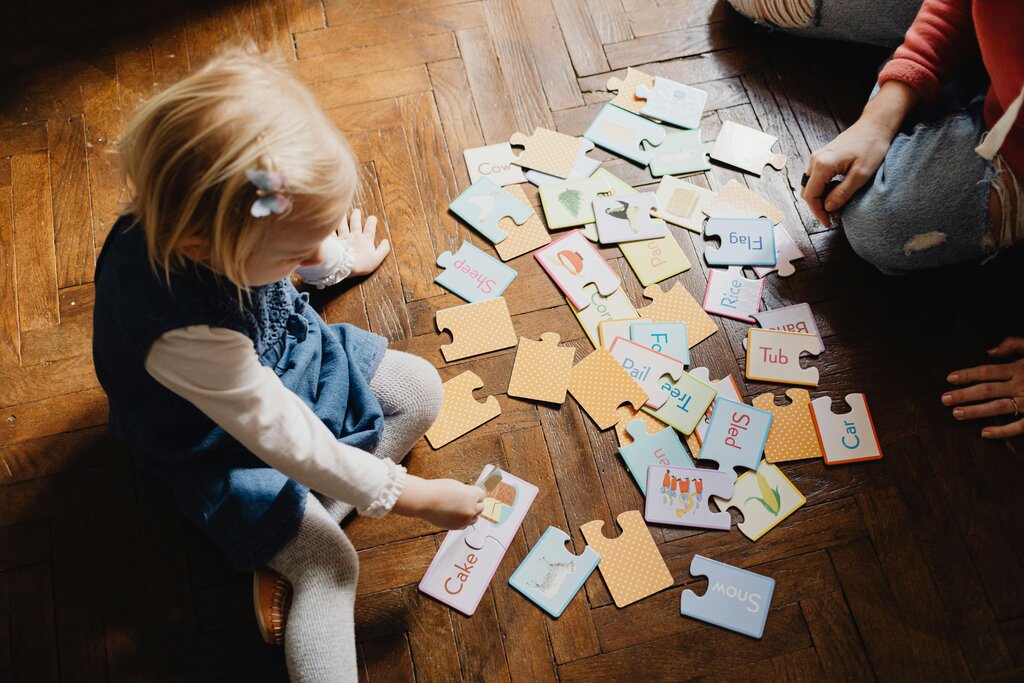
For a toddler, learning is not about worksheets or flashcards. It's about playing. Play is the serious work of childhood, allowing them to explore, experiment, and make sense of their environment.
Think about these common activities:
- Building with blocks: This teaches cause and effect, gravity, and spatial awareness. When you talk about the "big" block or the "red" one, you're building their vocabulary.
- Pretend play: A toddler pretending to cook or take care of a doll is practicing social roles, using new words, and structuring thoughts into simple narratives.
- Singing songs: Nursery rhymes and simple songs introduce rhythm, repetition, and new vocabulary in a fun, memorable way. The actions that go with songs like "The Wheels on the Bus" also connect words to meaning.
Play-based learning links directly to language development. When a child is engaged and having fun, their brain is more receptive to learning new words and concepts.
Your Role as a Language Guide
As a caregiver, you are your toddler's most important language teacher, but your role is more of a guide than an instructor. The most effective way to support their language development is by integrating it into your daily routines.
Narrate your day. As you make breakfast, say, "I'm pouring the milk. Now let's get a banana." This technique, sometimes called self-talk, surrounds your child with rich, contextual language. Similarly, parallel talk involves describing what your child is doing: "You're stacking the blocks. What a tall tower!"

Reading books together is another powerful tool. Point to pictures, name objects, and ask simple questions. Don't worry about finishing the book; let your child's curiosity lead the way. Responding to their babbles and early words, even if you don't fully understand, shows them that their attempts to communicate are valued. This encouragement is key to building their confidence to keep trying.
Let's check what you've learned about how toddlers grow and acquire language.
The understanding that an object still exists even when it is out of sight is known as:
Which activity primarily teaches a toddler about cause and effect, gravity, and spatial awareness?
Understanding these developmental stages helps you see the world through your toddler's eyes. By supporting their natural curiosity through play and conversation, you provide a rich foundation for them to learn any language.