ERP Systems in Practice
ERP Fundamentals
What Is an ERP System?
Imagine a business where the sales team uses one system, the accounting team another, and the warehouse a third. Data gets lost, communication breaks down, and simple tasks become complicated. Enterprise Resource Planning (ERP) systems were created to solve this problem.
Enterprise Resource Planning ERP systems integrate information across an entire organization that automate core activities such as finance accounting, human resources, manufacturing, production and supply chain management etc. to facilitate an integrated centralized system and rapid decision making resulting in cost reduction, greater planning, and increased control.
Think of an ERP as the central nervous system of a company. It's a single software platform that connects all the essential parts of the business, from finance to human resources, and from manufacturing to the supply chain. Instead of having separate, siloed applications that don't talk to each other, an ERP creates a single source of truth. Everyone in the company works with the same, up-to-date information.
From Silos to Synergy
Before ERP systems became common, companies often ran on a patchwork of disconnected software. The finance department couldn't easily see what the sales team was forecasting, and the supply chain team had no real-time view of inventory levels. This created information silos, where data was trapped within individual departments.
The concept grew out of manufacturing. In the 1960s, early inventory management systems helped track materials. These evolved into Material Requirements Planning (MRP) systems, which helped plan the entire manufacturing process. By the 1990s, these systems had expanded to include other business functions like finance and HR, giving birth to the first true ERP systems.
The Core Components
Modern ERP systems are modular, meaning businesses can choose the components they need. While the specific modules vary, most ERPs are built around a few core functions.
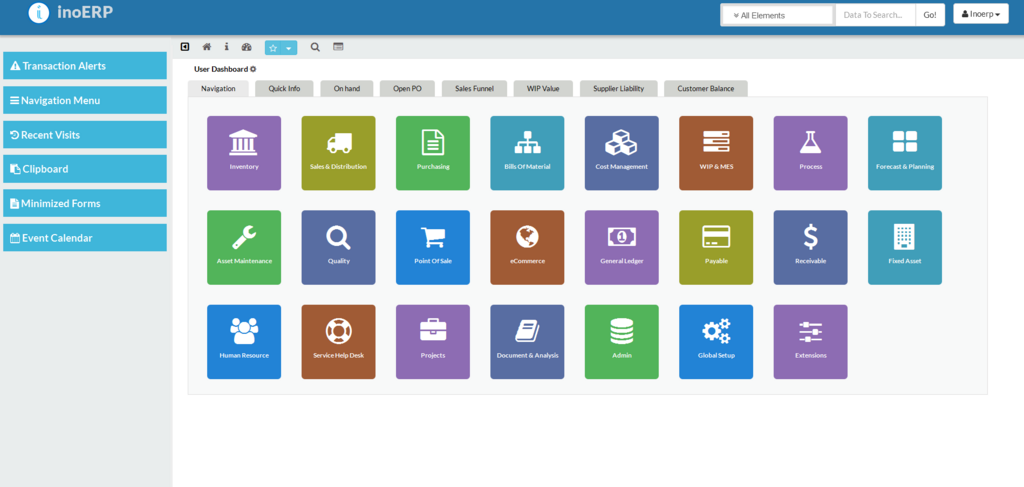
Here's a breakdown of the most common components:
| Component | Primary Function |
|---|---|
| Financial Management | Manages the general ledger, accounts payable/receivable, cash flow, and financial reporting. This is the financial backbone of the company. |
| Human Resources (HR) | Handles all employee-related data, including payroll, benefits, recruiting, onboarding, and performance management. |
| Supply Chain Management (SCM) | Oversees the flow of goods from procurement of raw materials to final delivery. This includes inventory management, warehousing, and logistics. |
| Customer Relationship Management (CRM) | Manages interactions with current and potential customers. It tracks sales leads, customer service history, and marketing campaigns to improve relationships. |
Some ERPs also offer specialized modules for manufacturing, project management, or e-commerce, depending on the industry.
Benefits and Challenges
When implemented successfully, an ERP system can transform a business. By creating a single, shared database, it boosts efficiency and provides clear insights into how the business is performing. The key benefits include:
- Improved Data Accuracy: With one source of information, you eliminate duplicate or conflicting data, leading to more reliable reporting.
- Streamlined Processes: Automating core business processes saves time and reduces the chance of human error. Workflows can move smoothly between departments.
- Better Resource Management: A clear, real-time view of operations helps managers make smarter decisions about everything from inventory levels to staffing.
Essentially, an ERP provides the data needed for better planning and control over the entire organization.
However, implementing an ERP is not a simple task. It's a major undertaking that comes with significant challenges.
The major impediments to successful ERP implementations are not technologically related issues like compatibility, technological complexity, and standardization.
The biggest hurdles are often human. One major challenge is complexity. ERP systems are large and intricate, and configuring one to fit a company's specific needs takes a lot of work.
The other key challenge is change management. An ERP implementation doesn't just change software; it changes how people do their jobs. Employees need to be trained, and existing workflows must be redesigned. Without buy-in from the people who will actually use the system every day, even the best ERP software can fail.
Ready to test your understanding of ERP fundamentals? Let's see what you've learned.
What is the primary problem that Enterprise Resource Planning (ERP) systems are designed to solve?
An ERP system is often described as the "central nervous system" of a company. What does this metaphor primarily emphasize?
Ultimately, an ERP system is a powerful tool for unifying a business and driving efficiency, but it requires careful planning and a commitment to managing the human side of the transition.