Equilibrium and Elasticity in Physics
Forces and Motion
What Makes Things Move?
Everything around us is either sitting still or in motion. A book rests on a table. A planet orbits a star. But why? What causes an object to start moving, stop moving, or change direction? The answer is force. In physics, a force is simply a push or a pull.
The subject of mechanics is logically divided into two parts: statics, which con- cerns the equilibrium of bodies under action of forces, and dynamics, which con- cerns the motion of bodies.
This idea seems simple, but it's the key to understanding almost everything about motion. To really dig in, we first need to understand that not all physical quantities are created equal. Some have direction, and some don't.
Direction Matters
Imagine you're giving someone directions. If you say, "Walk for 100 meters," you've only given them half the information. 100 meters in which direction? North? South? Down the street?
This highlights the difference between two types of quantities in physics: scalars and vectors.
scalar
noun
A quantity that is fully described by a magnitude (a number) alone.
Examples of scalars include distance (100 meters), speed (50 km/h), and mass (5 kg). They tell you "how much" but not "which way."
A vector is different. It needs both a magnitude and a direction to be complete.
vector
noun
A quantity that has both a magnitude and a direction.
Force is a vector. Pushing a box with a certain amount of force to the right is very different from pushing it with the same force upwards. The direction is crucial. We often draw vectors as arrows; the length of the arrow shows the magnitude, and the way it points shows the direction.
The Rules of Motion
Once we can describe motion and forces using vectors, we can start to predict how objects will behave. Over 300 years ago, Sir Isaac Newton laid out three fundamental laws of motion that became the bedrock of classical physics.
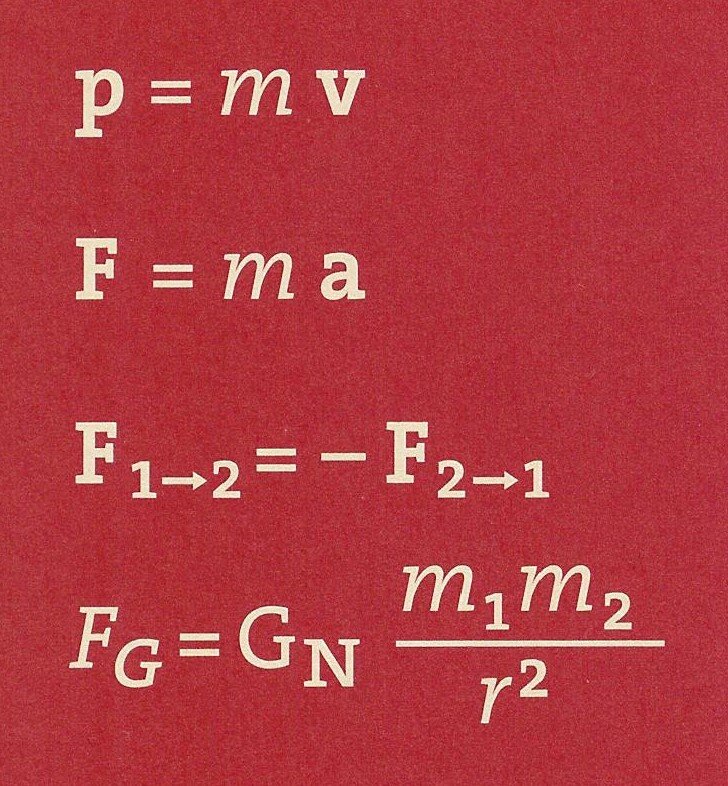
Newton's First Law: The Law of Inertia An object at rest stays at rest, and an object in motion stays in motion with a constant velocity, unless acted upon by a net external force.
This law is all about inertia, which is an object's resistance to a change in its state of motion. The more mass an object has, the more inertia it has. It’s why you can easily kick a soccer ball but not a bowling ball.
A book on a table won’t spontaneously fly into the air. A satellite in deep space will travel in a straight line at a constant speed forever, because there's no significant force (like friction or air resistance) to stop it.
Newton's Second Law: Force Equals Mass Times Acceleration The acceleration of an object is directly proportional to the net force acting on it and inversely proportional to its mass.
This is probably the most famous of the three laws, and it’s often written as an equation.
Here, is the net force (a vector), is the mass (a scalar), and is the acceleration (a vector). This law tells us that if you push on an object, it will accelerate in the direction you push it. To get a heavy object accelerating as quickly as a light one, you need to apply a much larger force.
Newton's Third Law: Action and Reaction For every action, there is an equal and opposite reaction.
This law describes what happens when two objects interact. Forces always come in pairs. When you push on a wall, the wall pushes back on you with an equal amount of force in the opposite direction. You might not notice the wall pushing back, but it is.
This is the principle that allows rockets to work. The rocket pushes hot gas out of its engine (the action), and the gas pushes the rocket forward (the reaction).
It’s important to remember that the action and reaction forces act on different objects. The rocket pushes on the gas, and the gas pushes on the rocket. They don't cancel each other out because they aren't acting on the same thing.
Which of the following is a vector quantity, meaning it has both magnitude and direction?
Newton's First Law of Motion is also known as the law of ______.
These concepts, from vectors to Newton's three laws, are the essential building blocks for analyzing how forces affect objects. They explain why things stay still, why they move, and how they interact.