Equational Reasoning for Boolean Logic
Boolean Logic Basics
A World of Two Values
In our everyday language, we deal with nuance, shades of gray, and complex ideas. But in the world of computers and logic, things are much simpler. At its core, this world is built on a system that only has two possible values: True or False. This system is called Boolean logic.
A Boolean variable is like a light switch. It can only be in one of two states: on (True) or off (False). There's no in-between, no dimmer setting. We often represent True with the number 1 and False with the number 0. This simple, two-state system is the foundation for how all modern digital devices process information.
The Basic Operations
To work with these True and False values, we use a few fundamental operations. Think of them as the grammar of Boolean logic. The three most basic ones are NOT, AND, and OR.
The NOT operation is the simplest. It just flips a value. If something is True, NOT makes it False. If it's False, NOT makes it True.
We can map out every possible outcome of a logical operation using something called a truth table. It’s a handy way to see the logic at a glance. Let's use the variable to represent a Boolean value.
Here is the truth table for NOT :
| P | NOT P |
|---|---|
| True | False |
| False | True |
Next up is the AND operation. The AND operation connects two or more Boolean variables and is only True if all of the variables are True. If even one of them is False, the whole expression becomes False.
Imagine you need your keys AND your wallet to leave the house. If you only have your keys, you can't go. If you only have your wallet, you still can't go. You need both. The statement "I can leave the house" is only True if "I have my keys" is True AND "I have my wallet" is True.
| P | Q | P AND Q |
|---|---|---|
| True | True | True |
| True | False | False |
| False | True | False |
| False | False | False |
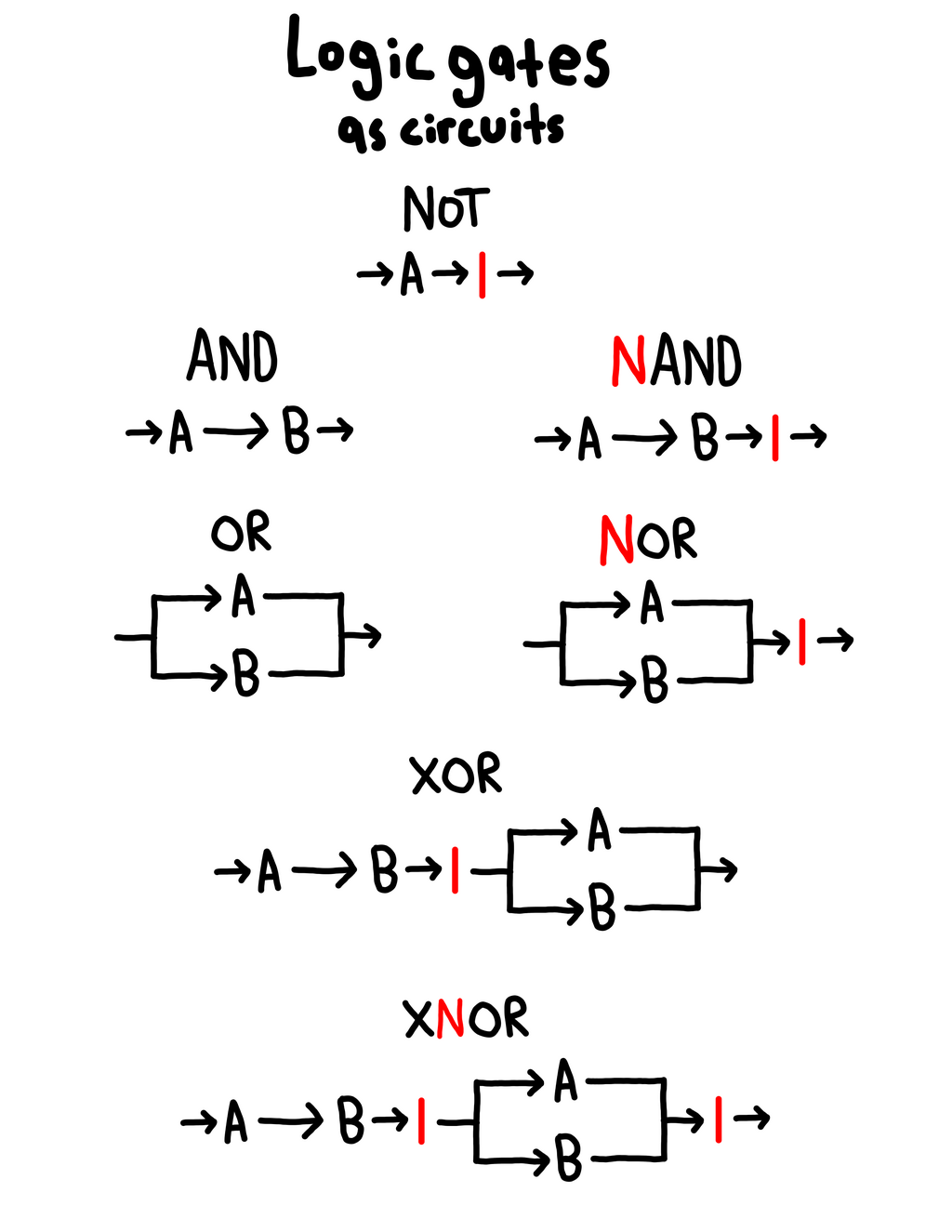
Finally, we have the OR operation. An OR expression is True if at least one of its variables is True. It doesn't matter if one is False or if both are True; as long as it's not all False, the result is True.
Think about ordering a drink that comes with a lemon OR a lime. You'd be happy if you got a lemon. You'd also be happy with a lime. You'd even be fine with both! The only time you'd be disappointed is if you got neither.
Here is the truth table for P OR Q:
| P | Q | P OR Q |
|---|---|---|
| True | True | True |
| True | False | True |
| False | True | True |
| False | False | False |
The Building Blocks of Computing
These three simple operations—NOT, AND, and OR—are the fundamental building blocks of all digital computing. Every complex task your computer performs, from rendering a video to sending an email, is ultimately broken down into millions or billions of these tiny, simple true-or-false calculations.
Truth tables are our window into this world. They provide a clear and complete picture of how a logical statement behaves under all possible conditions, leaving no room for ambiguity.
Let's check your understanding of these core concepts.
A Boolean variable can only hold one of two possible values. What are they?
If the statement A is True, what is the value of NOT A?
Mastering these basics is the first step toward understanding the logic that powers our digital world.