Epithelial Tissue Classification and Function
Epithelial Tissue Classification
A System for Naming
Epithelial tissue is one of the four basic types of animal tissue, acting as a protective barrier and lining for your body's surfaces and cavities. Think of it as the body's specialized wallpaper, covering everything from your skin to the inside of your stomach. Given its many roles, it's no surprise that epithelial tissue comes in many forms. To keep them all straight, biologists use a simple and logical naming system.
Epithelial tissue is classified into different types based on two main features: 1️⃣ The number of cell layers 2️⃣ The shape of the cells
This two-part naming convention tells you almost everything you need to know to identify a specific type of epithelial tissue. Let's break down each part.
The First Name: Layers
The first classification is based on how many layers of cells make up the tissue. There are two main categories: simple and stratified.
Simple epithelium consists of a single layer of cells. Every cell in this layer is attached to the base membrane, which is a thin layer of connective tissue that anchors the epithelium. This single-file arrangement is ideal for processes like absorption and filtration, where materials need to pass through the tissue quickly.
Stratified epithelium, on the other hand, is made up of two or more layers of cells stacked on top of each other. Only the bottom layer of cells touches the base membrane. This layered structure creates a thicker, more durable barrier, perfect for areas that need protection from abrasion and wear.
Think of it like building a wall. A simple epithelium is like a single row of bricks, while a stratified epithelium is a thick, multi-layered brick wall.
The Last Name: Shape
The second part of the name comes from the shape of the cells themselves. There are three basic shapes that epithelial cells can take.
Squamous
adjective
Cells that are flattened and thin, resembling the scales of a fish. The name comes from the Latin word squamosus, meaning "scaly."
Squamous cells are wider than they are tall. Because they are so thin, they create a very smooth surface.
Cuboidal
adjective
Cells that are shaped like cubes, with roughly equal height, width, and depth. Their nucleus is typically round and located in the center of the cell.
Cuboidal cells are boxy and provide a bit more volume than squamous cells.
Columnar
adjective
Cells that are taller than they are wide, resembling columns. The nucleus is usually elongated and located near the base of the cell.
These tall, pillar-like cells are often specialized for secretion or absorption.
When classifying stratified tissues, the shape of the cells in the outermost, or apical, layer determines the tissue's last name. For example, if the top layer is made of flat, squamous cells, the entire tissue is called stratified squamous, even if the deeper layers have a different shape.
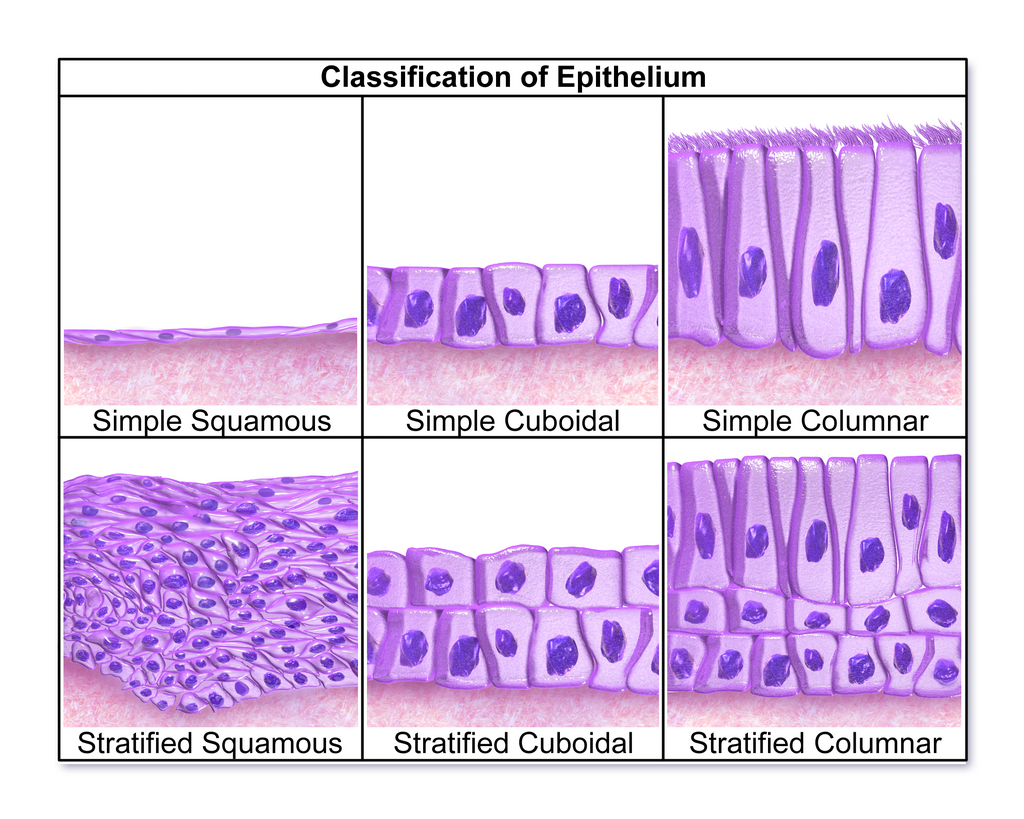
Putting it all together, we can form the names of different epithelial tissues. A single layer of flat cells is called simple squamous epithelium. Multiple layers of cube-shaped cells are called stratified cuboidal epithelium. This system provides a clear and descriptive way to categorize these fundamental tissues.
What is the primary advantage of having a single layer of cells, as seen in simple epithelium?
A tissue sample shows multiple layers of cells. When observing the outermost, or apical, layer, the cells appear much taller than they are wide. How would this tissue be classified?