Epithelial Tissue Classification and Function
Epithelial Tissue Overview
The Body's Border Control
Your body is a complex landscape of organs, vessels, and cavities. The tissue that covers nearly every surface, inside and out, is called epithelial tissue, or epithelium. Think of it as a living wallpaper that lines everything from your skin to the inside of your stomach. Unlike other tissues where cells might be loosely scattered, epithelial cells are packed together in dense sheets, like carefully laid tiles on a floor. This tight arrangement is crucial to its main job: forming a barrier.
Epithelial tissue, also referred to as epithelium, refers to the sheets of cells that cover exterior surfaces of the body, lines internal cavities and passageways, and forms certain glands.
This barrier isn't just a simple wall. It's a highly selective border that controls what passes in and out of different body regions. It's the gatekeeper for nutrients, the first line of defense against microbes, and the surface that interacts with the world.
Structure Defines Function
A key feature of epithelial tissue is its polarity. This doesn't have to do with magnets, but with having two distinct sides. The apical surface faces an open space, like the inside of your airway or the outer layer of your skin. The basal surface is the opposite side, anchored to the underlying tissue.
These two surfaces often have very different jobs. For example, in the small intestine, the apical surface is covered in tiny projections that absorb nutrients, while the basal surface passes those nutrients to the bloodstream.
To maintain their tight sheet-like structure, epithelial cells are connected by specialized cell junctions. These are like different kinds of stitching holding the fabric of the tissue together.
- Tight junctions seal the space between cells, preventing molecules from leaking through.
- Adherens junctions act like a belt, holding cells together.
- Desmosomes are like spot welds, providing strong connections that resist stretching and pulling.
- Gap junctions are small channels that allow for direct communication and passage of small molecules between adjacent cells.
The Foundation
Every sheet of epithelium rests on a thin, supportive layer called the basement membrane. This isn't a membrane in the cellular sense, but rather a complex mixture of proteins and carbohydrates secreted by both the epithelial cells and the underlying connective tissue. It acts as a foundation, anchoring the epithelium firmly in place.
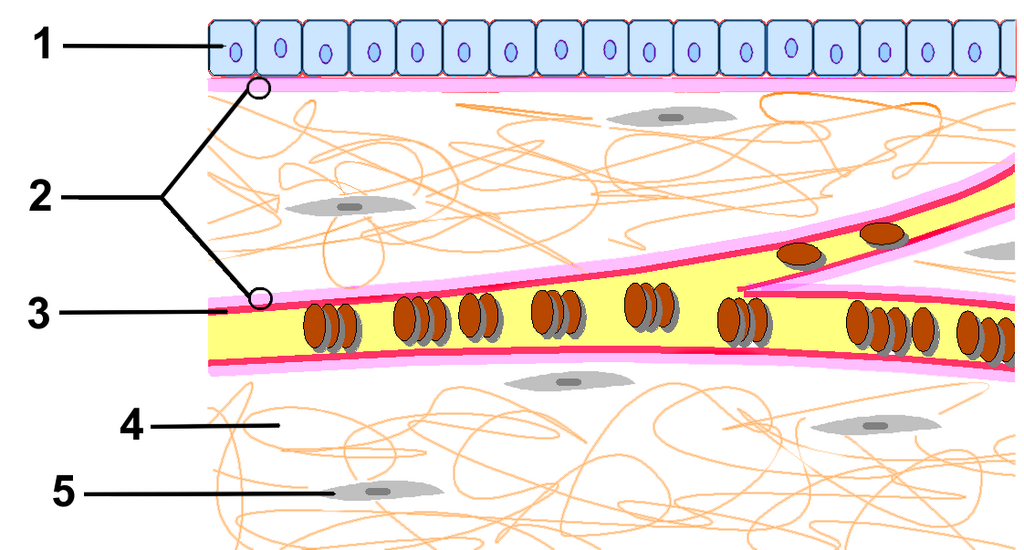
The basement membrane does more than just provide support. It also acts as a filter, regulating which molecules can pass from the underlying tissue into the epithelium. It plays a role in tissue repair, providing a scaffold for migrating cells during wound healing. Without this critical foundation, epithelial tissue couldn't perform its diverse and essential functions.
Now you have an idea of what makes this tissue type so special. Let's test your knowledge.