Epigenetics Explained
Introduction to Epigenetics
Beyond Your DNA
Think of your DNA as a massive instruction manual for building and running your body. It contains all the genes that code for everything from your eye color to how your cells function. For a long time, scientists believed this manual was written in permanent ink. But it turns out there’s a second layer of information written on top of the DNA itself, like notes scribbled in the margins.
Epigenetics
noun
Heritable changes in gene expression that do not involve alterations to the underlying DNA sequence.
Epigenetics is the study of these changes. The prefix epi- means "above" or "on top of," so epigenetics is literally the science of what's on top of your genes. These epigenetic marks don't change your DNA sequence, but they can change how your body reads it. They act like switches, turning genes on or off, or like a dimmer, turning them up or down. This process of turning genes on and off is called gene expression.
How Genes Are Controlled
Imagine your DNA is a giant library of cookbooks. You don't need to make every recipe every day. Epigenetic marks are like sticky notes and paper clips that tell the chef—your cells—which recipes to use and which to ignore. There are two main ways this happens.
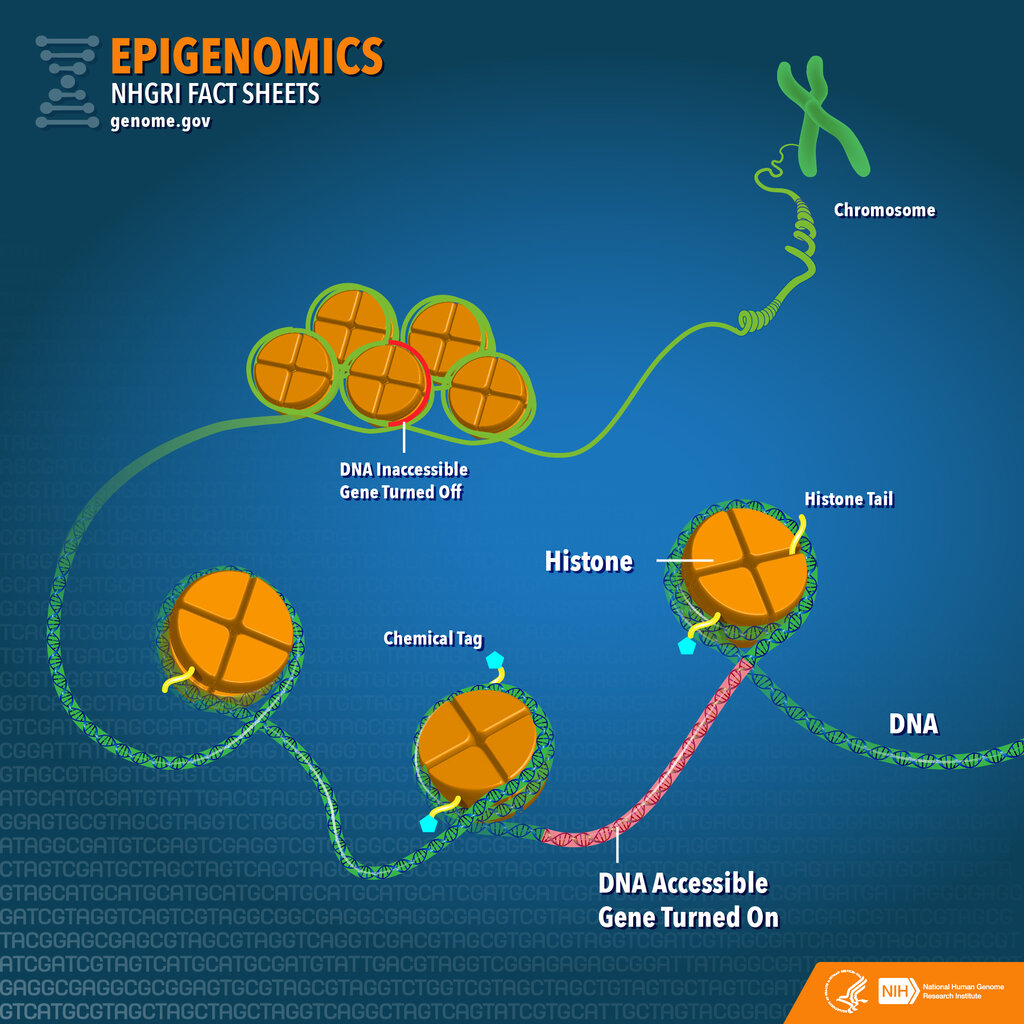
The first is DNA methylation. This is when a small chemical tag, called a methyl group, attaches directly to the DNA. Think of it as a sticky note that says, "Skip this recipe." Usually, when a gene is methylated, it's turned off and silenced. The cell's machinery just passes over it, leaving the gene unread.
The second mechanism is histone modification. Your DNA is incredibly long, so to fit inside a cell's nucleus, it's wrapped around proteins called histones, like thread around a spool. These histones can be modified. Some modifications cause the spool to tighten, packing the DNA so densely that it can't be read. This effectively turns the gene off. Other modifications cause the spool to loosen, making the DNA accessible and easy to read. This turns the gene on.
Why Epigenetics Matters
These epigenetic marks aren't static. They can change throughout your life based on your environment and lifestyle choices. Things like diet, exercise, stress, and exposure to toxins can all add or remove epigenetic tags.
This is a powerful idea. It means that while you can't change your genes, you might be able to influence how they are expressed. These changes explain why identical twins, who have the exact same DNA sequence, can develop different diseases and traits over their lifetimes.
Your experiences and environment can leave a chemical signature on your DNA that influences how your genes work.
When epigenetic processes go wrong, they can lead to health problems. For example, if a gene that's supposed to stop tumors from growing gets silenced by methylation, it could contribute to cancer. Understanding epigenetics opens up new ways of thinking about health and disease, showing us that the connection between our genes and our well-being is more dynamic than we ever imagined.
What is the primary focus of epigenetics?
In the analogy where DNA is a cookbook, epigenetic marks like DNA methylation and histone modification are best described as...