Epigenetics Explained A Book Summary
Introduction to Epigenetics
Beyond the Blueprint
Think of your DNA as a massive, detailed blueprint for building a house. It contains the instructions for everything, from the foundation to the light fixtures. For a long time, we thought this blueprint was set in stone. The instructions you were born with were the ones you had for life, determining everything from your eye color to your risk for certain diseases.
But that's not the whole story. What if there was a construction manager who could read the blueprint and make decisions? They might decide to build the porch first, put the kitchen on hold, or use a different type of wood for the floors. The blueprint itself hasn't changed, but the final house will be different based on these choices. This is where epigenetics comes in.
Epigenetics is the study of how people's behavior and environments influence the way their genes are expressed, even though their DNA sequence is itself unchanged.
Genetics is the study of the blueprint itself—the sequence of your DNA. Epigenetics is the study of the notes written in the margins. These notes don't rewrite the instructions, but they tell your body how to read them. They can highlight certain sections, cross others out, or add emphasis. This layer of control is what makes each of us unique, even identical twins who share the exact same DNA blueprint.
Turning Genes On and Off
Every single cell in your body, from a nerve cell in your brain to a muscle cell in your heart, contains the same set of genes. So how does a brain cell know to be a brain cell and not a heart cell? The answer is gene expression.
Gene expression is the process of turning specific genes "on" or "off." When a gene is on, the cell reads its instructions and produces a specific protein, which then carries out a job. When a gene is off, its instructions are ignored. Epigenetics is the master switchboard operator, controlling which genes are active in which cells, and when.
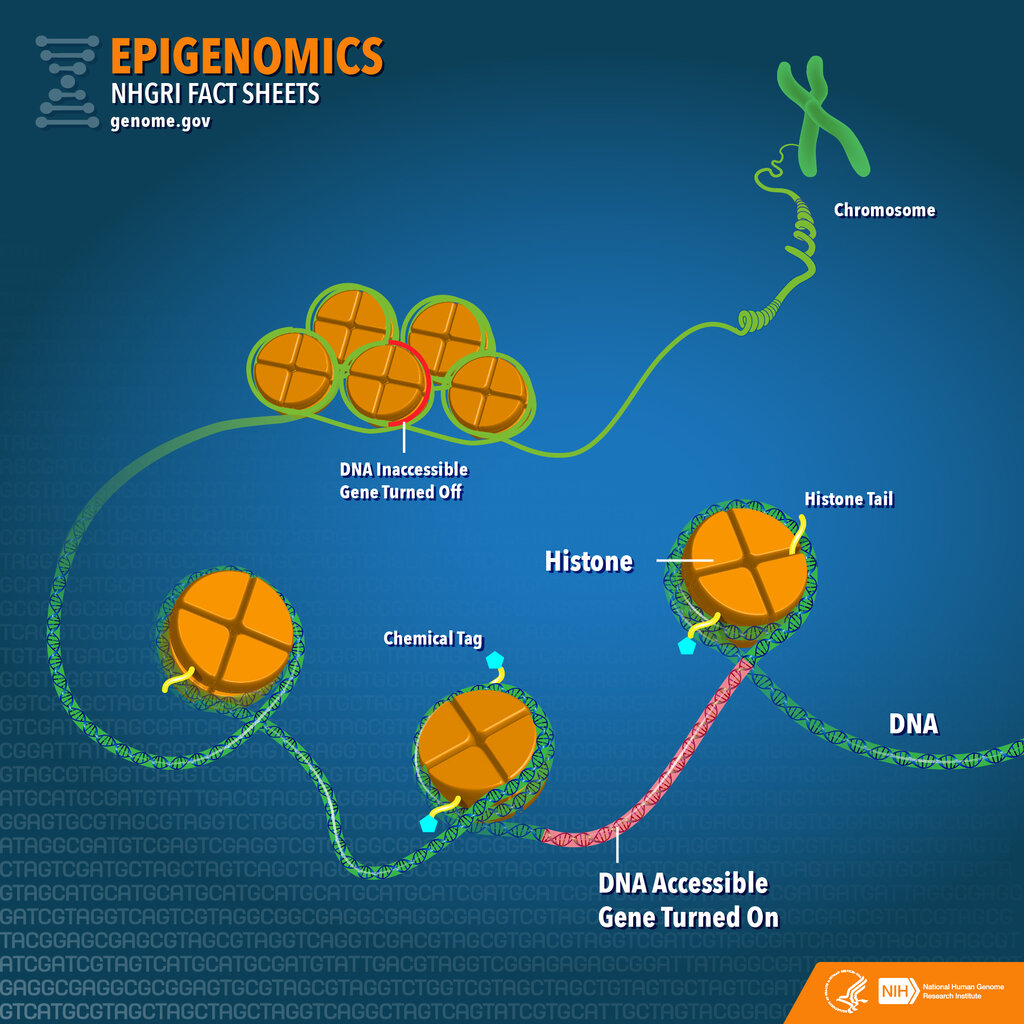
This process isn't just for building different types of cells. It's happening constantly, responding to the world around you. This is a crucial idea: your genes are not just a static set of commands. They are dynamic and responsive.
The Environmental Connection
The epigenetic notes in the margins aren't random. They are often written by your environment and lifestyle. Things like your diet, stress levels, exercise habits, and exposure to pollutants can all leave marks on your genes. These marks can influence which genes are turned on or off, subtly changing how your body functions over time.
Your DNA sequence is the hardware. Your epigenome is the software, telling the hardware how to run. And your environment helps write that software.
This interaction between environment and genes explains a lot. It helps us understand why one identical twin might develop a disease while the other remains healthy. Their DNA is the same, but their different life experiences have written different notes on their genes.
Understanding this dynamic relationship between our genes and our world is the key to epigenetics. It opens up a new way of thinking about health and disease, where our choices can have a direct conversation with our DNA.
Let's check your understanding of these foundational ideas.
What is the primary focus of epigenetics?
Using the 'house blueprint' analogy, what does the DNA sequence itself represent?
This is just the beginning. By grasping that our genes are responsive, not just prescriptive, we can start to explore the specific ways our environment shapes who we are.