Entropy Explained
Introduction to Thermodynamics
The Rules of Energy
Thermodynamics is the study of energy, pure and simple. It looks at how energy moves and changes form, governing everything from a star's fusion to the steam in a coffee cup. To make sense of it all, we first need to define what we're looking at.
system
noun
The specific part of the universe that we are interested in studying.
A system could be anything: a car engine, a single cell, or the planet Earth. Everything outside of that system is called the surroundings. The system and the surroundings together make up the universe. For instance, if your system is a hot cup of tea, the cup itself, the air around it, and the table it rests on are all part of the surroundings.
Describing a System's State
How do we describe a system? We use its properties. For a gas in a container, we might measure its pressure (), volume (), and temperature (). These measurable properties are called state variables because they tell us the state of the system.
Some of these properties are special. They are called state functions. A state function is a property that depends only on the current state of the system, not on the path taken to get there. Think of climbing a mountain. Your final altitude is a state function. It doesn't matter if you took a long, winding path or a steep, direct one. Your altitude is your altitude, determined solely by your final position. Your distance traveled, however, is not a state function; it depends entirely on the path you took.
In thermodynamics, temperature, pressure, and volume are all state functions. The final state is all that matters, not the journey.
When the state variables of a system, like temperature and pressure, stop changing, we say the system is in equilibrium. A cup of coffee left on a desk will eventually cool down to match the room's temperature. Once it does, its temperature is stable. It has reached thermal equilibrium with its surroundings.
The Laws of Thermodynamics
Now for the rules. Thermodynamics is built on a few fundamental laws that have never been shown to be violated.
First lsw of thermodynamics is a restatement of the principle of consertion of energy.
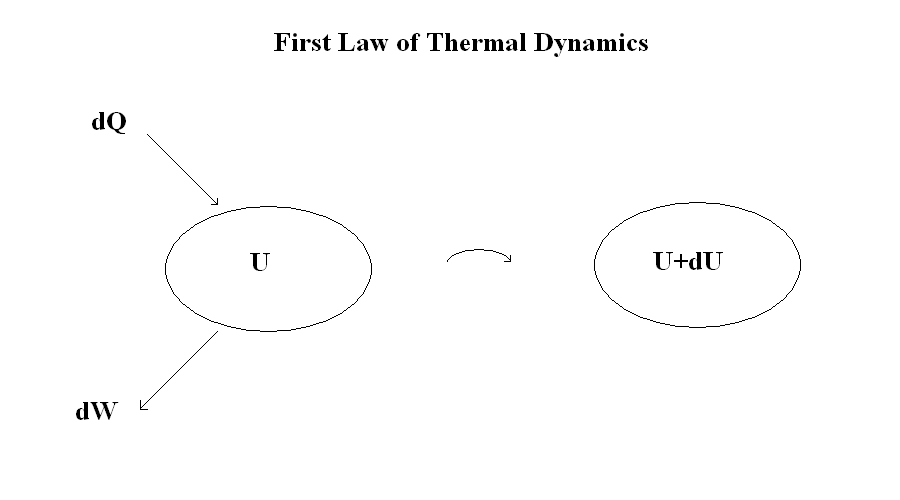
The First Law of Thermodynamics is the law of energy conservation. It states that energy cannot be created or destroyed, only converted from one form to another. The total energy of the universe is constant.
We can write this law as an equation that tracks the change in a system's internal energy (). A system's internal energy can be changed in two ways: by adding or removing heat () or by doing work ().
Here's what that means:
- is the change in the system's internal energy.
- is the heat added to the system.
- is the work done by the system on its surroundings (like a piston being pushed out).
If you add heat to a gas ( is positive), its internal energy increases. If the gas expands and does work ( is positive), its internal energy decreases because it spent some energy to do that work.
The First Law accounts for the quantity of energy, but it doesn't say anything about the direction of a process. A broken egg will never spontaneously reassemble, even though doing so wouldn't violate energy conservation. For that, we need the Second Law.
The explanation, as we now know, is provided by the second law of thermodynamics.
The Second Law of Thermodynamics tells us about the natural direction of processes. Heat always flows spontaneously from a hotter object to a colder one, never the other way around. A messy room never spontaneously cleans itself. These processes are irreversible.
The Second Law introduces a crucial concept: entropy. While we'll dive deep into entropy later, for now, you can think of it as a measure of disorder or randomness. The Second Law states that the total entropy of the universe always tends to increase. Every spontaneous process makes the universe, as a whole, a more disordered place.
Now that we have the fundamentals down, let's review them before moving on.
Time to check your understanding.
In thermodynamics, what best defines a 'system'?
Imagine you hike to the top of a mountain. Which of the following is an example of a state function?
These concepts—systems, states, and the laws of energy—form the bedrock of thermodynamics. They provide the framework for understanding why energy behaves the way it does throughout the universe.