Enterprise RAG Implementation
Introduction to RAG
Giving Models an Open Book
Large language models (LLMs) are powerful, but they have a fundamental limitation: they only know what they were taught during their training. Their knowledge is vast but static, like a brilliant student who has memorized an entire library but can't access any new books published after graduation. This can lead to outdated or incorrect answers.
Retrieval-Augmented Generation, or RAG, is a technique that gives these models an open book to read from. It connects an LLM to an external, up-to-date knowledge source. Before the model generates a response, it first retrieves relevant, current information from this source. This allows the model to provide answers that are not only fluent and coherent but also grounded in specific, timely, and accurate data.
Retrieval-Augmented Generation (RAG) is an AI framework that connects a language model to an external knowledge repository, allowing the model to fetch and include relevant information when generating an answer.
Think of it like an expert who, instead of answering a complex question purely from memory, quickly consults the latest industry reports and internal documents to give you the most reliable and current response possible.
The Limits of Memory
Without a system like RAG, even the most advanced LLMs face several key challenges, especially when used in a business context.
First, there's the knowledge cutoff. An LLM trained on data up to 2023 has no information about events, discoveries, or data from 2024. It's frozen in time.
Second, LLMs can hallucinate, meaning they can generate plausible-sounding but completely false information. They fill in gaps in their knowledge by making things up, which can be a major problem for applications requiring factual accuracy.
Finally, they lack domain-specific knowledge. A general LLM doesn't know your company's internal HR policies, the technical specifications of your latest product, or the confidential data from your research department. Feeding this private information into a public model for retraining is often impractical and raises serious security concerns.
RAG helps solve these problems by providing the model with a secure, targeted, and up-to-date source of information to draw from for each specific query.
How RAG Works
The RAG process is a straightforward, two-step dance: retrieval, then generation.
-
Retrieval: When you ask a question, the system doesn't immediately go to the LLM. First, it searches a designated knowledge base—this could be a collection of company documents, a database of support tickets, or a set of legal files. It finds and pulls out snippets of information that are most relevant to your query.
-
Generation: The retrieved information is then packaged up with your original question and sent to the LLM. The model is instructed to use this provided context to formulate its answer. This grounds the response in the supplied facts, dramatically improving its accuracy and relevance.
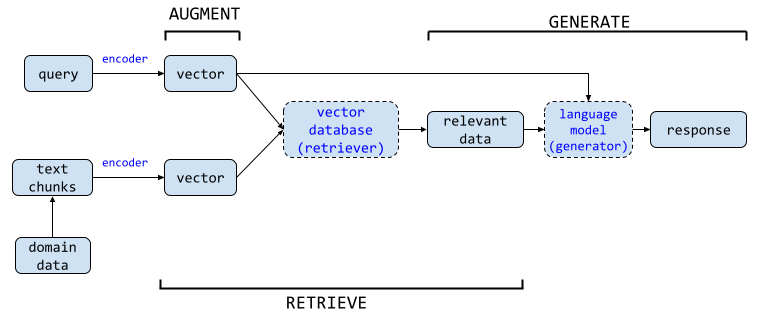
This simple but powerful architecture means you can build applications that are both intelligent and trustworthy, leveraging the conversational power of an LLM while ensuring the factual basis comes from your own curated data sources.
RAG in the Real World
The ability to ground LLM responses in specific data makes RAG incredibly useful for businesses. Companies are implementing it across various departments to build smarter, more reliable tools.
In customer support, RAG powers chatbots that can answer specific questions about a user's account history or troubleshoot problems using the latest product manuals. This is far more effective than a generic bot that can only answer pre-programmed questions.
A financial services firm might use RAG to create a tool for its advisors. The tool could quickly analyze the latest market reports and internal research to answer complex questions about investment strategies, ensuring the advice is timely and based on proprietary data.
In the healthcare sector, a RAG system could help clinicians by quickly searching through vast libraries of medical research and patient records to provide relevant information for diagnoses or treatment plans, all while maintaining patient privacy.
| Industry | Use Case Example |
|---|---|
| E-commerce | Personalized product recommendations based on real-time inventory. |
| Legal | Quickly finding precedents in case law databases. |
| Human Resources | Answering employee questions based on internal policy documents. |
| Manufacturing | Providing technicians with specific repair instructions from manuals. |
These examples show how RAG transforms LLMs from general-purpose conversationalists into specialized experts, capable of performing valuable, knowledge-intensive tasks.
What is the primary function of the "Retrieval" step in the Retrieval-Augmented Generation (RAG) process?
Which of the following problems, inherent to standalone LLMs, is RAG specifically designed to solve?
RAG is a foundational technique for building practical and powerful AI applications. By connecting language models to live data, it overcomes their inherent limitations and unlocks their potential for enterprise use.