Enterprise AI Systems Engineering
Multi-Tenant Isolation
Beyond Metadata Filtering
For any production multi-tenant RAG system, simple metadata filtering is insufficient. True isolation requires architectural decisions that enforce tenant boundaries at the infrastructure, data, and even cryptographic levels. The challenge is not merely preventing one tenant from seeing another's data, but ensuring that retrieval processes are not compromised by cross-tenant data, a phenomenon known as semantic leakages. This involves a trade-off between isolation strictness, performance, and operational cost.
Architectural Patterns for Isolation
The foundational choice in multi-tenant design is how you segregate data. There are three primary models, each with distinct implications for cost, complexity, and security.
| Pattern | Isolation Level | Cost-Effectiveness | Operational Complexity | Performance at Scale |
|---|---|---|---|---|
| Database-per-Tenant | Strongest (Physical) | Low | High | High (no cross-tenant noise) |
| Schema-per-Tenant | Strong (Logical) | Medium | Medium | High (isolated tables/indexes) |
| Shared Schema, Shared Table | Weakest (Application-Level) | High | Low | Low (contention, filtering overhead) |
The database-per-tenant model offers the most robust isolation, effectively air-gapping tenant data. However, it incurs significant operational overhead and cost, making it impractical for systems with high tenant churn or a large number of smaller tenants. The schema-per-tenant approach, often used in PostgreSQL, provides a strong logical boundary. Each tenant gets their own set of tables within a shared database, which simplifies management while keeping indexes and data physically separate.
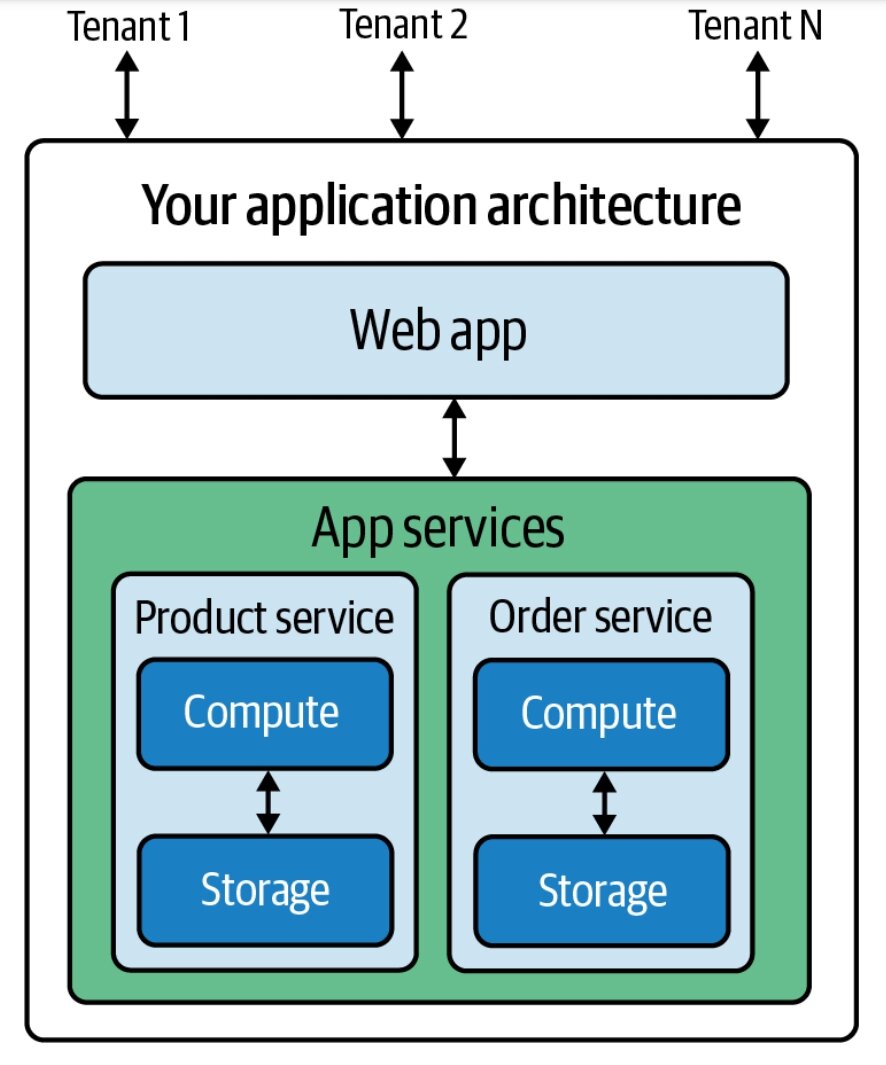
The most common pattern, due to its cost-efficiency and simplicity, is the shared schema. All tenants reside in the same table(s), distinguished by a tenant_id column. This is where the real engineering challenges begin, as isolation must be enforced programmatically.
Enforcing Boundaries at the Row Level
In a shared schema model, relying on the application to add a WHERE tenant_id = ? clause to every query is fragile. A single developer mistake can lead to a catastrophic data breach. A more robust solution is to enforce this logic directly within the database using Row-Level Security (RLS). RLS policies are rules attached to a table that automatically append security conditions to queries, making it impossible to access data belonging to another tenant, even if the application code fails to specify it.
-- Enable Row-Level Security on the documents table
ALTER TABLE documents ENABLE ROW LEVEL SECURITY;

-- Create a policy that restricts access based on the current tenant_id
-- The tenant_id is set for the session by the application's orchestration layer.
CREATE POLICY tenant_isolation_policy
ON documents
FOR ALL
USING (tenant_id = current_setting('app.current_tenant_id'));

-- Before querying, the application must set the session variable:
-- SET app.current_tenant_id = 'tenant-123';
-- SELECT content, embedding FROM documents WHERE ...;
-- The RLS policy implicitly adds "AND tenant_id = 'tenant-123'" to the query.
While RLS provides a powerful security guarantee, it isn't a silver bullet. When applied to vector similarity searches in databases like Postgres with pgvector, the query planner might struggle to optimize. It may perform the similarity search across a wide set of vectors first and then filter by tenant_id, especially with high-cardinality tenant spaces. This is inefficient and can negate the performance benefits of an approximate nearest neighbor (ANN) index. For this reason, some vector-native databases like Milvus or Pinecone advocate for namespace-based or index-per-tenant partitioning to ensure searches are scoped to a tenant's data from the start.
Encryption and Performance
For ultimate security, especially in regulated industries, tenant data should be encrypted at rest using tenant-specific keys. This can be achieved by integrating the RAG orchestration layer with a Key Management Service (KMS) like AWS KMS or HashiCorp Vault. When a tenant's data is ingested, the application requests a unique Data Encryption Key (DEK) from the KMS, encrypted with the tenant's master key. The vector embedding is then encrypted with this DEK before being stored. The encrypted DEK is stored alongside the vector.
During retrieval, the application fetches the encrypted DEK, sends it to the KMS to be decrypted, and then uses the plaintext DEK to decrypt the embedding in memory just before the similarity search. This ensures that even a full database dump would not expose tenant data without access to the KMS and the correct permissions. This process adds latency, so it's a trade-off between security and raw retrieval speed.
This architecture moves from a model of "trusting the code" to "enforcing at the foundation."
Finally, the performance impact of high-cardinality tenant filtering is a primary concern. As the number of tenants grows into the thousands or millions, index-per-tenant becomes unmanageable. In shared-schema systems, database partitioning is critical. Partitioning the vector index and data tables on tenant_id can allow the query planner to perform "partition pruning," effectively ignoring partitions that don't match the current tenant and dramatically speeding up queries by limiting the search space from the outset.
Let's test your understanding of these advanced isolation techniques.
In the context of multi-tenant RAG systems, what is 'semantic leakage'?
You are building a SaaS application expected to host thousands of small tenants. Which data segregation model is generally the most cost-efficient and simplest to start with, despite its isolation challenges?
By combining architectural separation, row-level security policies, and tenant-specific encryption, you can build a multi-tenant RAG system that is secure, scalable, and resilient against data breaches.