Enterprise AI Demystified
Introduction to Enterprise AI
What is Enterprise AI?
Artificial intelligence isn't just about futuristic robots or smart assistants. When AI is put to work to solve specific business problems, it's called Enterprise AI. Think of it as the application of AI technologies to improve performance, automate tasks, and create new opportunities within a company.
The scope of Enterprise AI is broad. It's not a single product you buy off the shelf. Instead, it's about integrating AI capabilities deep into a company's core operations. This could mean anything from optimizing a supply chain and managing customer relationships to detecting financial fraud. The goal is to make the entire organization smarter, faster, and more efficient.
Enterprise AI acts like a central nervous system for a business, processing vast amounts of information to help different parts of the company make better, more coordinated decisions.
Why AI Matters for Business
In today's competitive landscape, businesses are drowning in data. Enterprise AI provides the tools to turn that data into a strategic advantage. It helps in three key areas: enhancing decision-making, automating processes, and driving innovation.
For decision-making, AI algorithms can analyze complex datasets to uncover patterns and insights that a human might miss. A retail company, for example, can use AI to forecast demand for certain products, ensuring they have the right stock in the right stores at the right time. This prevents lost sales from stockouts and reduces costs from overstocking.
Automation is another huge benefit. Many business processes involve repetitive, rule-based tasks that are perfect for AI. By automating things like invoice processing or initial customer service queries, employees are freed up to focus on more creative, strategic work that requires a human touch.
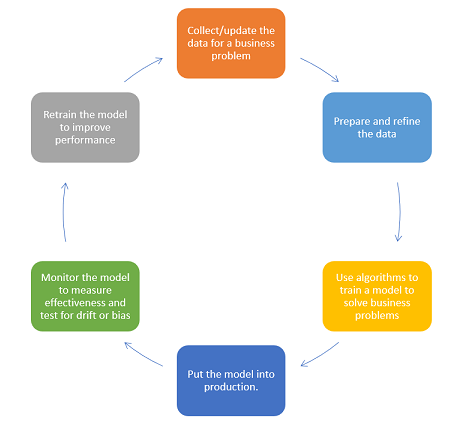
Finally, AI is a powerful engine for innovation. It can help companies develop new products and services, like personalized recommendation engines on e-commerce sites or predictive maintenance alerts for industrial machinery. By leveraging AI, businesses aren't just improving what they already do; they're creating entirely new ways to deliver value to their customers.
The Building Blocks of Enterprise AI
While the field of AI is vast, a few key technologies form the foundation of most enterprise applications. You don't need to be an expert in the underlying algorithms, but it's helpful to understand the basic capabilities.
| Technology | What It Does | Enterprise Example |
|---|---|---|
| Machine Learning (ML) | Learns patterns from data to make predictions. | Predicting which customers are likely to churn. |
| Natural Language Processing (NLP) | Understands and generates human language. | Powering customer service chatbots. |
| Computer Vision | Interprets and understands information from images and videos. | Automating quality control on a factory assembly line. |
These technologies are rarely used in isolation. An advanced Enterprise AI solution might use computer vision to analyze satellite imagery of farmland, machine learning to predict crop yields, and NLP to generate a report for the farm's managers. The power lies in combining these tools to solve complex, real-world business challenges.
The Next Wave: AI Agents
One of the most exciting trends in Enterprise AI is the rise of AI agents. An AI agent is an autonomous system that can perceive its environment and take actions to achieve specific goals. Think of it as a smart assistant that can do more than just answer questions; it can perform multi-step tasks.
In an enterprise setting, an AI agent could be tasked with managing an employee's travel arrangements. It would be able to check calendars for available dates, search for flights and hotels that match company policy, book the reservations, and add the itinerary to the employee's calendar, all without direct human intervention at each step.
This conversation explores how specialized AI agents can collaborate to solve complex enterprise challenges, moving beyond simple information retrieval to real business impact through coordinated action and automation.
These agents can interact with different software systems, use tools, and even collaborate with other agents to accomplish complex workflows. Their growing sophistication is paving the way for a new level of automation and efficiency in business.
Now, let's test your understanding of these core concepts.
What is the primary definition of Enterprise AI?
A company automates the process of reading customer support emails, identifying the core issue, and routing them to the correct department. This is a primary example of Enterprise AI being used to:
By integrating AI into their operations, companies are not just adopting new technology; they are fundamentally rethinking how business gets done.