Enterprise Accounting Fundamentals
Accounting Fundamentals
The Core Equation
At the heart of all accounting is a single, powerful idea: the accounting equation. It’s the bedrock that ensures a company's financial records are always in balance. Everything a company owns must equal the claims against those things.
Let's break that down.
Assets are what a company owns. This includes cash, inventory, equipment, buildings, and even money that customers owe the company (called accounts receivable).
Liabilities are what a company owes to others. This covers loans from a bank, bills from suppliers (accounts payable), and employee salaries that haven't been paid yet.
Equity is what’s left over for the owners. It represents the owners' stake in the company. If a company sold all its assets and paid off all its liabilities, the remaining amount would be its equity.
Think of it this way: what you have (assets) is funded by either what you owe (liabilities) or what you've put in yourself (equity).
Keeping the Balance
The accounting equation must always stay in balance. To maintain this balance, accountants use a system called double-entry bookkeeping. This means every single financial transaction affects at least two accounts. One account gets a debit, and another gets a credit.
In the world of accounting, debit simply means 'left side' and credit means 'right side' of an account. They don't mean 'good' or 'bad'.
Let's see it in action. Imagine you start a small business by investing $10,000 of your own money. The business's cash (an asset) increases by $10,000, and your equity in the business also increases by $10,000.
Here's how the equation looks:
- Assets (Cash: +$10,000) = Liabilities ($0) + Equity (+$10,000)
Now, let's say the business takes out a $5,000 loan from a bank. Cash (an asset) goes up by $5,000, and Loans Payable (a liability) also goes up by $5,000.
- Assets (Cash: +$5,000) = Liabilities (Loan: +$5,000) + Equity ($0)
After both transactions, the business has $15,000 in cash, a $5,000 loan, and $10,000 in owner's equity. The equation is still perfectly balanced.
This double-entry system provides a self-checking mechanism. If the total debits don't equal the total credits for a transaction, you know there's a mistake somewhere.
The accounting equation (and the balance sheet) should always be in balance.
The Three Key Reports
All of these transactions are eventually summarized into three main financial statements. These reports tell the story of a company's financial health from different angles.
The Balance Sheet
The Balance Sheet is a snapshot of a company's financial position at a specific point in time. It's a direct representation of the accounting equation, listing out all of the company's assets, liabilities, and equity on a particular day (like December 31st).
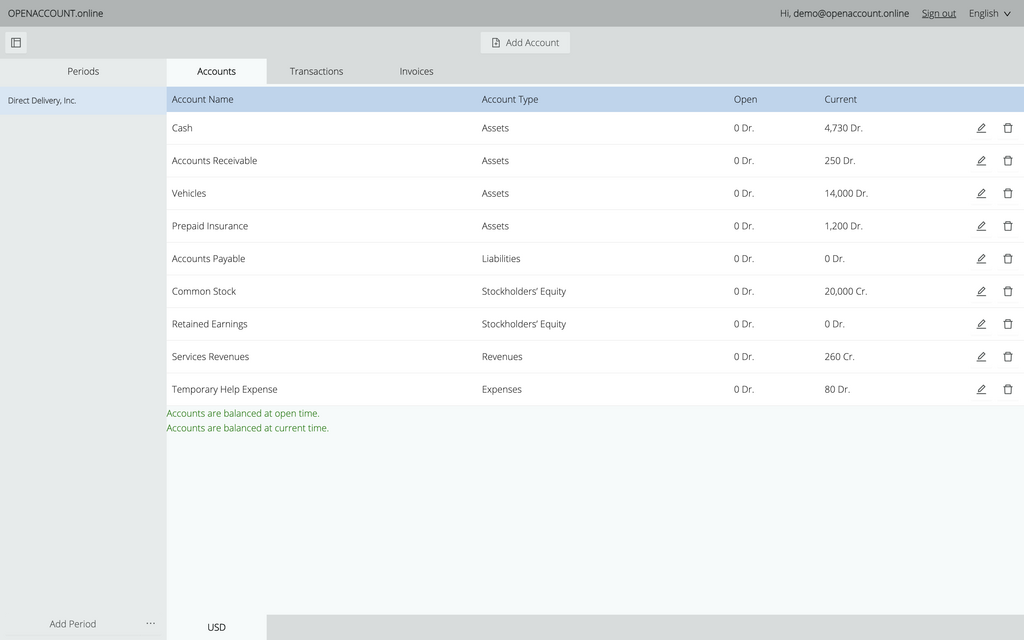
It gets its name because the two sides must balance: the total assets must equal the total liabilities plus equity. This statement helps stakeholders understand what the company owns and owes.
The Income Statement
While the balance sheet is a snapshot, the Income Statement is more like a video. It shows a company's financial performance over a period of time, such as a month, a quarter, or a year. It's also known as the Profit and Loss (P&L) statement.
It follows a simple formula:
Revenues are the money the company earns from selling its goods or services. Expenses are the costs incurred to generate that revenue, like employee salaries, rent, and marketing costs.
The final number, Net Income (or net loss), shows whether the company was profitable during that period. This "bottom line" is one of the most-watched figures in business.

The Cash Flow Statement
A company can be profitable on its income statement but still run out of cash. The Cash Flow Statement explains why. It tracks the movement of cash into and out of the company over a period.
This statement breaks down cash activities into three categories:
- Operating Activities: Cash generated from the main business operations, like sales and paying expenses.
- Investing Activities: Cash used for buying or selling long-term assets, such as equipment or property.
- Financing Activities: Cash from investors or banks, or cash paid out to them (like loan payments or dividends).
This report is crucial for understanding a company's ability to pay its bills and fund its operations.
Now that you've got the basics, let's test your understanding.
What is the fundamental accounting equation?
Which financial statement provides a snapshot of a company's assets, liabilities, and equity at a specific point in time?
These three statements, built on the foundation of the accounting equation and double-entry bookkeeping, provide a comprehensive picture of a company's financial story.