Enoch's Symbolic Journey of Consciousness
Historical Context
An Ancient Text's Journey
The Book of Enoch is not a single work but a collection of several texts written over centuries. It's an ancient Jewish apocalyptic writing attributed to Enoch, the great-grandfather of Noah from the Book of Genesis. While tradition names Enoch as the author, scholars believe it was written by various anonymous authors between 300 BCE and 100 BCE. This practice of writing under a respected historical figure's name is known as pseudepigraphy.
Fragments of the book's oldest sections were discovered among the Dead Sea Scrolls, written in Aramaic. However, these were only pieces of a larger puzzle. For centuries, the complete text was thought to be lost to the wider world.
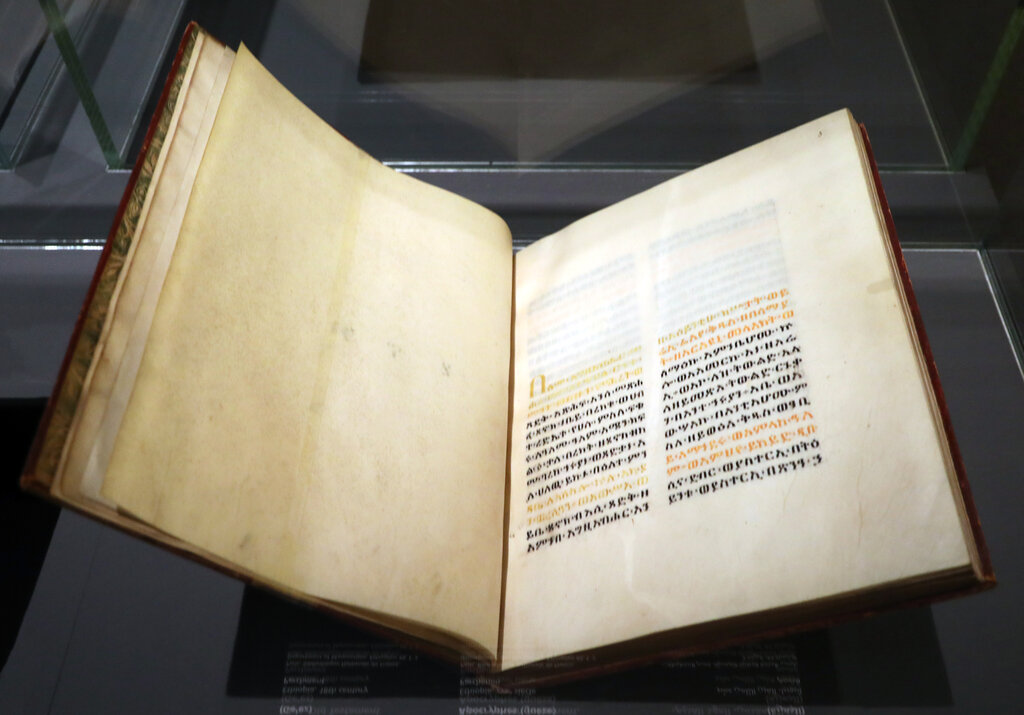
Preserved in Ethiopia
The entire, complete version of 1 Enoch survived only in Ge'ez, the classical liturgical language of Ethiopia. It was preserved within the biblical canon of the Ethiopian Orthodox Tewahedo Church and the Eritrean Orthodox Tewahedo Church.
How did it survive here when it was lost elsewhere? Christianity took root in Ethiopia very early, in the 4th century CE. The Kingdom of Aksum became one of the first empires to adopt the faith. Due to its geographic location and unique history, the Ethiopian church developed its own distinct traditions, somewhat isolated from the theological debates of the Roman and Byzantine worlds. This isolation helped preserve a collection of sacred texts, including the Book of Enoch, which fell out of favor and were eventually excluded from the canon in most other Christian traditions.
Content and Themes
While not considered scripture by most Jewish and Christian denominations today, the Book of Enoch is a foundational text for the Ethiopian and Eritrean Orthodox faithful. It offers an expanded narrative on events mentioned only briefly in Genesis.
The book provides detailed accounts of the origins of demons and giants, the reasons for the Great Flood, and the nature of fallen angels known as the Watchers.
It explores complex themes of divine justice, cosmology, and the final judgment. The book is structured into five distinct sections, each with its own focus.
| Section | Common Name |
|---|---|
| 1-36 | The Book of the Watchers |
| 37-71 | The Book of Parables |
| 72-82 | The Astronomical Book |
| 83-90 | The Book of Dream Visions |
| 91-108 | The Epistle of Enoch |
The practice of writing a text under the name of a respected historical figure, as is the case with the Book of Enoch, is known as:
While early fragments of the Book of Enoch were found in Aramaic, the complete, full version of the text survived only in which language?
Understanding this historical backdrop is the first step in approaching the text's deeper meanings.