English Vocabulary Expansion
Understanding Word Formation
The Building Blocks of Words
Many English words are like structures built from smaller pieces. If you can recognize the pieces, you can often figure out what the entire word means, even if you've never seen it before. The most important piece is the root.
root
noun
The core part of a word that contains its basic meaning. It can't be broken down further.
Think of the root as the foundation of a house. For example, the root port means "to carry." You can see it in words like transport (to carry across), import (to carry in), and portable (able to be carried).
Another common root is spect, which means "to look." This is the foundation for words like inspect (to look into), spectator (one who looks), and perspective (a way of looking at things).
Adding to the Beginning
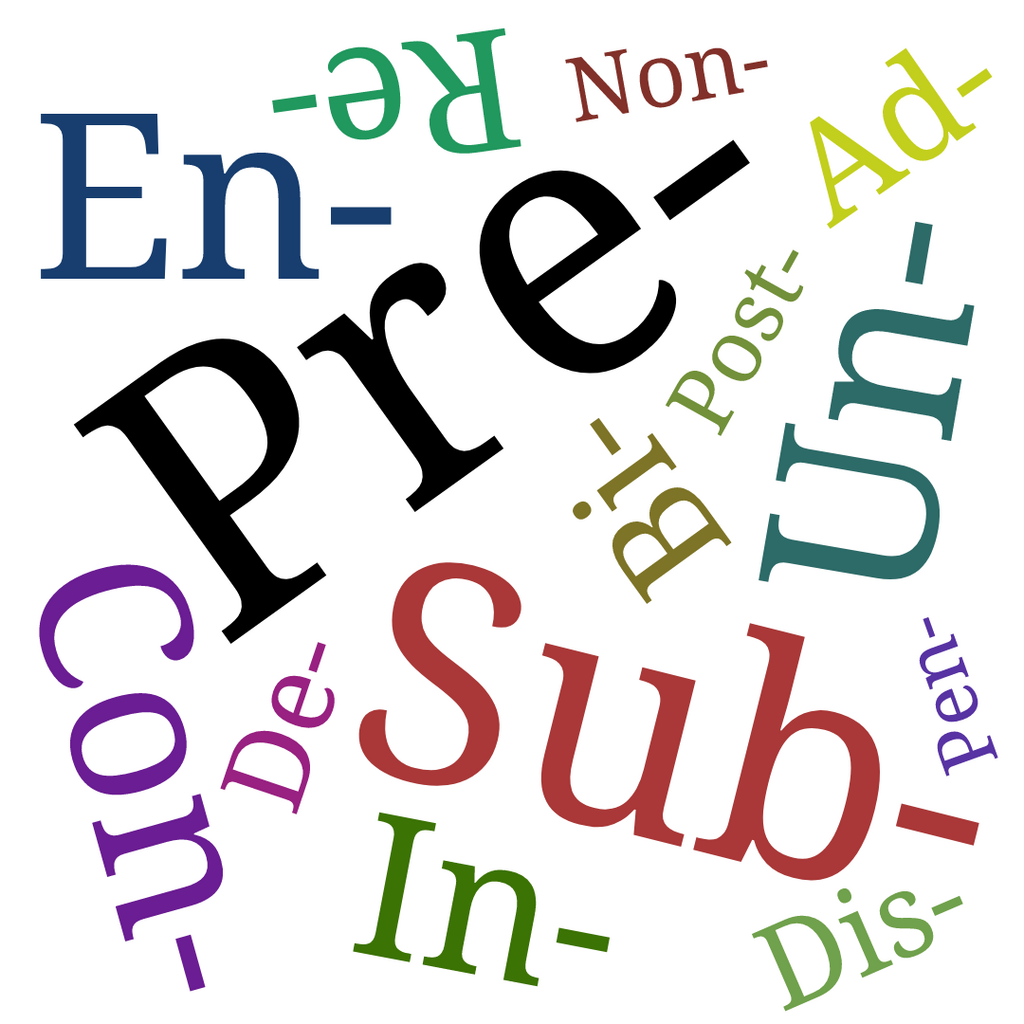
Once you have a root, you can add pieces to the beginning or end to change its meaning. A piece added to the beginning is called a prefix.
Understanding the roots, prefixes, and suffixes of words can help you decipher unfamiliar vocabulary and expand your word bank.
Prefixes modify the root's meaning. For instance, the prefix re- means "again." When you add it to the word view (to see), you get review, which means "to see again."
Here are some common prefixes and their meanings.
| Prefix | Meaning | Example |
|---|---|---|
| un- | not | unhappy (not happy) |
| re- | again | reread (read again) |
| pre- | before | preview (view before) |
| mis- | wrong | misspell (spell wrong) |
| dis- | opposite of | disagree (opposite of agree) |
Adding to the End
A word part added to the end of a root is called a suffix. Suffixes can also change a word's meaning, but they most often change its function, or part of speech. For example, a suffix can turn a verb into a noun or an adjective.
Adding the suffix -er to the verb teach creates the noun teacher (a person who teaches). Adding -ful to the noun beauty creates the adjective beautiful (full of beauty).
Let's look at a few common suffixes.
| Suffix | Meaning / Function | Example |
|---|---|---|
| -able | can be done | readable (can be read) |
| -ful | full of | hopeful (full of hope) |
| -less | without | hopeless (without hope) |
| -ness | state of being | happiness (state of being happy) |
| -ly | in a certain way | quickly (in a quick way) |
Putting It All Together
Now you can act like a detective when you see a long, unfamiliar word. By breaking it down into its parts—prefix, root, and suffix—you can make an educated guess about its meaning.
Let's try one: unremarkable.
- Prefix: un- means "not."
- Root: remark means "to notice or comment."
- Suffix: -able means "can be done."
So, unremarkable means something that cannot be remarked upon, or is not worthy of notice. It's ordinary.
This method isn't foolproof, as English has many exceptions, but it's a powerful tool for building your vocabulary. Before we practice, let's review the main ideas.
Ready to test your skills? Try the quiz below to see how well you can identify word parts.
In a word like "inspect," what is the function of the part "spect"?
A suffix is a word part added to the beginning of a root word.
By recognizing these small patterns, you unlock the meaning of thousands of words. Keep an eye out for them as you read.