English Grammar Mastery
Parts of Speech
The Building Blocks of Language
Think of sentences as structures built from different kinds of bricks. Each brick has a specific shape and purpose. In language, these bricks are words, and their purpose is defined by their "part of speech." Understanding these roles is the first step to building clear, strong sentences.
To start expanding your grammar knowledge, it’s helpful to begin with an understanding of the eight traditional parts of speech that make up our sentences: nouns, pronouns, verbs, adjectives, adverbs, prepositions, interjections, and conjunctions.
Words for Things and People
The most basic job a word can have is to name something. Nouns and pronouns handle this task.
Noun
noun
A word that represents a person, place, thing, or idea.
Nouns are everywhere. Your name is a noun. The device you're reading this on is a noun. Even concepts you can't touch, like love or justice, are nouns. They give us labels for everything we can think or talk about.
Examples:
- Person: Maria threw the ball.
- Place: I want to visit Paris.
- Thing: The computer is new.
- Idea: We value honesty.
Now, imagine talking without being able to use shortcuts. It would sound repetitive: "Maria threw the ball, and then Maria went home." Pronouns are the solution. They stand in for nouns to make our sentences flow better.
Pronoun
noun
A word used in place of a noun.
Common pronouns include I, you, he, she, it, we, and they. Using our previous example, we can say: "Maria threw the ball, and then she went home." It's much smoother.
Action and Being
Once we have our nouns, we need words to show what they're doing or what they are. This is the job of the verb.
Verb
verb
A word that expresses action or a state of being.
Verbs are the engines of sentences. They can show physical action (jump, write, listen) or mental action (believe, wonder, guess).
They can also link a noun to a description, showing a state of being. These are often forms of the verb "to be," like is, am, are, was, and were. They don't show action, but they are still verbs.
- Action: The dog chased the squirrel.
- State of Being: The dog is happy.
Words that Describe
Nouns and verbs give us a basic picture, but to make things interesting, we need descriptive words. Adjectives and adverbs add color and detail.
Adjective
noun
A word that modifies or describes a noun or pronoun.
Adjectives answer questions like "which one?" "what kind?" or "how many?" They give us more information about the nouns in our sentences.
- The tall building.
- A delicious meal.
- Several cars.
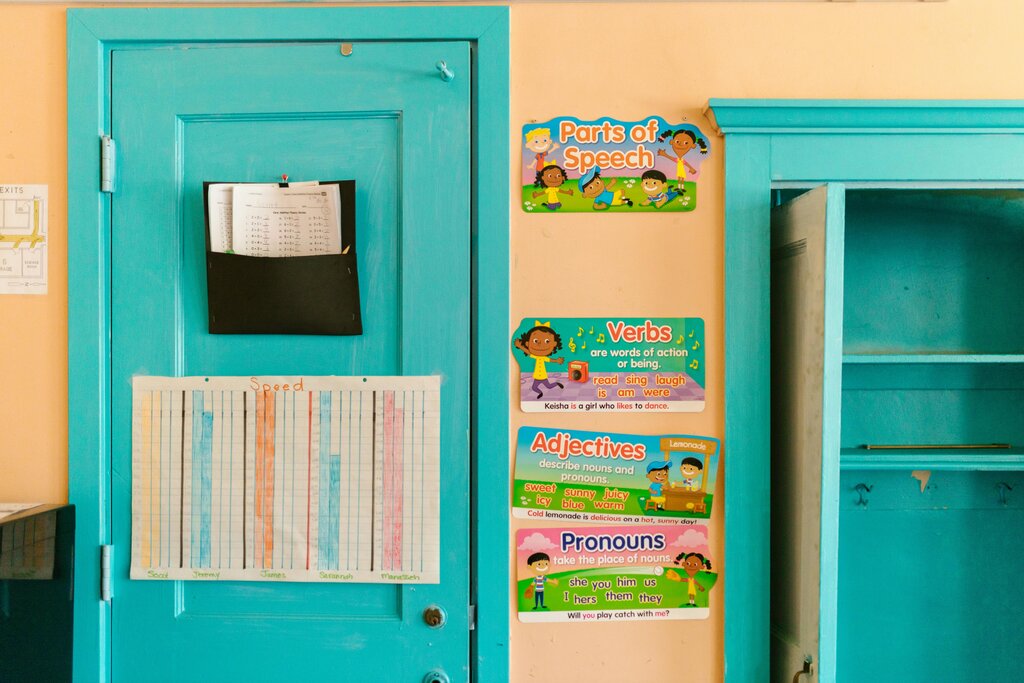
Adverbs do a similar job, but they usually describe verbs. They can also describe adjectives or even other adverbs.
Adverb
noun
A word that modifies a verb, an adjective, or another adverb.
Many adverbs end in "-ly," but not all of them do. They often answer questions like "how?" "when?" "where?" or "to what extent?"
- Modifying a verb: He spoke softly.
- Modifying an adjective: It was an extremely cold day.
- Modifying another adverb: She moved very slowly.
The Connectors
Some words work like glue, connecting other words and phrases to build more complex sentences. Prepositions and conjunctions are the primary connectors.
Preposition
noun
A word that shows the relationship between a noun (or pronoun) and another word in the sentence.
Think of a preposition as a word that shows location, time, or direction. It links a noun to the rest of the sentence to tell you where, when, or how.
- The cat is on the roof. (Location)
- We will meet after the movie. (Time)
- He walked toward the door. (Direction)
Conjunction
noun
A word that joins words, phrases, or clauses.
Conjunctions are crucial for linking ideas. The most common ones are for, and, nor, but, or, yet, so. They can join two simple words or two complete sentences.
- Joining words: I'd like a coffee and a donut.
- Joining sentences: She wanted to go, but she was too tired.
Emotional Bursts
Finally, some words don't connect to the sentence's grammar at all. They just pop in to show strong emotion.
Interjection
noun
A word or phrase that expresses a strong feeling or sudden emotion.
Interjections are often followed by an exclamation point. They are common in spoken language but less so in formal writing.
- Wow! That's amazing.
- Ouch! I stubbed my toe.
- Oh no, I forgot my keys.
Ready to test your knowledge? Let's see if you can identify the different parts of speech.
In the sentence, "The quick brown fox jumps over the lazy dog," which word is a noun?
Which word in the sentence "She sang a beautifully sad song" is an adverb?
Every word in a sentence has a role. By understanding these eight basic parts of speech, you've learned the fundamental grammar that governs all of English.