English for Product Designers
Design Terminology
Speaking the Language of Design
When designers, developers, and project managers collaborate, they need a shared language. Using precise, common terminology isn't just about sounding professional—it's about ensuring everyone is on the same page. Clear communication prevents misunderstandings, speeds up the design process, and leads to better products.
Design communication is the process of conveying ideas and information through visual, verbal, and written means to ensure that stakeholders understand design concepts and objectives.
Without this shared vocabulary, feedback becomes vague and goals become fuzzy. Let's break down some of the essential terms you'll encounter every day.
Core Concepts
Certain terms form the foundation of product design conversations. While some might seem similar, their distinctions are critical.
User Experience (UX)
noun
The overall experience a person has when using a product, especially in terms of how easy or pleasing it is to use. It encompasses all aspects of the end-user's interaction with the company, its services, and its products.
UX is the big picture: the user's entire journey and feelings.
User Interface (UI)
noun
The visual elements of a product that a user interacts with, such as buttons, icons, spacing, typography, and color schemes. UI is a key part of the overall user experience.
If UX is the journey, UI is the specific set of controls and visuals you use along the way. Next, let's look at the tools we use to visualize these concepts.
Wireframe
noun
A basic visual guide used to suggest the structure of a website or app. It's a low-fidelity representation that focuses on layout, content placement, and functionality, not on graphic design.
Wireframes are like the blueprint of a house. They show where the rooms are but not the color of the paint or the type of furniture.
Prototype
noun
An early, interactive model of a product used for testing. Prototypes can range from simple paper mockups to high-fidelity digital models that closely resemble the final product.
A prototype lets you simulate the user experience, allowing for user testing and validation before any code is written.
The Design Process
Design isn't a single event but a structured process. This process has its own vocabulary that describes how ideas move from concept to reality.
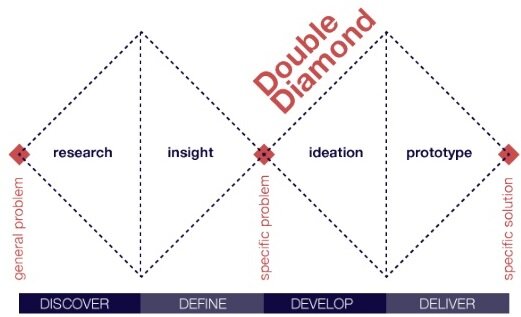
Understanding these terms helps you map your work and communicate progress to your team.
Ideation
noun
The creative process of generating, developing, and communicating new ideas. In design, this often involves brainstorming sessions, sketching, and other techniques to produce a broad set of possible solutions.
This is the
Iteration
noun
The repetitive process of refining a design. It involves creating a version of the design, testing it, getting feedback, and then making improvements in a new version or 'iteration.'
Iteration is fundamental to good design. It's how you move from a rough idea to a polished, user-friendly product. Once a design is ready, the final step is the handoff.
Handoff
noun
The process of transferring a completed design from the design team to the development team for implementation. This typically includes design files, specifications, assets, and style guides.
A clear, well-documented handoff is crucial for ensuring the final product matches the design intent. Precise language is key to making every stage of this process successful.
When everyone on a team uses the same terms, it eliminates ambiguity. 'Make it pop' is not useful feedback. 'Increase the color contrast on the primary call-to-action button' is.
Mastering this vocabulary is the first step toward clear, effective communication in your design career. It helps build trust with your team and empowers you to articulate your design decisions with confidence.
Ready to test your knowledge?
A user finds an app easy to navigate and accomplishes their goal quickly, but thinks the buttons and color scheme are ugly. Which part of the experience is successful, and which part is failing?
What is the primary purpose of a wireframe?