English for Beginners
Parts of Speech
The Building Blocks of Language
Sentences are made of words, but these words aren't all the same. They belong to different categories, called parts of speech, based on the job they do. Understanding these categories is the first step to building clear, effective sentences.
To start expanding your grammar knowledge, it’s helpful to begin with an understanding of the eight traditional parts of speech that make up our sentences: nouns, pronouns, verbs, adjectives, adverbs, prepositions, interjections, and conjunctions.
Naming Words
Some words are for naming. These are the foundation of what we talk about.
Noun
noun
A word that names a person, place, thing, or idea.
Nouns are everywhere. Your name is a noun. The device you're reading this on is a noun. Concepts like love, justice, and curiosity are also nouns. They give us labels for everything we can see, touch, or think about.
Examples: Maria, city, table, freedom
But constantly repeating nouns can sound clumsy. "Maria went to the store because Maria needed milk." To avoid this, we use stand-ins.
Pronoun
noun
A word used in place of a noun.
Pronouns make our language flow more smoothly. Common pronouns include I, you, he, she, it, we, and they. They act as shortcuts, referring back to a noun that has already been mentioned.
Action and Description
Once we have our nouns, we need words to describe what they are doing and what they are like. This is where verbs and adjectives come in.
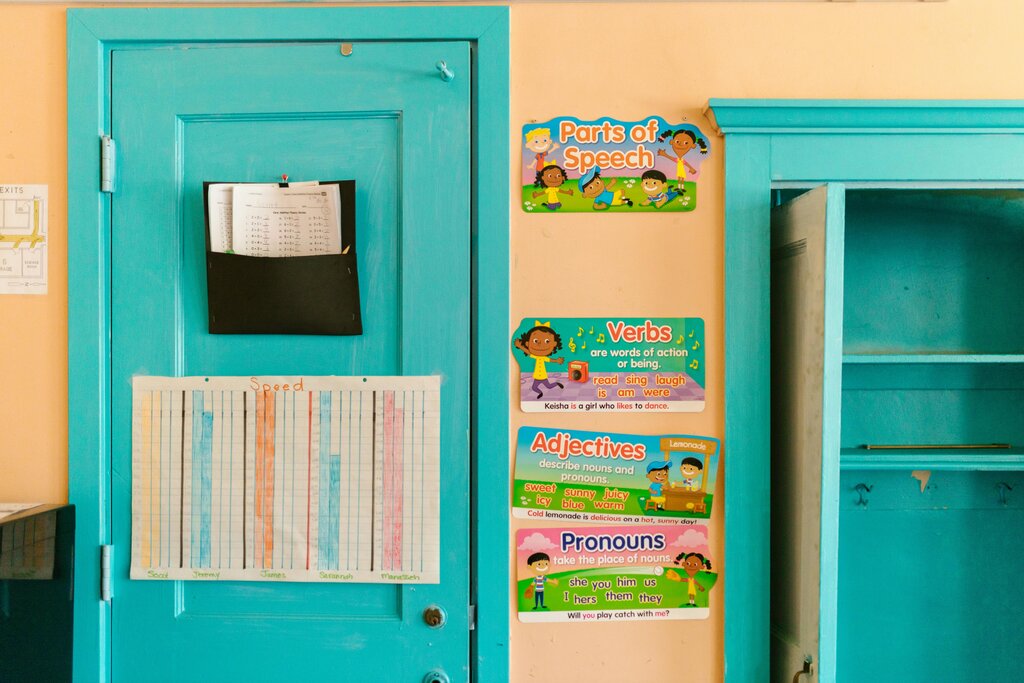
Verb
verb
A word that expresses an action or a state of being.
Every complete sentence must have a verb. Action verbs show something happening, like run, think, or decide. Linking verbs, like forms of "to be" (am, is, are), connect the subject of the sentence to more information about it.
Adjective
noun
A word that describes or modifies a noun or pronoun.
Adjectives add detail and color to our language. They answer questions like: Which one? What kind? How many? Words like happy, tall, three, and enormous are all adjectives.
Just as adjectives modify nouns, another part of speech modifies verbs, adjectives, or even other adverbs.
Adverb
noun
A word that describes or modifies a verb, an adjective, or another adverb.
Adverbs often end in "-ly," but not always. They answer questions like: How? When? Where? To what extent? Examples include quickly, yesterday, outside, and completely.
Connecting Words
The final pieces of the puzzle are words that connect everything, showing relationships between ideas and adding emotional context.
Preposition
noun
A word that shows the relationship between a noun or pronoun and another word in the sentence.
Prepositions often indicate location (in, at, under), time (before, after, during), or direction (to, from, across). They link a noun (like table) to the rest of the sentence.
Conjunction
noun
A word that joins words, phrases, or clauses.
Think of conjunctions as the glue of a sentence. The most common ones are for, and, nor, but, or, yet, and so. They allow us to create more complex and interesting sentences by connecting thoughts.
Interjection
interjection
A word or phrase that expresses strong emotion.
Interjections are short bursts of feeling. They often stand alone, followed by an exclamation point or a comma. Words like ouch!, hey, and oops are all interjections.
Time to review these building blocks.
Ready to test your knowledge?
In the sentence, "The curiosity of the cat led it into trouble," what part of speech is the word curiosity?
What is the primary function of a pronoun?
Recognizing these eight parts of speech is the key to understanding how sentences work. With this foundation, you can start building any idea you want.