England 1200-1600 A Nation Transforms
Medieval England Overview
A Land of Lords and Vassals
In medieval England, your place in the world was fixed from birth. Society was built on a system of loyalties and land known as feudalism. At the very top was the king, who technically owned all the land. He granted large estates, called fiefs, to powerful nobles and bishops in exchange for their military service and loyalty.
These nobles, in turn, granted smaller parcels of land to lesser lords or knights. These knights pledged to fight for their lord when called upon. This chain of obligation went all the way down to the peasants, or serfs, who worked the land. They weren't slaves, but they were tied to the land and couldn't leave without the lord's permission. In exchange for a place to live and protection, they gave the lord a share of their crops and worked on his personal fields.
This structure kept society stable, but it also meant there was very little social mobility. Most people lived and died in the same class they were born into. The entire system rested on the agricultural work of the peasantry, organized through what was known as the manorial system. Each manor, controlled by a lord, was a self-sufficient community with its own fields, village, church, and mill.
The Crown and the Cross
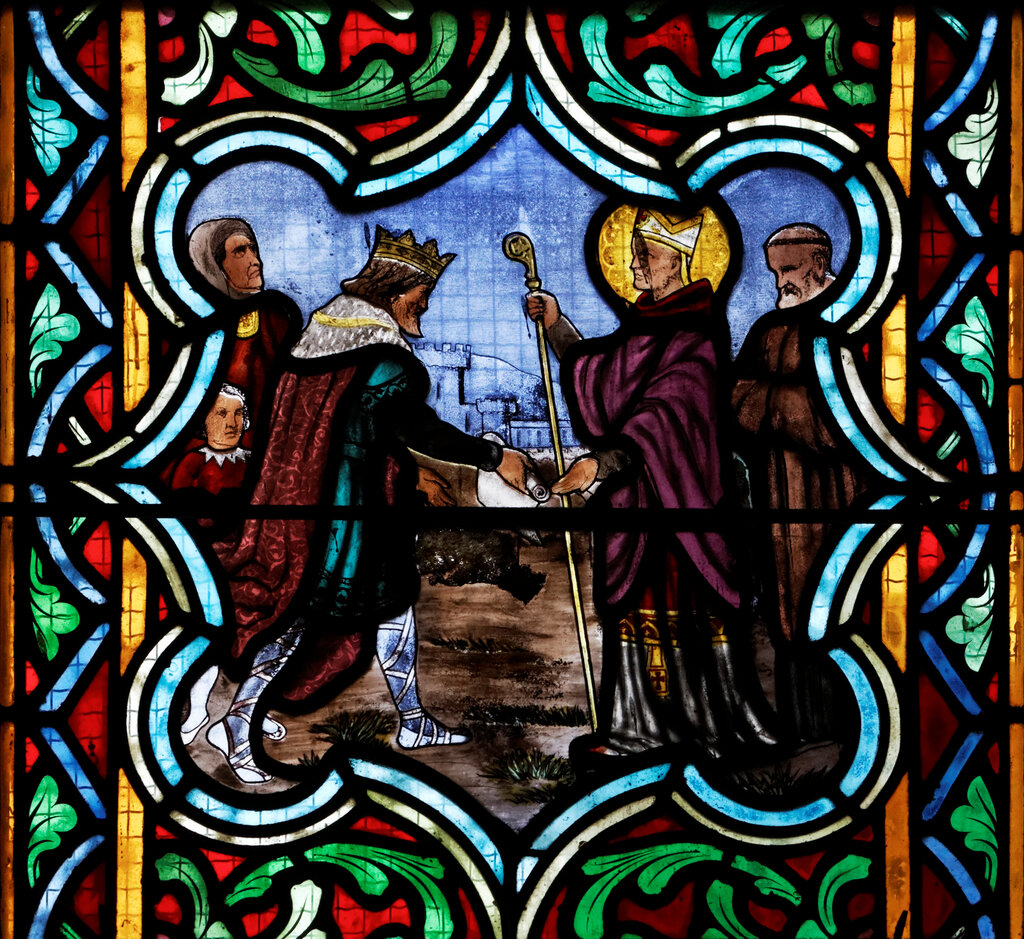
Two powers dominated medieval England: the monarchy and the Church. The king was the supreme ruler, responsible for defending the realm, administering justice, and managing the kingdom's finances. However, a king's power was not absolute. He relied on the support of his powerful nobles, and conflicts between the crown and the aristocracy were common. The Magna Carta of 1215, though signed just before our period, established the principle that everyone, including the king, was subject to the law.
The Catholic Church was the other great power. Its influence was everywhere. The local priest was a central figure in every village, and the church calendar dictated the rhythm of the year with its holy days and festivals. Beyond spiritual guidance, the Church was a massive landowner—perhaps controlling a quarter of all the land in England. Bishops and abbots were powerful figures who often served as advisors to the king, blurring the lines between religious and political authority.
Life on the Manor
For the vast majority of people, life revolved around the agricultural seasons. Peasants lived in small, simple houses in villages clustered around the lord's manor house and the church. Their days were filled with hard physical labor in the fields, governed by a system called open-field farming. The land was divided into large fields, which were then subdivided into narrow strips for each family.
To keep the soil fertile, they used a three-field rotation system: one field was planted with wheat or rye in the autumn, a second with oats or barley in the spring, and the third was left fallow (unplanted) to recover. This was a significant improvement over earlier two-field systems and helped increase food production.
Life for the nobility was vastly different. They lived in castles or large manor houses, and their time was spent managing their lands, engaging in politics, and training for warfare. Hunting and falconry were popular pastimes, as were tournaments and lavish feasts. A knight's primary duty was to his lord, providing military service in exchange for land.
While nobles enjoyed a diet rich in meat and wine, a peasant's meal typically consisted of dark bread, cheese, and a thick vegetable stew called pottage. Meat was a rare luxury.
By this period, however, a new social group was growing in importance: townspeople. As trade expanded, towns and cities grew, populated by merchants, craftsmen, and artisans. These urban centers operated outside the strict feudal system of the countryside. Here, a person's status was determined more by wealth and skill than by birth.
Beyond the Fields
While agriculture was the foundation of the economy, trade and commerce were becoming increasingly vital. England's primary export was wool, which was highly prized across Europe. Merchants formed powerful associations called guilds, which controlled the practice of their craft in a particular town. Guilds set standards for quality, fixed prices, and trained new members through apprenticeships.
This period also saw remarkable cultural and intellectual growth. Magnificent Gothic cathedrals, with their soaring arches and stunning stained-glass windows, were built across the country. In literature, writers began to use English instead of French or Latin. The most famous example is Geoffrey Chaucer's The Canterbury Tales, a collection of stories that provides a vivid snapshot of medieval English society.
Education, though not widespread, was also expanding. The universities of Oxford and Cambridge were established as centers of learning, attracting scholars from all over Europe. While literacy was still rare for the general population, knowledge was no longer the exclusive property of the clergy. This slow shift laid the groundwork for the immense changes that would come in the following centuries.
The medieval feudal system was primarily based on an exchange of what?
Which statement best describes the status of a serf in medieval England?