Engineering Stealth and Low Observability
Radar Cross Section
The Signature of Stealth
When a radar system scans the sky, it isn't seeing an airplane in the way our eyes do. Instead, it sees a reflection. The brightness of that reflection is called the Radar Cross Section, or RCS. It's a measure of how detectable an object is, not how big it is physically.
Think of it like shining a flashlight in a dark room. A large, flat mirror aimed directly at you will reflect a blinding glare. A small, crumpled piece of foil might reflect less light overall, but in scattered, unpredictable glints. A ball bearing reflects a tiny, consistent point of light from any angle. The RCS, represented by the Greek letter (sigma), is the radar equivalent of that reflected glare. A smaller means a dimmer reflection, making the object harder to find.
Radar Cross Section (RCS) is a measure of how detectable an object is by radar.
The Range Equation
The importance of RCS becomes clear in the Radar Range Equation. This formula determines the maximum distance at which a radar can detect an object. While the full equation is complex, its relationship with RCS is what matters for stealth.
The fourth root relationship is crucial. It means that to cut a radar's detection range in half, you don't need to halve the RCS. You need to reduce it by a factor of 16. A small decrease in an object's RCS leads to a dramatic reduction in how far away it can be seen.
This is the core principle of stealth technology. By minimizing , an aircraft can fly much closer to a radar system before being detected, potentially avoiding it entirely.
Measuring Invisibility
RCS values can range from millions of square meters for a large ship to a tiny fraction of a square meter for an insect. To manage this huge range, engineers use a logarithmic scale called decibels relative to one square meter, or .
This unit compresses the scale, making it easier to compare objects. A negative value in dBsm means the object has a radar cross section smaller than one square meter.
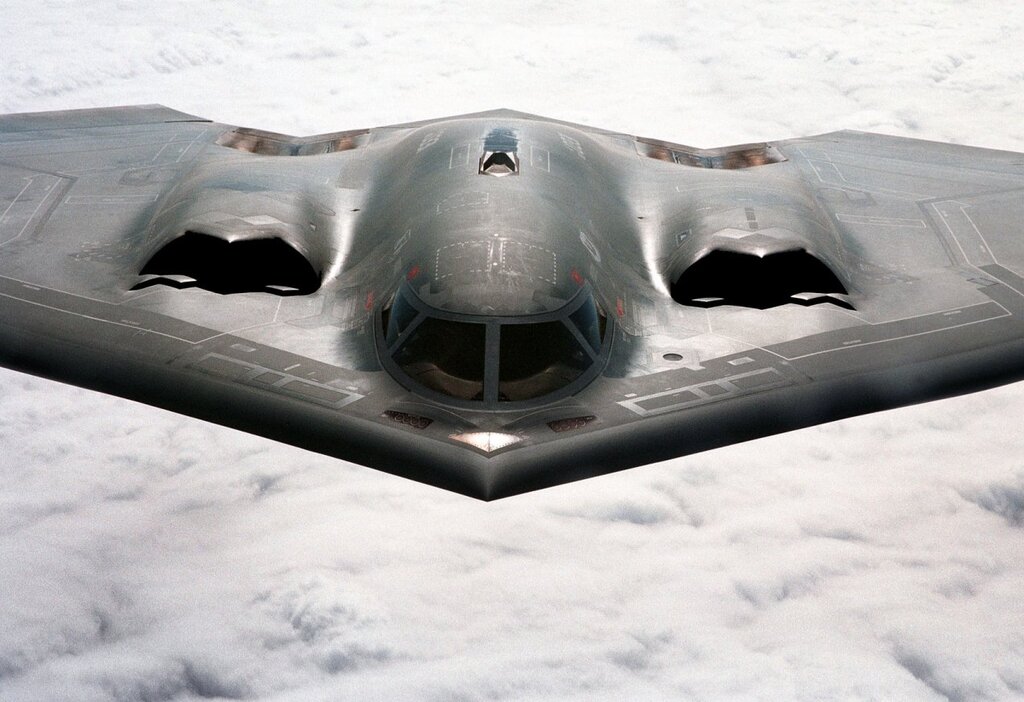
The difference between physical size and RCS is staggering. A large bomber like the B-2 has a wingspan of over 170 feet, but its advanced shaping and materials give it an estimated RCS similar to that of a small bird.
| Object | Typical RCS (m²) | Typical RCS (dBsm) |
|---|---|---|
| Conventional Bomber | 100 | +20 |
| Fighter Jet | 1 - 5 | 0 to +7 |
| Human | 1 | 0 |
| Stealth Aircraft (B-2) | 0.01 - 0.001 | -20 to -30 |
| Bird | 0.01 | -20 |
| Insect | 0.00001 | -50 |
The Physics of Reflection
An object's shape is the primary factor determining its RCS. Radar energy reflects in different ways depending on the surface it hits. The two main types of reflection are specular and diffuse.
is mirror-like. It happens when radar waves hit a large, flat surface. Almost all the energy bounces off in a single, predictable direction, just like light off a mirror. If that surface is angled perfectly toward the radar receiver, the RCS will be enormous. But if it's angled even slightly away, the reflection will miss the receiver entirely, and the RCS will be tiny. This is why conventional aircraft with flat tails and slab-sided fuselages light up a radar screen.
Diffuse reflection occurs on rough or complex surfaces. The energy scatters in many directions at once. While less intense in any single direction than a specular glint, it provides a much more consistent, albeit weaker, return from multiple angles. Things like antennas, cockpit canopies, and panel gaps can create diffuse reflections.
A key goal in stealth design is to eliminate specular reflections by carefully angling all surfaces and to minimize diffuse reflections by keeping the aircraft's skin as smooth as possible.
This foundational understanding of how an object's physical properties translate into its radar signature is the first step in appreciating the science of low observability.
What does Radar Cross Section (RCS) primarily measure?
An object's physical size is always directly proportional to its RCS.