Engineering Mechanics of Gear Systems
Gear Geometry Law
The Fundamental Law of Gearing
For two gears to transfer power smoothly and quietly, they must obey a specific rule. Imagine two gear teeth pushing against each other. At the exact point where they touch, you can draw a line that is perpendicular to both surfaces at that instant. This line is called the common normal. The fundamental law of gearing states that for the gears to maintain a constant angular velocity ratio, this common normal must always pass through a fixed point on the line connecting the centers of the two gears. This fixed point is called the pitch point.
If the common normal doesn't consistently pass through the pitch point, the speed of the driven gear will fluctuate, even if the driving gear's speed is constant. This results in noisy, inefficient, and vibrating machinery.
This principle of maintaining a constant velocity ratio is known as conjugate action. Any two tooth profiles that satisfy the law of gearing are said to be conjugate profiles. While many complex shapes could theoretically work, one has become the universal standard for its elegance and practicality: the involute profile.
The Involute Advantage
An involute curve is the path traced by a point on a taut string as it is unwrapped from a cylinder. For gears, this cylinder is called the base circle and is the fundamental starting point for the gear's tooth geometry. The involute shape is special because it perfectly satisfies the law of gearing.
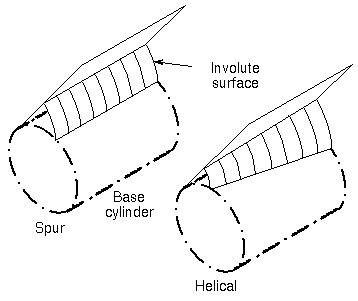
One of the biggest advantages of the involute profile is its tolerance to small changes in the center-to-center distance of the gears. Even if the gears are mounted slightly too far apart or too close together, the involute shape ensures the common normal still passes through the pitch point, maintaining a constant velocity ratio. This makes manufacturing and assembly much more forgiving.
Key Geometric Concepts
To fully understand gear geometry, we need to define a few key circles and an important angle.
- Base Circle: As mentioned, this is the circle from which the involute curve is generated. It's a fundamental parameter of the gear.
- Pitch Circle: This is a theoretical circle representing the point where the gear effectively meshes with its partner. Imagine two simple cylinders rolling against each other without slipping; their diameters would be the pitch circles of the equivalent gears.
The line of action, or common normal, is always tangent to the base circles of both meshing gears. The angle this line makes with a line tangent to the pitch circles at the pitch point is called the pressure angle (often denoted by ).
The pressure angle is a critical design parameter. Standard values are typically 14.5°, 20°, and 25°. A larger pressure angle results in a wider, stronger tooth base, which can handle heavier loads. However, it also creates larger radial forces on the gear shafts, which translates to higher loads on the bearings supporting them. Designers must balance the need for tooth strength against the capacity of the bearings.
A larger pressure angle results in robust, load-bearing gear teeth, contributing to enhanced durability and improved load distribution—key considerations in the design of polymer gears for demanding engineering environments.
According to the fundamental law of gearing, what must always pass through the fixed pitch point to ensure a constant angular velocity ratio?
What is the primary advantage of using an involute profile for gear teeth?