Engineering Foundations Semester 1
Calculus Fundamentals
The Language of Change
Calculus is the mathematical tool for understanding how things change. For engineers, this is fundamental. Whether it's the stress on a bridge changing as a load moves across it, the velocity of a rocket, or the flow of current in a circuit, calculus provides the language to describe and predict these dynamic situations.
Calculus is a branch of mathematics that studies continuous change through concepts like derivatives (differential calculus) and integrals (integral calculus).
Everything in calculus is built on one core idea: the concept of a limit. It's a simple but powerful idea that lets us zoom in on a single moment in time or a single point in space to understand its properties.
Limits and Continuity
A limit answers the question: what value does a function approach as its input gets closer and closer to a certain number? We don't care about what happens exactly at the number, just what's happening in its immediate neighborhood.
Imagine you're driving a car and tracking your speed. As you approach a red light, your speed gets closer and closer to zero. The limit of your speed as you approach the light is 0 mph, even if you never technically stop moving.
This notation says, "The limit of the function as approaches the value is ."
Limits lead directly to the idea of continuity. A function is continuous if you can draw its graph without lifting your pen from the paper. There are no sudden jumps, gaps, or holes. For a function to be continuous at a point , the limit as approaches must exist, the function must be defined at , and these two values must be the same.
Derivatives, The Rate of Change
The derivative measures the instantaneous rate of change of a function. Think of it as the slope, but not of a straight line. It's the slope of a curve at a single, specific point. This slope is given by a tangent line, a line that just touches the curve at that point without crossing it.
For an engineer, this is incredibly useful. If a function describes the position of an object over time, its derivative gives the object's instantaneous velocity. The derivative of the velocity function, in turn, gives its acceleration.
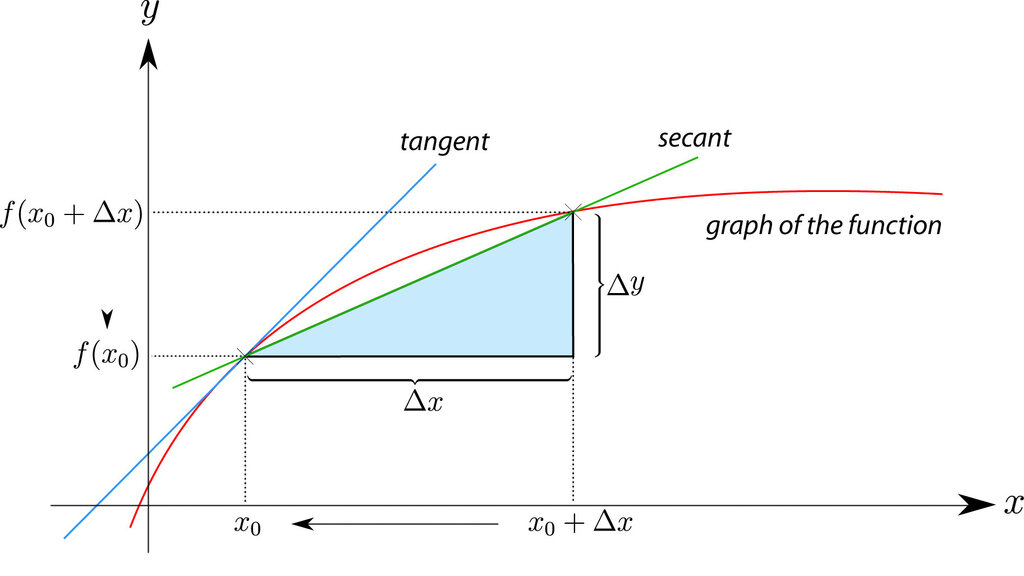
The derivative of a function is written as (read "f prime of x") or (read "dy dx"). It's formally defined using a limit:
This formula calculates the slope of the secant line between two points on the curve that are very close together (a distance of apart) and finds the limit as that distance shrinks to zero. While we can use this definition directly, we typically rely on a set of differentiation rules to find derivatives more quickly.
| Rule | Function Form | Derivative |
|---|---|---|
| Power Rule | ||
| Product Rule | ||
| Quotient Rule | ||
| Chain Rule |
These rules are the workhorses of differentiation, allowing engineers to analyze complex functions that model real-world systems.
Integrals, The Sum of Parts
If differentiation is about breaking things down to find a rate of change, integration is about putting them back together. Integration is a process of summation. It allows us to find the total accumulation of a quantity or, most famously, the area under a curve.
Integral Calculus deals with accumulation. The integral calculates the area under a curve, representing the accumulation of a quantity over time or some other variable.
This has direct applications in engineering. For instance, if you have a function for the variable force applied to an object over a distance, integrating that function gives you the total work done. If you have a function for the flow rate of water into a tank, integrating it tells you the total volume of water in the tank after a certain time.
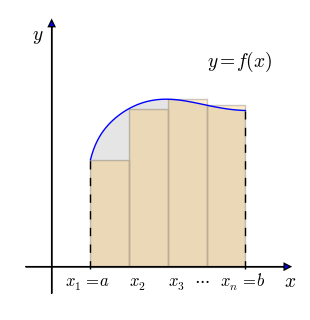
The definite integral of a function from to is written as:
This represents the area between the function's curve, the x-axis, and the vertical lines and . The connection between derivatives and integrals is one of the most important discoveries in mathematics: The Fundamental Theorem of Calculus. In essence, it states that differentiation and integration are inverse operations. If you integrate a function and then differentiate the result, you get the original function back.
Here's a brief look at some common integration methods:
U-Substitution: This is the reverse of the chain rule, used when the integrand contains both a function and its derivative.
Integration by Parts: The reverse of the product rule, useful for integrating products of functions.
Trigonometric Substitution: Used for integrands involving square roots of quadratic expressions.
Mastering these techniques is crucial for solving the kinds of problems that appear constantly in engineering analysis.
What is the central question that the concept of a limit in calculus seeks to answer?
A function f(x) is considered continuous at a point c if which of the following conditions are met?
Calculus is more than just a set of rules and formulas. It's a powerful framework for thinking about and solving problems that involve continuous change, a constant in the world of engineering.