Engineering Control Systems Fundamentals
Introduction to Control Systems
Making Things Behave
At its heart, a control system is simply a way to make a device or system behave in a specific, desired manner. Think about setting the temperature in your home. You don't just turn the furnace on and hope for the best. You tell a small box on the wall, the thermostat, that you want it to be 70°F. The thermostat then takes charge, turning the heat on and off to maintain that exact temperature. That's a control system in action.
The main purpose of a control system is to manage a process to achieve a desired outcome. This is especially important when dealing with disturbances, which are unexpected factors that can throw a system off course. For a car's cruise control, a sudden hill is a disturbance. For a thermostat, a window left open on a cold day is a disturbance. A good control system can handle these issues automatically to keep things on track.
Two Flavors of Control
Control systems generally come in two main types: open-loop and closed-loop.
An open-loop system is the simpler of the two. It performs its job without ever checking the result. The control action is completely independent of the system's output. It follows its instructions and assumes the outcome will be correct.
A classic example is a basic toaster. You set the dial for how dark you want your toast and push the lever. The toaster's heating elements turn on for a fixed amount of time. It doesn't matter if you put in a thin slice of white bread or a thick, frozen bagel; the toaster runs for the same duration. It never checks the color of the toast.
A closed-loop system, on the other hand, is smarter. It uses feedback to continuously monitor its own output and adjust its actions accordingly. This is why it's also called a feedback control system.
In a closed-loop system, a sensor measures the output. This measurement is then 'fed back' and compared to the desired value, which we call the setpoint. The difference between the setpoint and the actual output is called the error. The system's job is to minimize this error.
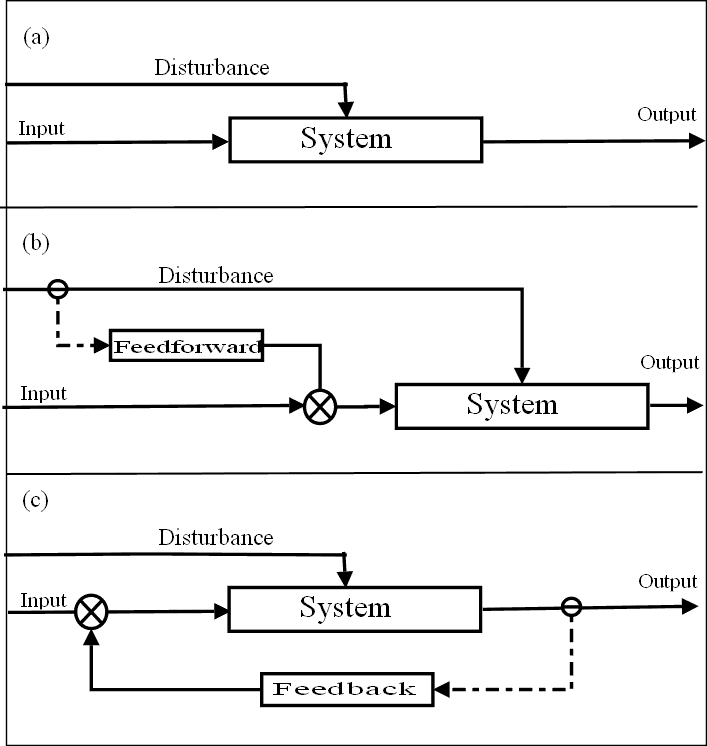
The diagram above shows the key difference. The top image is an open-loop system where the process flows in one direction. The bottom image shows a closed-loop system. Notice the arrow looping from the output back to the beginning. That's the feedback path, and it makes all the difference.
The Power of Feedback
So why go to the trouble of adding sensors and feedback? Because feedback gives a system several powerful advantages.
It reduces the effect of disturbances. Let’s go back to cruise control. You set your speed to 65 mph. When the car starts climbing a hill, the car naturally slows down. A sensor detects this drop in speed. The control system sees the error between your setpoint (65 mph) and the actual speed (say, 62 mph) and tells the engine to supply more power. It automatically counters the disturbance of the hill.
It improves accuracy. An open-loop system can only be as good as its initial calibration. A microwave might have a 'popcorn' button, but it doesn't know the specific size or brand of your popcorn bag, so it often under- or overcooks it. A closed-loop system with a sensor that could detect the popping frequency would be far more accurate, stopping at the perfect moment every time.
It can stabilize an unstable system. Some systems are naturally unstable, like balancing a broomstick on your hand or flying a modern fighter jet. Without constant, tiny adjustments based on feedback, they would fail immediately. Closed-loop control makes them stable and manageable.
| Feature | Open-Loop System | Closed-Loop System |
|---|---|---|
| Feedback | No | Yes |
| Complexity | Simple | Complex |
| Cost | Less expensive | More expensive |
| Accuracy | Less accurate | More accurate |
| Disturbances | Cannot compensate | Can compensate |
Of course, there's no free lunch. Closed-loop systems are more complex and expensive because they require sensors and more sophisticated controllers. But for many applications, the benefits of stability and accuracy are well worth the trade-off.
Let's test your understanding of these fundamental concepts.
In a closed-loop control system, what is the term for the difference between the desired value (setpoint) and the actual measured output?
A standard electric toaster, which operates on a timer without checking how brown the toast is, is an example of which type of system?
Control systems are a fundamental part of modern engineering, working behind the scenes to make our world more predictable, efficient, and safe.