Engineering and Applications of Ferrite Materials
Ferrite Crystal Chemistry
The Architecture of Magnetism
Ferrites are a special class of magnetic materials. Unlike metallic magnets like iron or neodymium alloys, ferrites are ceramics. They are made by mixing iron oxide (Fe₂O₃) with one or more other metallic elements, such as manganese (Mn), zinc (Zn), or nickel (Ni). This ceramic nature is their secret weapon.
Because they are ceramics, ferrites are poor electrical conductors. This high electrical resistivity is crucial for high-frequency electronics, like power supplies and radio antennas. In conductive materials, rapidly changing magnetic fields create swirling electrical currents called eddy currents, which waste energy as heat. The insulating nature of ferrites stops these currents in their tracks, making them highly efficient.
The Spinel Family
Many of the most common ferrites share a crystal structure with a mineral called spinel (MgAl₂O₄). This structure, with the general formula AB₂O₄, is built on a rigid framework of oxygen ions. The metal ions, or cations, are nestled into specific gaps within this oxygen lattice. There are two types of gaps: smaller tetrahedral sites (A-sites) and larger octahedral sites (B-sites).
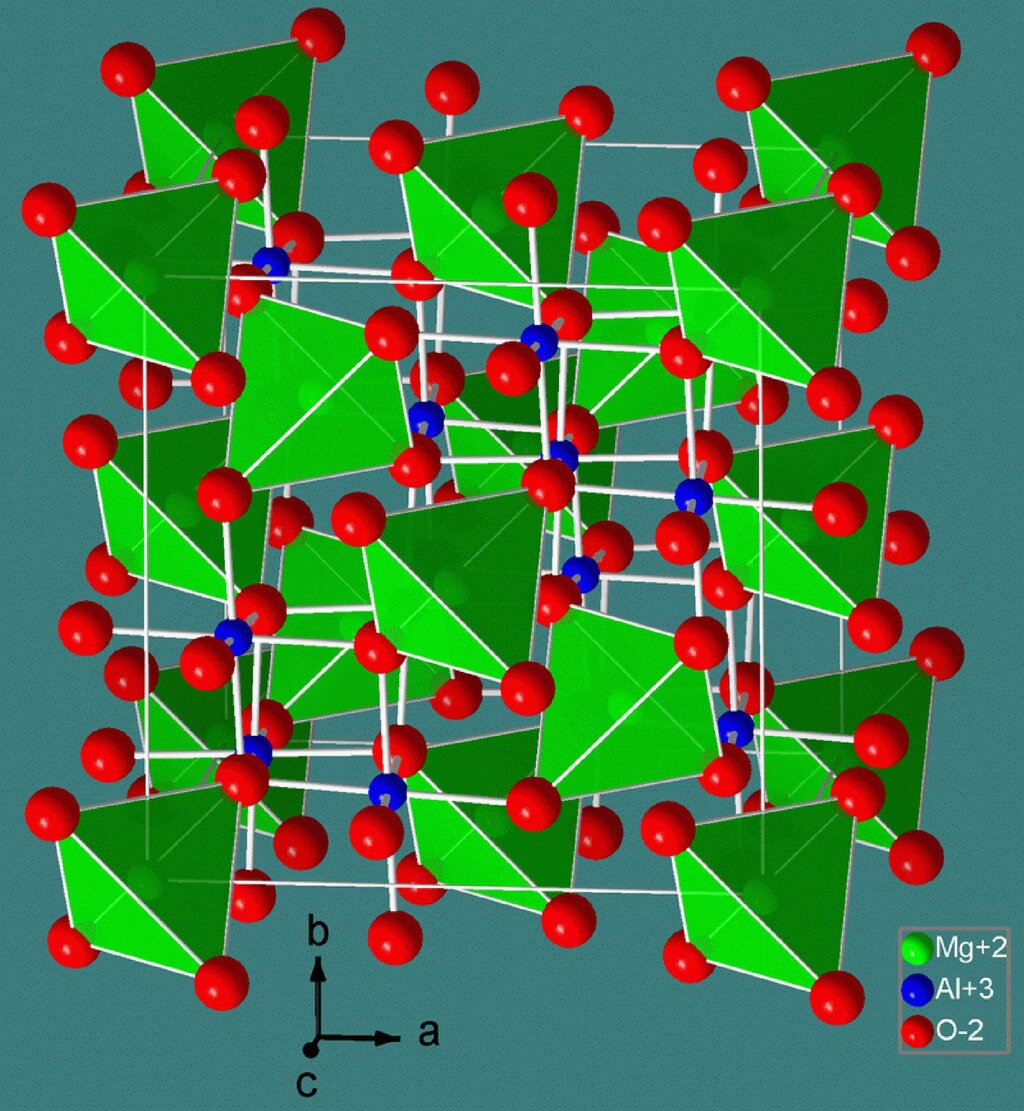
The magnetic properties of a ferrite depend heavily on which cations sit in which sites. In a normal spinel structure, the A-sites are occupied by the divalent cations (like Zn²⁺ or Mn²⁺) and the B-sites are occupied by the trivalent iron ions (Fe³⁺).
However, many useful ferrites have an inverse spinel structure. Here, things get mixed up. All the divalent cations and half of the trivalent iron ions occupy the B-sites, while the other half of the iron ions take the A-sites. This specific arrangement is fundamental to their magnetic behaviour.
| Structure Type | Tetrahedral (A) Site Occupants | Octahedral (B) Site Occupants |
|---|---|---|
| Normal Spinel | Divalent Cations (e.g., Zn²⁺) | Trivalent Cations (Fe³⁺) |
| Inverse Spinel | Trivalent Cations (Fe³⁺) | Divalent Cations + Trivalent (Fe³⁺) |
Other Key Structures
While spinel is common, it's not the only structure ferrites can adopt. Another important class is the garnet structure. Ferrites with this structure, like Yttrium Iron Garnet (Y₃Fe₅O₁₂ or YIG), have a more complex crystal lattice. This complexity gives them unique magnetic properties that are ideal for microwave applications, such as in radar and satellite communications.
Hexagonal ferrites, such as Barium Ferrite (BaFe₁₂O₁₉) and Strontium Ferrite (SrFe₁₂O₁₉), represent another crucial category. Their hexagonal crystal structure leads to strong magnetic anisotropy, meaning they prefer to be magnetised along a single axis. This property results in high coercivity and makes them excellent materials for permanent magnets, used in everything from refrigerator magnets to electric motors.
Why Structure Dictates Function
The electrical resistivity of ferrites comes directly from their crystal chemistry. The bonding between the metal cations and oxygen anions is primarily ionic, meaning electrons are tightly held by the oxygen ions. Unlike in metals, there are no free-moving electrons to conduct electricity. This ceramic nature, determined by the crystal structure and bonding, is precisely what makes ferrites so valuable.
The specific arrangement of different metal ions in the tetrahedral and octahedral sites also dictates the net magnetic moment of the material. By carefully choosing the combination of divalent cations (Mn, Zn, Ni, etc.) and their placement in the lattice, engineers can fine-tune the magnetic properties of a ferrite for a specific application.
Crystal field theory explains the colors and magnetic properties of transition metal coordination compounds, which form crystalline solids.
Let's review the key terms we've covered.
Ready to test your knowledge?
What is the primary advantage of ferrites being ceramic materials for use in high-frequency applications?
In an inverse spinel ferrite structure, where are the divalent cations (like Zn²⁺) primarily located?
Understanding these crystal structures is the key to understanding why ferrites are indispensable in modern electronics. The precise placement of atoms defines their most important properties.