Energy Fundamentals Production and Capture
Energy Fundamentals
Energy and Its Forms
Energy is the capacity to do work. It’s what makes things happen, from a car moving down the road to the sun warming the Earth. While it comes in many forms, all energy can be categorized into two fundamental types: kinetic and potential.
Kinetic energy is the energy of motion. Potential energy is stored energy.
Think of a bowling ball. When it's sitting on the rack, it has potential energy. It has the potential to move. When you roll it down the lane, that potential energy converts into kinetic energy. The faster the ball moves, the more kinetic energy it has.
Potential energy is energy stored due to an object's position or state. A rock at the top of a hill has gravitational potential energy. A stretched rubber band has elastic potential energy. A battery contains chemical potential energy, stored in its chemical bonds.
Other forms of energy are just expressions of these two types at a microscopic level.
- Thermal energy comes from the kinetic energy of tiny, randomly moving atoms and molecules in a substance. The hotter something is, the faster its particles are moving.
- Chemical energy is a form of potential energy stored in the bonds between atoms in molecules. When these bonds are broken during a chemical reaction, that energy is released.
- Electrical energy is related to the potential energy of charged particles (like electrons) in an electric field.
The Rules of Energy
Energy doesn't just appear or disappear. It follows strict rules, which are described by the laws of thermodynamics.
The principle of conservation of energy is a fundamental concept in physics.
The First Law of Thermodynamics is the law of energy conservation. It states that energy cannot be created or destroyed; it can only be changed from one form to another. The total amount of energy in an isolated system remains constant.
When we burn gasoline in a car, we are converting the chemical potential energy in the fuel into thermal energy and then into the kinetic energy that moves the car. No energy is lost, but not all of it becomes useful motion. Much of it is converted into thermal energy (heat) that dissipates into the environment.
This brings us to energy efficiency. Efficiency is a measure of how much useful energy we get out of an energy conversion process. It's often expressed as a percentage.
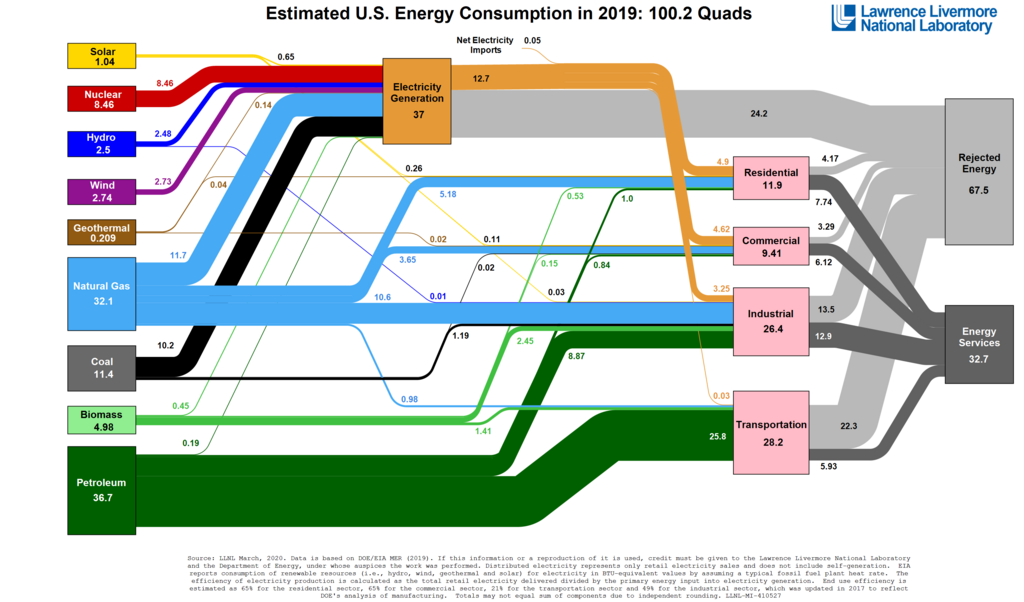
The Second Law of Thermodynamics explains why no energy conversion is 100% efficient. It introduces the concept of entropy, which is a measure of disorder or randomness in a system. The Second Law states that the total entropy of an isolated system always increases over time.
In any energy transformation, some energy is converted into a less useful form, typically low-quality heat. This increases the overall disorder of the universe.
Imagine your bedroom. It's easy for it to get messy (high entropy), but it takes effort—an input of energy—to clean it up (low entropy). The universe works the same way. Energy tends to spread out and become less concentrated and less useful. This is why a hot cup of coffee cools down to room temperature, but a room-temperature cup of coffee never spontaneously heats up. The energy disperses, increasing entropy.
Check Your Understanding
Let's review the key concepts we've covered.
Now, test your knowledge with a few questions.
All forms of energy can be fundamentally categorized into which two types?
A diver standing on a high-dive platform is about to jump. Which type of energy is most prominent at this moment?
These fundamental principles govern every energy interaction, from the smallest atoms to the largest power plants.