End-to-End MLOps with Python
Introduction to MLOps
From Laptop to Real World
A machine learning model can seem like magic on a data scientist's computer. It predicts customer churn with 95% accuracy or identifies cat photos flawlessly. But moving that model from a controlled environment into the messy, unpredictable real world is where the real challenge begins. This is where MLOps comes in.
MLOps
noun
Short for Machine Learning Operations, it is a set of practices that aims to deploy and maintain machine learning models in production reliably and efficiently.
Think of it like this: building a model is like designing a revolutionary new car engine. MLOps is the entire assembly line, quality control, and maintenance garage needed to build thousands of cars with that engine, get them on the road, and keep them running smoothly.
It combines the principles of DevOps (which focuses on software development and IT operations) with the unique challenges of machine learning. The goal is to shorten the lifecycle of ML models while delivering high-quality, reliable results.
MLOps is an emerging practice that applies DevOps principles to machine learning projects.
The ML Lifecycle
Creating and managing a machine learning model isn't a one-time event. It’s a continuous cycle. A model is built, deployed, and then watched closely to see how it performs with new, live data. Over time, its performance can degrade, and it will need to be retrained or replaced. This entire process is known as the machine learning lifecycle.
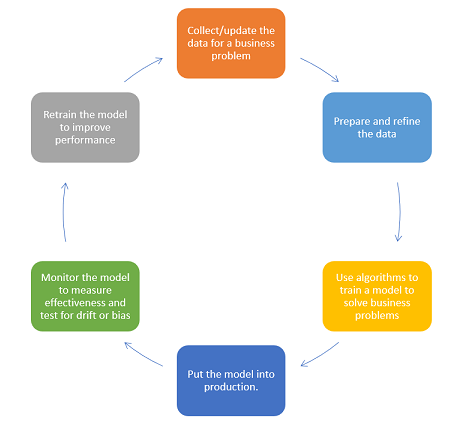
This cycle involves several distinct stages:
- Business Problem: It all starts with a clear goal. What are we trying to achieve?
- Data Collection & Preparation: We gather and clean the data needed to train the model.
- Model Training: We use the prepared data to teach the model how to make predictions.
- Deployment: The trained model is integrated into a live application.
- Monitoring: We track the model's performance to ensure it's still making accurate predictions.
- Retraining: When performance drops, we use new data to retrain the model, and the cycle begins again.
MLOps provides the tools and structure to manage this entire process efficiently.
Core Components of MLOps
To manage the ML lifecycle, MLOps relies on three key pillars: experiment tracking, workflow orchestration, and monitoring.
- Experiment Tracking
A data scientist might run hundreds of experiments to find the best model. They'll try different algorithms, tweak settings called hyperparameters, and use various subsets of data. Keeping track of all these variations manually is a recipe for chaos.
Experiment tracking tools automatically log the important details of each run: the code version, the data used, the model parameters, and the final performance metrics. This creates a reproducible and organized history of the project, making it easy to compare results and revert to previous versions.
- Workflow Orchestration
The journey from raw data to a deployed model involves a sequence of steps. Data needs to be fetched, cleaned, transformed, and then fed into a training process. After training, the model must be tested and validated before it can be deployed.
Workflow orchestration tools automate this entire pipeline. They act as a conductor, ensuring each step runs in the correct order and handling any failures along the way. This automation saves time, reduces human error, and makes the whole process repeatable.
In the third step, you will learn to use orchestration tools such as Apache Airflow or Prefect to automate and schedule the ML workflows.
- Monitoring
Once a model is live, the job isn't over. The world changes, and so does the data. A model trained to predict housing prices last year might not perform well with this year's market data. This phenomenon is known as model drift.
Monitoring tools track the model's performance in the production environment. They watch for drops in accuracy, changes in the input data, and other signs that the model is becoming stale. When a problem is detected, alerts can be triggered to let the team know it's time to retrain or update the model.
Without MLOps, even the most advanced ML models can lose their value over time due to data drift—a gradual change in the data that the model was trained on versus the data it sees in production.
Tools of the Trade
Several open-source tools have become popular for implementing MLOps principles.
- MLflow: An open-source platform to manage the ML lifecycle, including tracking experiments, packaging code into reproducible runs, and sharing and deploying models.
- Apache Airflow: A platform to programmatically author, schedule, and monitor workflows. It's a powerful tool for orchestrating complex data pipelines.
- Grafana: A popular tool for monitoring and observability. It can be used to create dashboards that visualize a model's live performance, system health, and other key metrics.
These tools form a powerful stack for building a robust MLOps foundation.
Let's check your understanding of these core concepts.
What is the primary goal of MLOps?
A model trained to identify fashion trends starts to make less accurate predictions as styles change over time. What is this phenomenon called?
By adopting MLOps, organizations can bridge the gap between building a model and making it a valuable, reliable part of their business operations.