Emerging Tech Frontiers and Practical Applications
Agentic and Multimodal AI
Beyond Text Generation
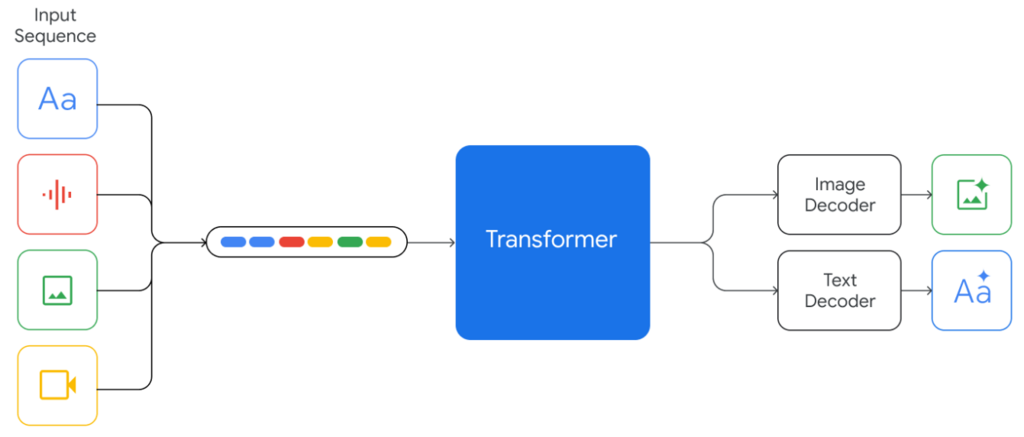
The conversation around Generative AI has moved past simply creating text. The models of 2024 and 2025 are fundamentally different, evolving from text-only chatbots into sophisticated systems that can understand and interact with the world in a much richer way. This shift is toward native multimodality.
Instead of treating text, images, and audio as separate problems to be solved by different models, new architectures process them simultaneously. A single prompt can include a video clip, a spoken question, and a line of code, and the model can generate a response that synthesizes information from all of them. This isn't just a party trick; it's a profound change. Gartner predicts that by 2027, 40% of enterprise GenAI solutions will be multimodal, enabling more complex and intuitive applications.
The Rise of Agentic AI
The other major leap is the move toward Agentic AI systems. Earlier models were reactive; they waited for a prompt and then generated a response. Agentic systems are proactive. They can be given a high-level goal, and they will reason, plan, and execute a series of steps to achieve it. They can use tools, access external data, and even ask for clarification when needed.
Imagine a customer support agent. Instead of just summarizing a complaint, an agentic system could understand the user's email, access the order database to check their purchase history, query a knowledge base for troubleshooting steps, and then draft a personalized reply with a proposed solution. If the solution requires a refund, it could even initiate that process in the company's financial software. This is a move from generating content to accomplishing tasks autonomously.
Specialized vs. General Models
For a long time, the race was to build the biggest, most powerful general foundation models. While these large language models (LLMs) are incredibly versatile, the industry is now seeing a significant shift toward smaller, highly specialized models. These (SLMs) are fine-tuned on domain-specific data for sectors like law, medicine, or manufacturing.
The trade-off is clear: a massive general model might know about everything from Shakespeare to quantum physics, but a medical SLM will have a much deeper and more accurate understanding of diagnostic criteria or pharmaceutical interactions. For high-stakes enterprise applications, accuracy and reliability trump encyclopedic knowledge.
| Feature | General Foundation Model (LLM) | Domain-Specific Model (SLM) |
|---|---|---|
| Training Data | Massive, diverse internet text | Narrow, high-quality industry data |
| Size | Very large (billions of parameters) | Smaller, more efficient |
| Best For | General knowledge, creative tasks | High accuracy, specialized tasks |
| Cost | Expensive to train and run | Cheaper, faster inference |
| Example | ChatGPT, Claude | A model for legal contract review |
Training these specialized models in highly regulated fields presents a challenge due to data privacy. You can't just feed a model millions of private medical records or confidential financial documents. This is where comes in. Instead of using real-world data, companies generate artificial data that mimics the statistical properties of the original dataset without containing any real, sensitive information. This allows them to train highly accurate models for industries like healthcare and finance without compromising privacy.
Despite the promise, enterprise adoption faces hurdles. Calculating a clear return on investment (ROI) can be difficult, and integrating these complex systems into existing workflows is a major technical and organizational challenge. Companies are moving cautiously, starting with pilot programs to prove value before committing to large-scale deployments.
Let's review these new frontiers in AI.
What is the key characteristic of a "natively multimodal" AI model as described in the new frontiers of AI?
Which of the following best describes an "Agentic AI" system?
The shift toward multimodal, agentic, and specialized AI isn't just a technical upgrade. It represents a new phase where AI moves from being a tool for generating information to a partner in executing complex tasks.