Embedded Systems Basics with ATmega328PB
Embedded Systems Basics
One Job, Done Well
Think about your laptop. You can use it to browse the internet, write an email, play a game, or edit a video. It's a general-purpose computer, a jack-of-all-trades.
Now, think about your microwave. It has one job: to heat food. It has a simple keypad, a small screen, and it does its task perfectly every time. The computer inside the microwave is an embedded system—a computer designed to perform a specific, dedicated function within a larger device. You can't install new software on your microwave or use it to check social media. It does one thing, and it does it reliably.
An embedded system is a combination of computer hardware and software designed for a specific function.
These specialized computers are everywhere: in your car's engine, your digital watch, your coffee maker, and your TV remote. They are the hidden brains making our modern world work. At the heart of most of these systems is a special kind of chip called a microcontroller.
microcontroller
noun
A small computer on a single integrated circuit (chip) containing a processor core, memory, and programmable input/output peripherals.
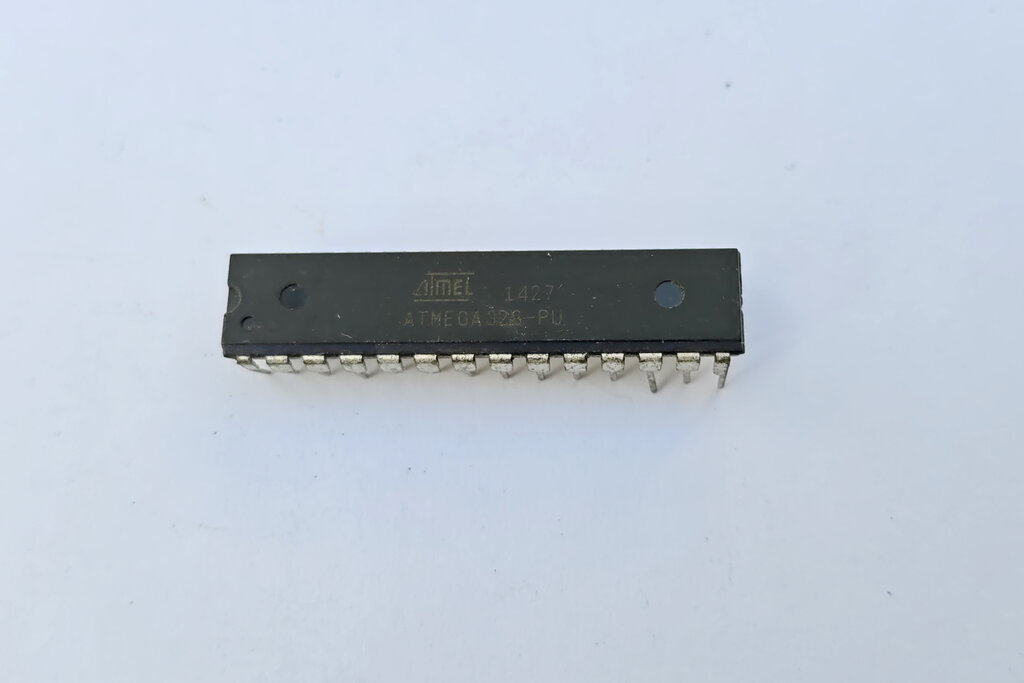
In this course, we'll be working with a popular microcontroller called the ATmega328PB. Think of it as a tiny, programmable brain that we can teach to interact with the physical world.
The Brains of the Operation
You've probably heard of a microprocessor before. It's the central processing unit (CPU) in your laptop or phone, like an Intel Core i9 or Apple M1. A microprocessor is incredibly powerful, but it's just the processor. It needs other separate chips for memory, storage, and handling inputs and outputs to function.
A microcontroller, like our ATmega328PB, is different. It's an all-in-one solution. It bundles the processor, memory, and input/output capabilities all onto a single chip. This makes it compact, power-efficient, and perfect for embedded systems.
| Feature | Microprocessor (CPU) | Microcontroller (MCU) |
|---|---|---|
| Components | Just the processor | Processor, Memory (RAM), Storage (Flash), I/O all on one chip |
| Design | Needs many external components | Self-contained, minimal external parts needed |
| Use Case | General-purpose computing (laptops, servers) | Specific tasks (appliances, controllers) |
| Cost | Higher | Lower |
| Power Use | High | Very Low |
Let's use an analogy to understand the key parts of our microcontroller. Imagine the microcontroller is a tiny kitchen, and its job is to cook a meal.
CPU (Central Processing Unit): This is the chef. It reads the recipe, step-by-step, and performs all the actions. It’s the core that does the thinking and executing.
Flash Memory: This is the recipe book. It’s where the program—our set of instructions—is permanently stored. When you turn the microwave off and on again, it still remembers how to be a microwave because the recipe is in the book. This memory is "non-volatile," meaning it holds its data without power.
RAM (Random Access Memory): This is the kitchen counter or fridge. It’s a temporary workspace where the chef keeps the ingredients (data) they are currently using. RAM is very fast to access, but it’s "volatile." If the power goes out, everything on the counter is lost.
I/O (Input/Output) Pins: These are the chef's hands and senses. Input pins let the microcontroller sense the outside world—like pressing a button on the microwave. Output pins let it affect the world—like turning on the light, spinning the plate, or making the beeping sound.
Putting It All Together
So, an embedded system is a device built for a special purpose. Its brain is a microcontroller, a single chip that contains a CPU, memory, and I/O. Our job is to write the program—the recipe—that tells the CPU what to do with its inputs and outputs.
When we write code for the ATmega328PB, we're not creating a program that runs on a laptop screen. We're creating firmware that will live inside the chip's Flash memory. This firmware will read sensors, listen for button presses, and control lights, motors, and displays to make something happen in the real world.
What is the primary characteristic of an embedded system?
What is the key difference between a microprocessor and a microcontroller?