Embarking on Your Painting Journey
Introduction to Painting
Choosing Your Paint
Walking into an art supply store can be overwhelming. Let's simplify things by looking at the three most common types of paint for beginners: acrylic, oil, and watercolor.
Pigment
noun
The natural or synthetic particles that give paint its color. It's mixed with a binder to create the final product.
Acrylic paint is a great starting point. It's a water-based paint, which means it dries quickly and you can clean your brushes with just soap and water. Its versatility is its biggest strength. You can thin it with water to act like watercolor, or use it straight from the tube for thick, textured effects similar to oil paint.
Oil paint is the classic medium used by masters for centuries. Oils are made from pigment suspended in a drying oil, like linseed oil. They dry very slowly, which gives you plenty of time to blend colors and make changes. This slow drying time is a blessing for careful blending but can be a challenge if you want to work quickly. Cleanup requires solvents like turpentine or mineral spirits.
Watercolor paint is unique because it's transparent. Instead of covering up the paper, you layer thin washes of color that the light shines through. It’s known for its luminous, airy quality. Watercolors are unforgiving—it's hard to cover up mistakes—but they can produce beautiful, delicate results. You'll need special absorbent paper to keep it from buckling.
| Feature | Acrylic | Oil | Watercolor |
|---|---|---|---|
| Drying Time | Fast (minutes) | Slow (days) | Fast (minutes) |
| Cleanup | Soap and water | Solvents | Soap and water |
| Opacity | Opaque | Opaque | Transparent |
| Surface | Canvas, wood, paper | Canvas, wood | Paper |
Tools of the Trade
Besides paint, you only need a few other things to get started: brushes and something to paint on.
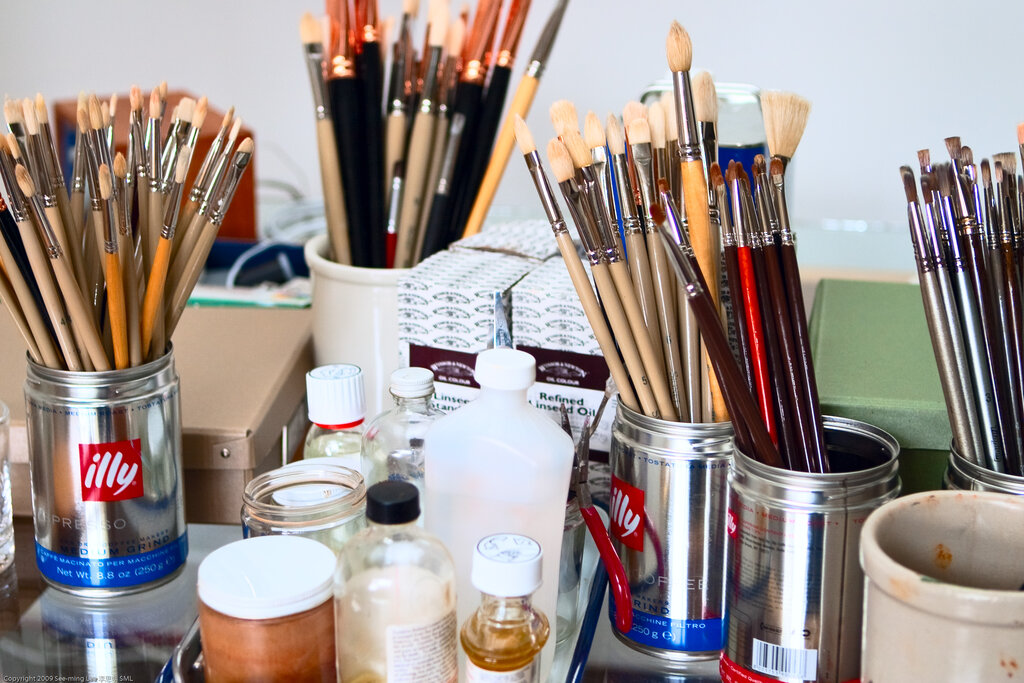
Brushes come in many shapes and sizes. A few basic shapes will cover most of your needs:
- Round: Has a pointed tip, good for fine lines and details.
- Flat: Has a square end, useful for broad strokes and filling large areas.
- Filbert: A flat brush with an oval shape, great for blending and creating soft edges.
Brushes are made with either natural hairs (like sable or hog) or synthetic fibers. Synthetic brushes are more affordable, durable, and work well with acrylics. Natural hair brushes are prized by oil and watercolor painters for how they hold and release paint.
To keep your brushes in good shape, always clean them thoroughly after painting. For acrylics and watercolors, use mild soap and water. For oils, use a solvent first, then soap and water. Reshape the bristles and let them dry completely.
A good starting set: a small round brush for details, a medium-sized filbert for general work, and a large flat brush for covering big areas.
Your painting surface, or support, depends on your paint. For acrylics and oils, a canvas is the standard choice. You can buy pre-stretched canvas, which is ready to paint on, or more affordable canvas panels, which are stiff boards wrapped in canvas.
For watercolors, you need special watercolor paper. This paper is thick and absorbent. It's sold by weight; a heavier paper (like 300 lb or 640 gsm) is less likely to wrinkle or 'buckle' when wet. Paper also comes in different textures: cold-press has a slight texture (the most common), while hot-press is smooth.
Making Your First Marks
The way you hold your brush can dramatically change your strokes. Holding it close to the bristles, like a pencil, gives you more control for detailed work. Holding it further back on the handle encourages looser, more expressive marks.
Experiment with different strokes. See what happens when you press hard versus lightly. Try using the tip, the side, and the flat of the brush. There are no wrong answers here; it's about learning what your tools can do.
One of the most exciting parts of painting is mixing your own colors. You don't need dozens of tubes of paint to create a vibrant painting.
You can mix almost any color from just three primary colors: red, yellow, and blue. When you mix two primary colors, you get a secondary color:
- Red + Yellow = Orange
- Yellow + Blue = Green
- Blue + Red = Violet
To make a color lighter, you add white (this is called a tint). To make it darker, you add black (a shade). But be careful with black—it can make colors look dull. A more interesting way to darken a color is to mix in a small amount of its complementary color (the color opposite it on the color wheel). For example, adding a tiny bit of red to green will create a deep, rich dark green.
Layering and blending are key techniques for creating depth. With fast-drying acrylics, you can easily paint new layers on top of dry ones. This is called glazing if the top layer is transparent. With slow-drying oils, you can blend colors directly on the canvas for soft, smooth transitions. A key rule for oils is 'fat over lean,' which means each new layer should have a bit more oil in it than the one below it to prevent cracking as the paint dries.
In watercolor, you can work 'wet-on-wet' by applying paint to wet paper, which makes colors bleed into each other beautifully. Or you can work 'wet-on-dry,' applying paint to dry paper for crisp, defined shapes.
If a beginner painter wants a medium that dries quickly and can be cleaned up with just soap and water, which type of paint should they choose?
An artist wants to paint the fine, detailed whiskers on a cat. Which brush shape is best suited for this task?
Painting is a skill that grows with practice. Don't worry about making masterpieces right away. The goal is to get comfortable with your materials and have fun exploring what they can do.