Elizabeth I Image Politics
Elizabethan England Context
A Queen in a Man's World
When Elizabeth I took the throne in 1558, many doubted she would last. England was a fractured kingdom, and the idea of a queen ruling in her own right was still a radical concept. European society was deeply patriarchal, and powerful female rulers were rare. Her predecessor and half-sister, Mary I, had a difficult reign, which only fueled the belief that women were unfit to govern.
Elizabeth I (r. 1558–1603) inherited a precarious throne.
Elizabeth faced immediate pressure to marry and produce an heir, which would have meant ceding much of her power to a husband. She skillfully navigated this expectation for decades, using the prospect of marriage as a diplomatic tool while ultimately remaining single. She had to project an image of strength, stability, and divine authority to command the respect of her male counselors and the loyalty of her subjects.
A Kingdom Divided by Faith
Religion was the most explosive issue of the day. The previous decades had seen England swing violently between Protestantism and Catholicism. Elizabeth’s father, Henry VIII, broke from the Roman Catholic Church to establish the Church of England. Her half-brother, Edward VI, pushed the country further toward Protestantism. Then, her half-sister, Mary I, ruthlessly tried to restore Catholicism, earning her the nickname “Bloody Mary.”
Elizabeth, a Protestant, inherited a nation deeply scarred by this religious turmoil. She sought a compromise known as the “Elizabethan Religious Settlement,” which established the Church of England as a moderate Protestant institution. However, this “middle way” pleased few extremists. Devout Catholics viewed her as an illegitimate heretic, while radical Protestants, or Puritans, felt her reforms didn't go far enough.
This religious tension was a constant source of instability, fueling numerous plots to overthrow Elizabeth and replace her with a Catholic monarch.
Foreign Threats
Beyond her own borders, Elizabeth faced powerful enemies. The greatest threat came from Spain, the dominant Catholic power in Europe, ruled by King Philip II. Philip had been married to Elizabeth's sister, Mary I, and saw himself as a defender of the Catholic faith. He supported plots against Elizabeth and viewed England’s Protestantism and its raids on Spanish shipping as direct challenges to his power.
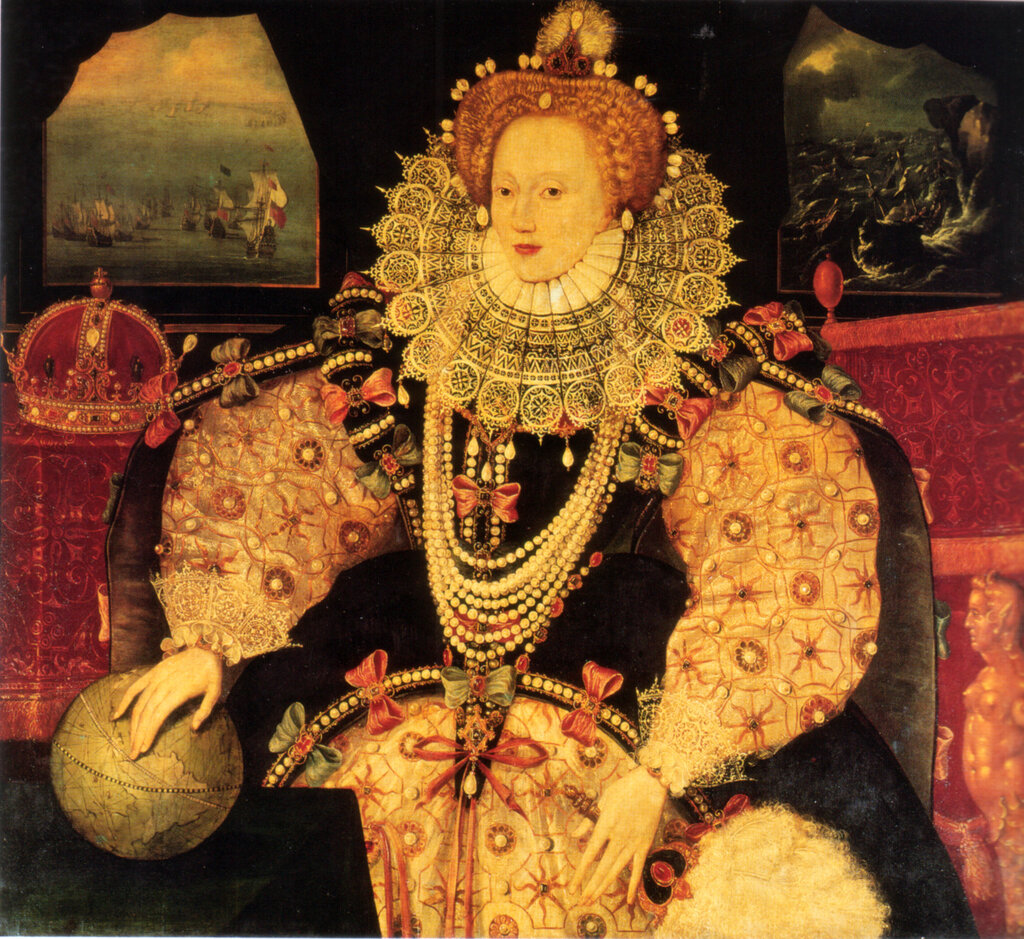
This rivalry culminated in 1588 with the Spanish Armada, a massive naval fleet sent to invade England and depose Elizabeth. The unlikely English victory was a pivotal moment. It was seen as divine approval of Elizabeth's rule and the Protestant cause, greatly enhancing her reputation at home and abroad.
The Power of Image
In an era before mass media, a monarch's image was a crucial political tool. Since most of her subjects would never see her in person, Elizabeth's likeness was carefully managed through official portraits. These paintings were not simply realistic depictions; they were works of propaganda, packed with symbols designed to convey specific messages about her power, legitimacy, and virtues.
Symbols were a language everyone could understand, regardless of their ability to read. Pearls signified purity and virginity. A globe or a hand resting on a map symbolized England’s growing international power. A phoenix represented rebirth and immortality, while a pelican, which was believed to pierce its own breast to feed its young, symbolized her selfless devotion to her people.
The Tudor rose was used in Queen Elizabeth I's portraits to refer to the Tudor dynasty and the unity it brought to the realm.
Through these carefully crafted images, Elizabeth created a powerful public persona. She was the Virgin Queen, married to her kingdom, and a semi-divine figure chosen by God to lead England into a golden age. This visual campaign was essential for maintaining her authority in a dangerous and uncertain world.
Now, let's test your understanding of Elizabeth's world.