Elite Pitch Dynamics and Match Strategy
Clay Mineralogy and Dynamics
Mineralogy Dictates Performance
The performance of a cricket pitch is dictated not by the percentage of clay, but by its mineralogical composition. The specific clay minerals present determine the surface's dynamic properties, including its shrink-swell capacity, cohesion, and ability to withstand play. Understanding the crystalline structures of these minerals is the first step in predicting a pitch's behavior over the course of a match.
Lattice Structures
Clay minerals are hydrous aluminium phyllosilicates, composed of repeating layers of silica tetrahedra and alumina octahedra. The arrangement of these layers defines their classification and behavior.
Kaolinite possesses a 1:1 lattice structure, where one silica tetrahedral sheet is bonded directly to one alumina octahedral sheet. Strong hydrogen bonds between these stacked layers prevent water from penetrating, resulting in minimal swelling and shrinking. This structural rigidity gives kaolinitic soils low plasticity and a low Cation Exchange Capacity (CEC), typically 3-15 meq/100g. Pitches with high kaolinite content are often described as 'dead' because they offer poor pace and bounce and do not develop the characteristic cracks required for late-match spin.
Illite has a 2:1 structure, with an octahedral sheet sandwiched between two tetrahedral sheets. However, potassium ions () are fixed in the interlayer spaces, strongly binding the layers together. This limits swelling, though not as severely as in kaolinite. Illite exhibits intermediate properties, with a CEC of 15-40 meq/100g, offering a moderate level of pace and bounce but lacking the durability of smectite-dominant pitches.
Smectite clays, such as montmorillonite, are the gold standard for Test match pitches. They also have a 2:1 lattice structure, but the bonds between layers are weak due to isomorphic substitution, resulting in a net negative charge. This allows water and cations to easily enter the interlayer space, causing significant swelling. This high shrink-swell capacity is responsible for the network of cracks that develops as the pitch dries, a key factor in its deterioration. Smectites boast a high CEC (80–150 meq/100g) and a massive specific surface area, reaching up to 800 m²/g.
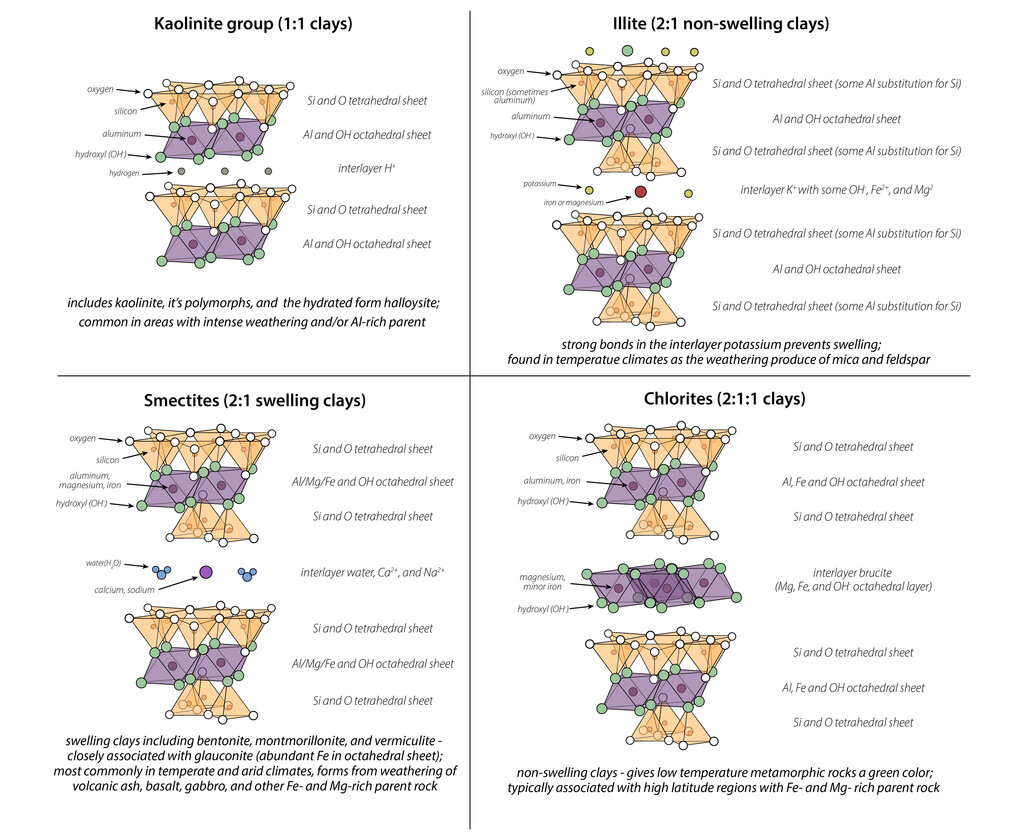
The differences in lattice structure directly influence the electrochemical environment surrounding each clay particle, which in turn governs the soil's physical behavior under compaction and moisture change.
Electrochemical Dynamics
The negative charge on the surface of clay particles attracts a cloud of positively charged ions (cations) from the soil water. This creates an electrochemical field known as the Diffused Double Layer (DDL).
The thickness of the DDL is critical. In smectite-rich soils, the high negative charge results in a thick, dispersed DDL. This creates strong repulsive forces between clay particles, allowing them to slide past each other easily. This property is what gives the clay high plasticity, enabling it to be compacted to a high maximum dry density (MDD) under heavy rolling without fracturing.
Conversely, kaolinite's low surface charge produces a thin, compressed DDL. The clay particles are held closer together with weaker repulsive forces, resulting in lower plasticity and cohesion. During compaction, these soils are more likely to behave brittly.
This electrochemical behavior, governed by Cation Exchange Capacity (CEC), directly translates into the engineering properties of the soil. A higher CEC, characteristic of smectites, enhances cohesion and allows the soil to retain structural integrity even at high moisture contents. This is fundamental to creating a durable pitch surface that can be precisely managed.
Application and Analysis
The mineralogy's impact is most evident in the pitch's cracking pattern. Smectite-rich soils produce a deep, well-defined network of cracks as they dry. This 'self-healing' mosaic allows the pitch to retain bounce and pace, while the edges of the cracked blocks provide purchase for spinners. Kaolinitic soils, lacking this shrink-swell capacity, crumble into a fine dust, creating a surface with low energy return that offers little assistance to either pace or spin bowlers.
To identify the mineralogical profile of a potential pitch soil, X-Ray Diffraction (XRD) is the standard analytical technique. XRD analysis bombards a soil sample with X-rays and measures the diffraction patterns as the beams interact with the crystalline structures of the clay minerals. Each mineral has a unique diffraction 'fingerprint', allowing for precise quantification of the smectite, illite, and kaolinite content.
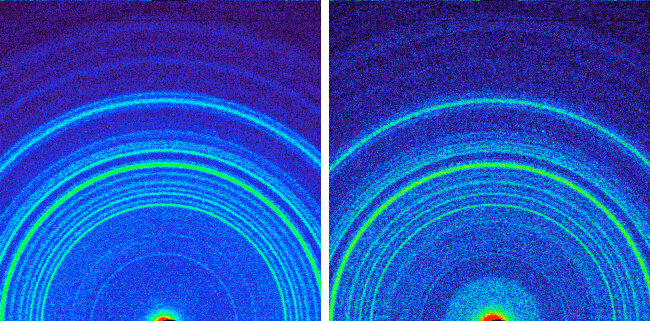
By integrating XRD data with physical tests, curators can create a detailed mineralogical footprint of their soils. This allows for the selection of materials that will produce a pitch with predictable and desirable performance characteristics, ensuring a surface that offers consistent carry, bounce, and a dynamic evolution over five days of play.
Test your understanding of clay mineralogy and its impact on pitch dynamics.
What is the primary factor determining a cricket pitch's performance, such as its pace, bounce, and how it wears over a match?
A curator is building a Test match pitch designed to develop significant cracks for spinners on days 4 and 5. Which clay mineral should be predominant in the soil?
Ultimately, a deep knowledge of clay mineralogy moves pitch preparation from an art to a science, providing the tools to engineer surfaces that meet the highest standards of the game.