Elite Cricket Pitch Analytics and Performance Reporting
Clay Mineralogy Dynamics
The Soil's DNA
The intrinsic potential of a cricket pitch is dictated by its mineralogical composition. While particle size distribution defines texture, it is the specific geochemistry of the clay fraction that governs performance. The key lies in understanding the behavior of different clay mineral groups, primarily the contrast between expansive 2:1 phyllosilicates like smectite and the more stable 1:1 minerals such as kaolinite.
Smectites, particularly montmorillonite, possess a 2:1 lattice structure: two tetrahedral silica sheets sandwiching an octahedral alumina sheet. The isomorphous substitution within this lattice, typically for in the tetrahedral sheet or for in the octahedral sheet, creates a net negative charge. This charge is balanced by hydrated interlayer cations (, ), which can be readily exchanged. The weak bonding between these layers allows water molecules to penetrate the interlayer space, causing significant volumetric swelling. Upon drying, the layers contract, a process essential for developing the hard, cracked surface that produces pace and bounce.
Conversely, kaolinite has a 1:1 structure with minimal isomorphous substitution, resulting in a very low net charge and negligible shrink-swell potential. The layers are held together by strong hydrogen bonds, preventing water from entering. This structural stability means kaolinite soils do not provide the necessary binding and cracking for high-pace wickets. Illite, another 2:1 mineral, has a structure where potassium ions are fixed in the interlayer, acting as a bridge and preventing the significant swelling seen in smectites. It offers a compromise but lacks the dynamic properties of smectite.
CEC and Soil Performance
Cation Exchange Capacity (CEC) is a direct measure of the soil's ability to hold positively charged ions. Smectites exhibit high CEC values (80-150 meq/100g) due to their lattice structure, while kaolinites have very low values (3-15 meq/100g). A high CEC is crucial not just for nutrient retention but for managing soil moisture. The exchangeable cations attract a shell of water molecules, enhancing the soil's water holding capacity.
This high CEC allows smectite-rich soils to retain moisture deeper in the profile during preparation, which can then be drawn to the surface during rolling to achieve maximum compaction and hardness.
The relationship between mineralogy, CEC, and physical behavior is non-negotiable. Linear shrinkage, a critical indicator of a soil's potential to form a hard, fast pitch, is directly correlated with smectite content. Soils with high linear shrinkage values (typically >15%) demonstrate the capacity for significant cracking upon drying, a hallmark of elite pitches. Similarly, the swelling nature of smectite contributes to superior aggregate stability when wet, preventing the pitch from turning to slurry under initial watering.
Because these mounds are rich in phyllosilicates, alteration – the process by which liquid water interacts with rocks and changes their chemistry to form clay minerals – must also have been much more regionally extensive than previously thought.
Identifying the Right Clay
Visual inspection is insufficient for determining a soil's mineralogical makeup. The definitive technique for clay mineral identification is X-ray Diffraction (XRD). By analyzing the diffraction pattern of a soil sample, we can identify the specific clay minerals present and their relative abundance.
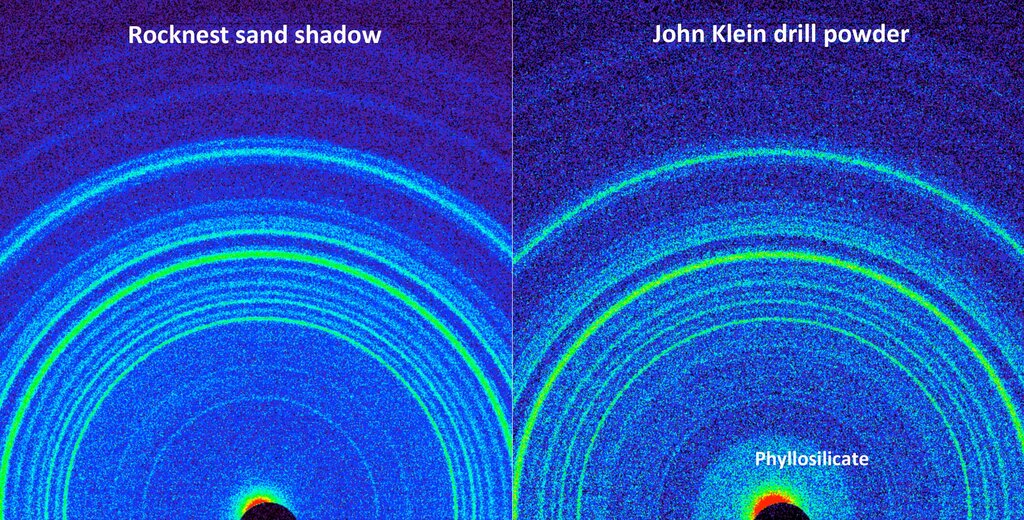
In an XRD analysis, smectite is identified by its characteristic basal spacing () of approximately 14-15 Å, which expands to around 17 Å after ethylene glycol solvation—a key diagnostic feature. Kaolinite shows a sharp peak at 7 Å that disappears upon heating, while illite has a persistent peak at 10 Å. A curator can use this data to select soils with a dominant smectite fraction, ensuring the raw material has the necessary geochemical properties for producing a world-class surface.
Time to test your understanding of these fine distinctions.
Which property of smectite clays is most responsible for the development of the hard, cracked surface essential for a high-pace cricket pitch?
A soil curator performs an X-ray Diffraction (XRD) analysis. They observe a peak at 14 Å which expands to 17 Å after ethylene glycol solvation. What clay mineral has been identified?
Understanding the clay mineralogy is the first step in mastering the science of pitch preparation. It dictates the soil's response to every action, from watering and rolling to the final day's play.