Eleventh Grade Mole Concept
Avogadro's Number
Just as a dozen represents exactly 12 items, the mole is a fundamental counting unit in chemistry used to measure huge quantities of microscopic particles like atoms, molecules, or ions. One mole of any substance contains exactly representative particles. This massive value is known as , denoted as .
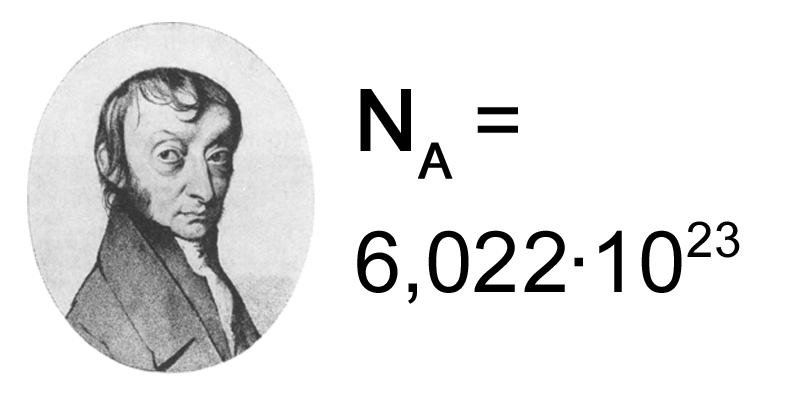
To convert any given number of particles () into moles (), we use a simple ratio. Since one mole always contains particles, the relationship is expressed as .
For example, if a sample contains atoms of helium, we can find the equivalent number of moles by dividing this total by Avogadro's constant:
This mathematical shortcut allows us to scale up unimaginable particle counts into manageable, real-world chemical values.
Answer: 0.5 moles
Correct
Spot on. Dividing the molecules of carbon dioxide by Avogadro's constant () yields exactly moles. Since this conversion math works in reverse, we can also calculate the absolute number of particles in a sample if we already know the number of moles.
To find the number of particles (), we simply multiply the moles () by Avogadro's constant (). This is written as . Let's put this into action with a microscopic lookup: if you have a beaker with moles of sodium ions, you can find the exact ion count by scaling up your molar value.
Let's perform the calculation for that beaker of sodium ions. We multiply by :
Notice how the decimal shifted to keep our answer in standard scientific notation. Now it is your turn to perform a reverse lookup to find the total particle count in a specific substance.
Answer: 9.033 \times 10^{23}
Correct
Multiplying by results in exactly water molecules, keeping the scale perfectly consistent.
Now, let's explore what happens when we zoom in even further. A single water molecule () is made up of individual atoms: specifically, two hydrogen atoms and one oxygen atom. This means that if you have a collection of molecules, you can find the total number of constituent simply by multiplying the number of molecules by the number of atoms in a single molecule.
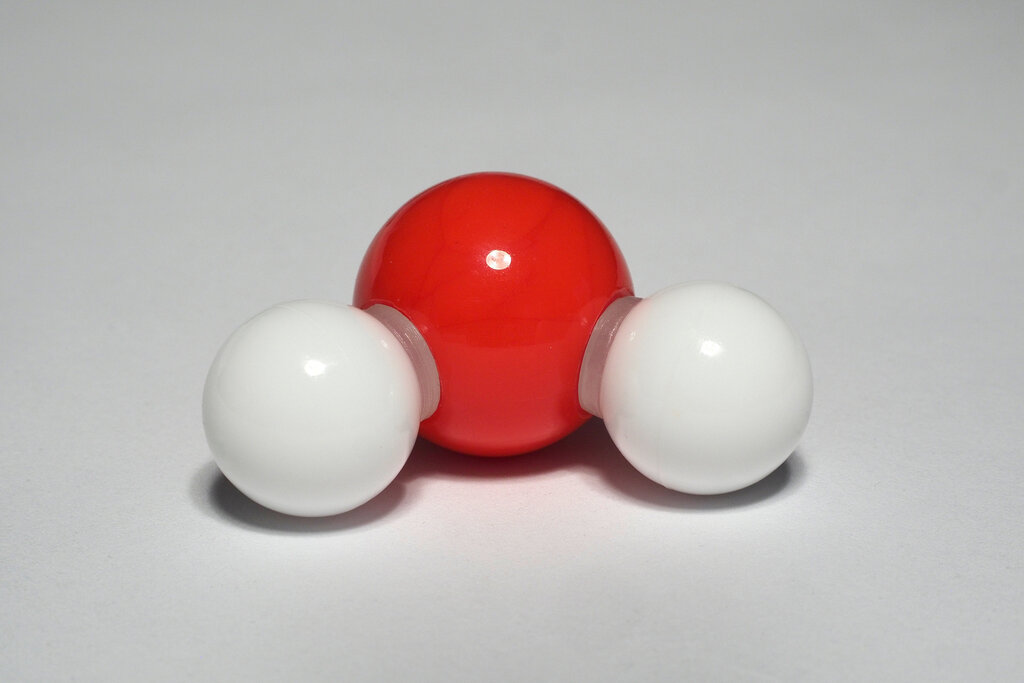
For example, in of water molecules, we have molecules. Because each water molecule contains exactly (), the total number of individual atoms in that mole is:
Let's apply this scaling method to a different substance to make sure we have this molecular breakdown mastered before moving on to mass.
Answer: 12.044 Na
Almost there
Your mathematical intuition is incredibly strong! You correctly recognized that of carbon dioxide () molecules yields exactly molecules, and because each molecule contains exactly one carbon atom, there are indeed of carbon atoms (which is carbon atoms).
However, we need to be careful with how we write our units. Because the symbol already stands for the number , writing "" actually means , which multiplies the value twice! To write this correctly, you can either use the raw value in standard scientific notation, , or write it in terms of the constant simply as .
Key Tip: When writing quantities in terms of Avogadro's constant, use the actual mole value as the coefficient. For example, moles of atoms is simply written as atoms (which is equal to atoms).
Let's test this notation and molecular breakdown on another gas. A flask contains of oxygen gas () molecules. Let's find the total number of individual oxygen atoms in this flask.
Answer: 3.0 N_A atoms
Not quite
Let's break down exactly what is happening in that flask. A flask containing moles of gas contains moles of oxygen molecules (). However, because each single molecule is made up of exactly two oxygen atoms, the total amount of oxygen atoms is doubled, giving us moles of individual oxygen atoms. Since mole of anything is equal to , our moles of oxygen atoms is written simply as atoms.
Remember: Always look closely at the chemical formula! For any diatomic gas like or , the number of individual atoms will always be exactly twice the number of molecules.
Let's apply this same logic to another common gas to lock this mental model in. Imagine you have a container holding moles of nitrogen gas () molecules. Let's determine how many individual nitrogen atoms are in that container.