Elevating Your Karate Beyond the Basics
Kinetic Power Generation
The Body's Engine
In foundational karate, you learned to make the correct shapes with your body. Now, you will learn to generate power. The secret isn't bigger muscles or faster arms. It's in your center, specifically your hips and core. This is where true power originates, turning simple blocks and strikes into explosive techniques.
The core concept is (腰の回転), or hip rotation. Think of your hips as the engine of a car. Your limbs are the wheels. Without the engine turning, the wheels have no power. Similarly, a punch thrown with only the arm is weak. A punch driven by the sharp, sudden rotation of the hips channels the entire body's mass into a single point of impact.
Your arms and legs don't create power; they deliver it. The hips and core create it.
This rotation is what allows you to transition between defensive and offensive postures seamlessly. The end of a block becomes the beginning of a strike, with the hips providing the connection. To do this correctly, you must master two key positions: Hanmi and Shomen.
| Position | Hip Alignment | Common Use |
|---|---|---|
| Hanmi | Half-facing (angled at 45°) | Defensive blocks (e.g., Age-uke, Gedan-barai in Kokutsu-dachi) |
| Shomen | Square-facing (forward) | Offensive strikes (e.g., Gyaku-zuki in Zenkutsu-dachi) |
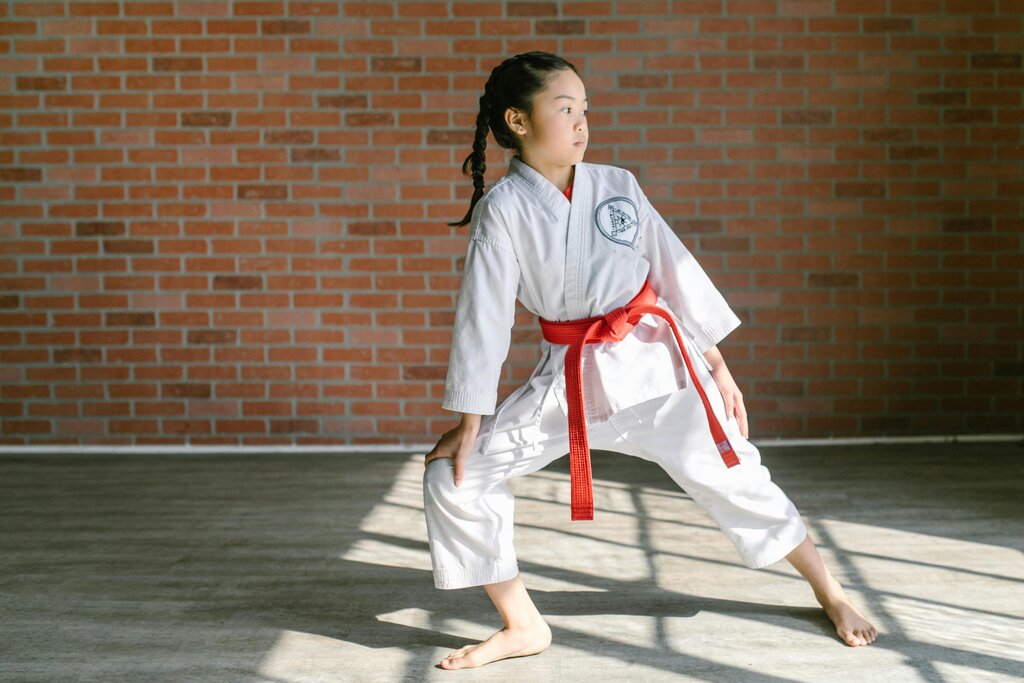
The act of moving from Hanmi to Shomen is the power generator. Imagine you are in a back stance (Kokutsu-dachi), executing a block. Your hips are in Hanmi. To counter-attack, you shift your weight forward into a front stance () and drive a reverse punch. That transition involves snapping your hips from Hanmi to Shomen, creating a wave of energy that travels up your torso and out through your fist.
Staying Level
As you transition between stances like Zenkutsu-dachi and Kokutsu-dachi, one detail is crucial: your head must maintain a consistent level. Any bobbing up and down wastes energy and disrupts momentum. Your center of gravity should move smoothly, like a boat gliding on calm water, not bouncing on waves.
To achieve this, focus on using your leg muscles. Bend your knees to lower your stance and push off the floor to move. Your upper body should remain relaxed and stable. This level transition ensures that all the energy generated from the ground is channeled horizontally into your technique, rather than being wasted on vertical movement.
Snap vs. Thrust
Let's apply this to a specific technique: the reverse punch, or . The power of this punch comes directly from the speed and sharpness of your hip rotation. There are two primary mechanics for this power generation: snap and thrust.
Snap (Kime): This is a vibratory action. The hips rotate sharply and then immediately stop, or even recoil slightly, at the moment of impact. This creates a shocking, penetrating force. Think of cracking a whip. The power comes from the sudden stop at the end of the motion.
Thrust: This is a driving, pushing force. The hips rotate and continue to drive forward through the target. This is useful for displacing an opponent or breaking through their guard. The power is sustained and heavy.
To refine your Gyaku-Zuki, practice the hip vibration. Stand in a front stance. Place your hands on your hips. Without moving your feet, rotate your hips from Hanmi to Shomen as quickly as possible. The movement should be small, sharp, and explosive. Feel the power ripple through your core. Now, add the punch. The fist should land at the exact same instant your hips lock into the Shomen position.
Regardless of the type of strike the power for that strike begins in your feet, is developed in your legs, directed by your waist, and delivered by your hands.
This integration of ground, legs, hips, and limbs is the essence of intermediate karate. You are no longer just moving your arms and legs; you are moving your entire body as a single, powerful unit.
Time to check your understanding of these core principles.
According to the principles discussed, where does true power in karate techniques originate?
What is the Japanese term for hip rotation, described as the engine for your power?
Mastering these concepts transforms your karate from a series of movements into a dynamic expression of power.