Elevating Your Home Cooking Skills
Advanced Knife Efficiency
From Chop to Flow
You already know how to hold a knife and make basic cuts. Now, let's move beyond individual actions and build a rhythm. Professional cooking isn't about frantic chopping; it's about efficient, repeatable motions that turn a pile of raw ingredients into a perfectly prepped station. The goal is flow: a state where your hands move with purpose and precision, almost without thinking.
This efficiency is built on two pillars: consistent cuts and a smart workflow. When every piece of carrot is the same size, it cooks at the same rate. This means no more half-raw, half-mushy vegetables in your final dish. Uniformity is the secret to predictable, delicious results, especially when you're cooking multiple ingredients in the same pan.
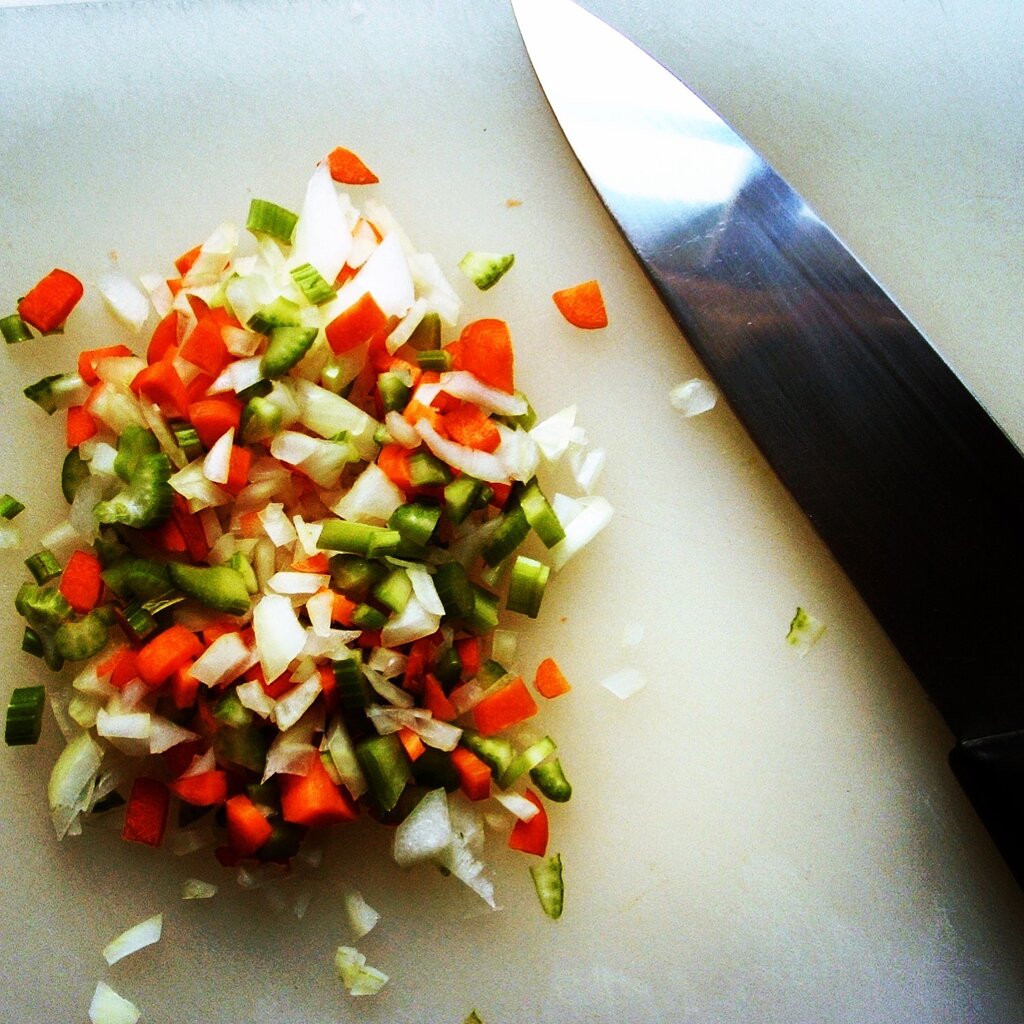
Think about roasting vegetables. A large chunk of potato takes much longer to soften than a small one. If your cutting is haphazard, your dish will be too. By mastering consistent dicing, you gain control over the cooking process. It’s the difference between hoping for a good result and guaranteeing one.
Taming Tricky Produce
Round, wobbly, and oddly-shaped vegetables are where many home cooks slow down. The professional approach is to create stability first. Before you try to dice a butternut squash, for example, make it safe to handle.
Start by trimming off the top and bottom to create two flat surfaces. Stand it on one end and peel the tough skin with a peeler or your knife. Then, cut the squash where the thin neck meets the round bulb. Now you have two manageable pieces. Cut the bulb in half and scoop out the seeds. From here, you can slice each section into planks, then sticks, and finally, a perfect dice. The principle is simple: turn unstable shapes into stable, flat-sided blocks.
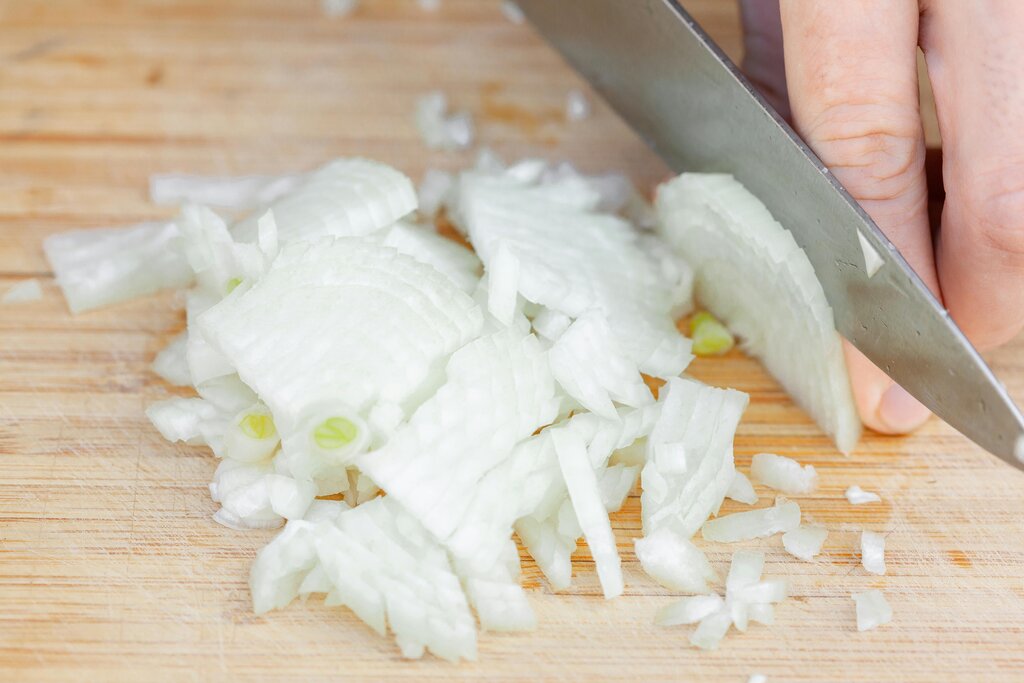
This same logic applies to onions and shallots. To dice them quickly and safely, slice the onion in half through the root and stem ends. Place the flat, cut side down on your board. Make several vertical cuts towards the root, but don't slice all the way through it. The root holds the layers together for you. Next, make one or two horizontal cuts, again stopping short of the root. Finally, slice downwards across your initial cuts to produce a fine, even dice. The whole process is anchored by the root, preventing the layers from sliding apart.
All of this preparation is part of a larger philosophy called (pronounced meez-on-plahs). It's the disciplined practice of getting every single ingredient prepped and organized before you start cooking. It might seem slower at first, but it transforms the actual cooking process from a chaotic scramble into a calm, controlled execution.
Safety at Speed
As your speed increases, your attention to safety must increase with it. Your guiding hand, using the claw grip, is your most important safety tool. Your knuckles should always be forward, acting as a guide for the side of the knife blade. The blade should just graze your knuckles as you cut. This feels counterintuitive at first, but it makes it physically impossible to cut your fingertips, which should be curled safely back.
Maintain a firm, but not tense, on the knife. Choking up on the blade with your thumb and index finger gives you more control than holding the handle alone. Remember that a sharp knife is a safe knife. It requires less pressure to cut, which means it's less likely to slip. If you feel yourself hacking or forcing the blade, it’s a sign your knife needs honing or sharpening.
Your knife should move, but your guiding hand and the food should stay mostly still. Bring the food to the knife, not the other way around.
The final element of an efficient workflow is organization. Work cleanly. Keep your cutting board organized with a bowl for finished cuts and another for scraps. A tidy station is a fast station because you never have to stop and clear space. This entire system—from creating stable surfaces to organizing your workspace—is what bridges the gap between simply cutting food and cooking with professional efficiency.
What is the primary benefit of making consistent, uniform cuts when prepping vegetables?
According to professional technique, what is the first step you should take when cutting a round, unstable vegetable like a butternut squash?
With these techniques, you can tackle any prep task with confidence and control.