Elevating Your Dance Practice
Technical Fluidity
The Unseen Work of Fluidity
Great dancers make complex sequences look effortless. The secret isn't just mastering individual steps, but mastering the space between them. This is where technical fluidity comes in. It's the skill of connecting movements into a seamless, continuous flow of energy. Instead of seeing a series of poses, the audience sees a single, uninterrupted story told through motion. This is achieved by understanding how the body functions as a single, integrated unit.
The foundation of this is the kinetic chain—the idea that each part of your body is linked. A movement initiated in your core travels through your torso, out to your shoulders, and down to your fingertips. Nothing moves in isolation. When you shift your weight, it's not just your feet that move; your hips, spine, and head all adjust in a coordinated sequence. Efficient weight transfer is about guiding this flow of energy intentionally, making sure each transition has a clear purpose and direction. You don't just arrive at a position; you flow through it.
Focus on transitions: Smooth transitions between moves are crucial in freestyle dancing.
The Plié as an Engine
Think of the plié not as a static position, but as the engine driving your movement. It’s the primary tool for creating seamless transitions. Every jump begins and ends in a plié. It’s the spring that propels you into the air and the cushion that absorbs the impact upon landing, allowing you to rebound into the next step without a jarring stop. This continuous bending and stretching of the knees keeps the energy flowing.
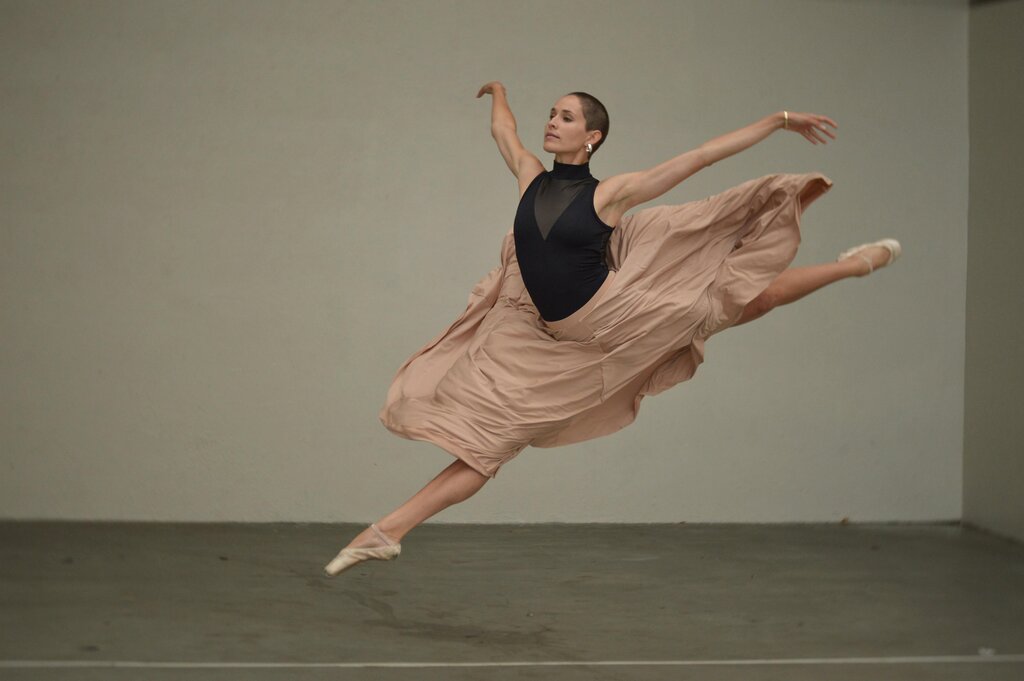
When moving from one position to another, a subtle plié acts as the connective tissue. For example, in a simple chaîné turn sequence, the plié between each turn is what allows you to maintain momentum and travel across the floor smoothly. Without it, the turns become a series of distinct, jerky actions. By using the plié as a transitional motor, you ensure that your movement never truly stops; it simply changes form.
Adding Three-Dimensionality
Once the lower body is connected through the plié, the upper body adds artistry and depth. This is where advanced épaulement comes into play. You already know the basic placement of the shoulders, but true fluidity requires integrating it into every transition. It's the subtle angling of the shoulders and head relative to the legs that transforms a flat, two-dimensional movement into a rich, three-dimensional one. It guides the audience's eye and adds expressive quality.
Épaulement is the difference between simply executing a step and truly dancing it. It's the whisper that follows the statement.
As you transition, think of your torso spiralling gently. For instance, when moving from a fourth position into a pirouette, the slight twist in the upper body isn't just for preparation; it's part of the movement's texture. This creates a more dynamic and professional line, showing that the entire body is engaged in the transition. It ensures that the upper and lower halves of the body are in constant, subtle dialogue.
Managing Momentum
Fluidity is also about managing momentum. In powerful movements like grand jetés or fast turning sequences, you generate significant force. The challenge is not to let that momentum die at the end of the step. Instead, you must learn to harness it and redirect it into the next movement. The key is core engagement. A strong centre allows you to control the speed and direction of your momentum, preventing you from overshooting your mark or losing your balance.
In turns, is a critical tool for momentum management. It not only prevents dizziness but also helps regulate the speed of your rotation, allowing for a clean finish that flows directly into the subsequent step. When you land from a jump, don't just stop. Use the energy of the landing, channelled through a deep plié, to push off into a run, a slide, or another jump. Every end is a new beginning.
These principles of connection, propulsion, and momentum are universal. Whether you're blending balletic lines with the grounded movements of contemporary dance or the sharp hits of hip-hop, the underlying mechanics remain the same. Fluidity comes from understanding how to bridge these different vocabularies with seamless, energy-efficient transitions.
What is the primary goal of technical fluidity in dance?
The concept of the 'kinetic chain' implies that movement initiated in the core travels outwards to the limbs, and that no part of the body moves in complete isolation.
By focusing on what happens between the steps, you elevate your dancing from a sequence of positions to a continuous, expressive performance.