Elementary Math Adventures
Understanding Numbers
The World of Numbers
Numbers are all around us. They tell us how old we are, what time it is, and how many cookies are left in the jar. Before we can add or subtract, we first need to get to know numbers themselves. The first step is learning to count.
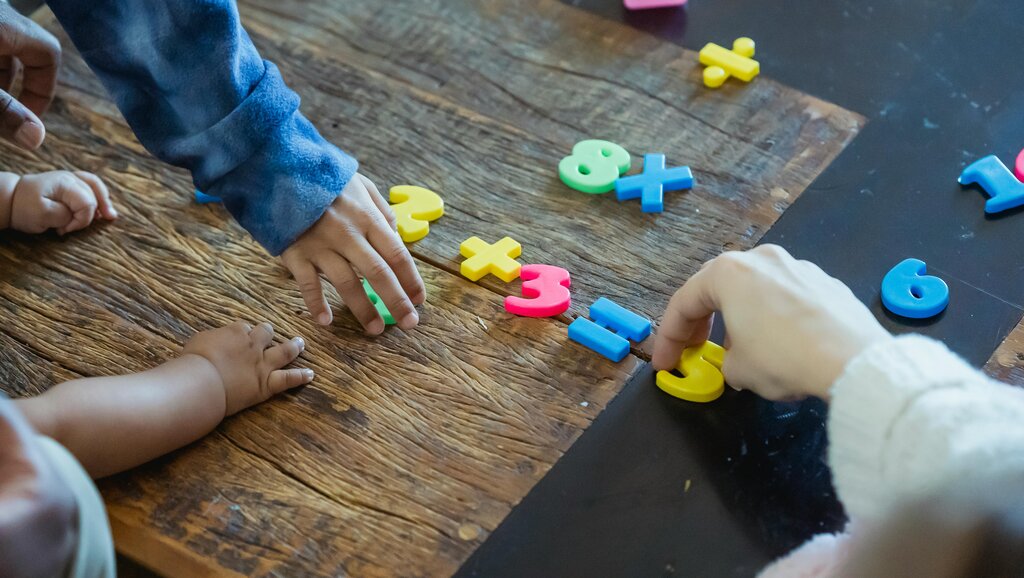
Counting is like walking up a staircase, one step at a time. We start at 1, then go to 2, 3, and so on. Each number has its own name and its own symbol, called a numeral. The numeral for the number three is 3. The numeral for the number nine is 9.
Counting to 100
Let's count all the way to 100. It might seem like a lot, but you'll notice some patterns that make it easier. For example, after you learn the numbers up to 9, you'll see them repeat in the tens (11, 12, 13...) and the twenties (21, 22, 23...). Look for these patterns in the chart below.
| 1 | 2 | 3 | 4 | 5 | 6 | 7 | 8 | 9 | 10 |
|---|---|---|---|---|---|---|---|---|---|
| 11 | 12 | 13 | 14 | 15 | 16 | 17 | 18 | 19 | 20 |
| 21 | 22 | 23 | 24 | 25 | 26 | 27 | 28 | 29 | 30 |
| 31 | 32 | 33 | 34 | 35 | 36 | 37 | 38 | 39 | 40 |
| 41 | 42 | 43 | 44 | 45 | 46 | 47 | 48 | 49 | 50 |
| 51 | 52 | 53 | 54 | 55 | 56 | 57 | 58 | 59 | 60 |
| 61 | 62 | 63 | 64 | 65 | 66 | 67 | 68 | 69 | 70 |
| 71 | 72 | 73 | 74 | 75 | 76 | 77 | 78 | 79 | 80 |
| 81 | 82 | 83 | 84 | 85 | 86 | 87 | 88 | 89 | 90 |
| 91 | 92 | 93 | 94 | 95 | 96 | 97 | 98 | 99 | 100 |
Did you see the pattern? Every time you get to a number that ends in 9, the next number starts a new group of ten. A great way to practice is to count things you see every day, like your toys, the steps in your house, or the cars passing by your window.
Even and Odd
Some numbers are even, and some are odd. An even number is any number you can split into two equal groups. For example, 6 is even because you can split it into two groups of 3. An odd number is a number that always has one left over when you try to split it. The number 7 is odd because you get one group of 3 and one group of 4.
Here's a quick trick: look at the very last digit of a number.
- If the last digit is 0, 2, 4, 6, or 8, the number is even.
- If the last digit is 1, 3, 5, 7, or 9, the number is odd.
So, the number 34 is even, and the number 81 is odd.
Tens and Ones
When we have numbers bigger than 9, we use a system called place value. This just means that a digit's position in a number tells you its value. Let’s look at two-digit numbers, which have a tens place and a ones place.
Place Value
noun
The value of a digit based on its position in a number.
Consider the number 23. The digit on the right (3) is in the ones place. It means we have 3 single units. The digit on the left (2) is in the tens place. It doesn't just mean 2; it means 2 groups of ten, which is 20.
So, 23 is really 2 tens and 3 ones.
Comparing Numbers
Sometimes we need to know if a number is bigger, smaller, or the same as another number. We use special symbols for this: $ > $ (greater than), $ < $ (less than), and $ = $ (equal to).
A fun way to remember the greater than and less than signs is to think of them as a hungry alligator's mouth. The alligator always wants to eat the bigger number!
(12 is less than 15) (30 is greater than 20) (5 is equal to 5)
When comparing two-digit numbers, first look at the digit in the tens place. The number with the bigger digit in the tens place is the greater number. For example, in 45 and 28, 4 is bigger than 2, so 45 is greater than 28. If the tens digits are the same, then look at the ones digits.
What number comes right after 39?
Which of the following is an EVEN number?
Great work! You've just learned the building blocks of mathematics. Understanding what numbers are, how to count them, and how they relate to each other is the first big step on your math journey.