Element Transmutation Nuclear Reactions
Atomic Structure
The Building Blocks of Matter
Everything around you—the air you breathe, the device you're reading this on, even you—is made of atoms. For a long time, people thought atoms were the smallest possible things. But it turns out, they're made of even tinier particles.
At the center of every atom is a dense core called the nucleus. It contains two types of particles: positively charged protons and neutral neutrons. Whizzing around the nucleus in designated paths, or shells, are negatively charged electrons.
The positive charge of a proton and the negative charge of an electron are equal and opposite. Neutrons, as their name suggests, have no charge at all. In a neutral atom, the number of electrons is equal to the number of protons, so their charges cancel each other out.
proton
noun
A subatomic particle with a positive electric charge, found in the nucleus of an atom.
neutron
noun
A subatomic particle with no electric charge, found in the nucleus of an atom.
electron
noun
A subatomic particle with a negative electric charge that moves in the space around the nucleus.
An Atom's Identity
What makes a carbon atom different from a gold atom? It's all about the number of protons. The number of protons in an atom's nucleus is its defining feature. This count is called the atomic number, and it's unique for each element. Every atom with one proton is a hydrogen atom. Every atom with six protons is a carbon atom. No exceptions.
While protons define the element, the protons and neutrons together determine its mass. The total number of protons and neutrons in the nucleus is called the mass number. Electrons are so incredibly light that their mass is considered negligible when calculating the mass number.
So, if you know an atom's atomic number and its mass number, you can figure out exactly what it's made of. For example, a neutral sodium atom has a mass number of 23 and an atomic number of 11. This tells us it has 11 protons, 11 electrons, and $23 - 11 = 12$ neutrons.
Atomic Cousins
While the number of protons for a given element is fixed, the number of neutrons can vary. Atoms of the same element that have different numbers of neutrons are called isotopes.
Take hydrogen, for example. It's the simplest element, with an atomic number of 1. All hydrogen atoms have one proton. But they can have zero, one, or two neutrons.
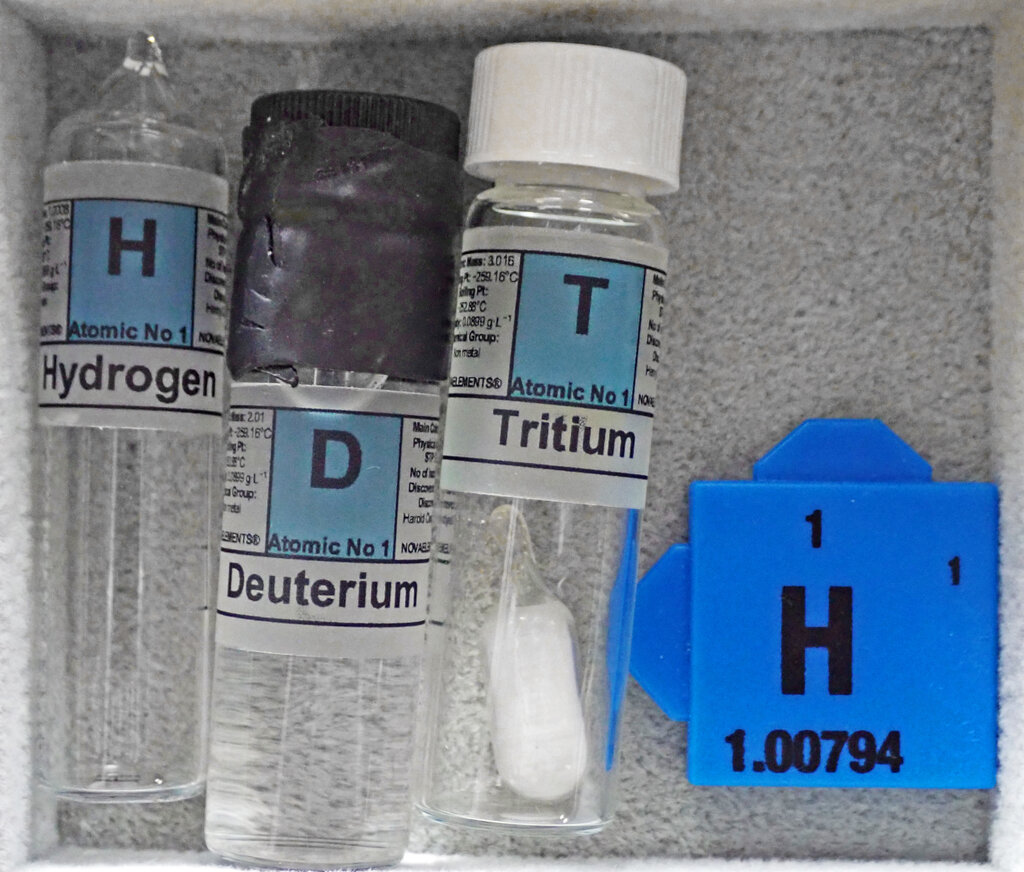
These isotopes are chemically identical—they all behave like hydrogen. But their different number of neutrons gives them different masses. This difference is important in fields like geology, medicine, and archaeology.
| Isotope Name | Protons | Neutrons | Electrons | Mass Number |
|---|---|---|---|---|
| Hydrogen-1 (Protium) | 1 | 0 | 1 | 1 |
| Hydrogen-2 (Deuterium) | 1 | 1 | 1 | 2 |
| Hydrogen-3 (Tritium) | 1 | 2 | 1 | 3 |
Isotopes are often written with their mass number, like Carbon-14 or C-14. Since we know carbon always has 6 protons, we can quickly figure out that this particular isotope has $14 - 6 = 8$ neutrons.
Time to check your understanding of the atom.
The identity of an element is determined by its number of ______.
An atom has an atomic number of 15 and a mass number of 31. How many neutrons does it have?
Understanding these fundamental pieces—protons, neutrons, and electrons—is the first step to understanding how atoms interact to form the complex world around us.